Winter 2025
A. Miner Second Line
Allison Miner (1949–1995), the woman who shaped Jazz Fest’s legacy
Published: December 1, 2025
Last Updated: March 1, 2026

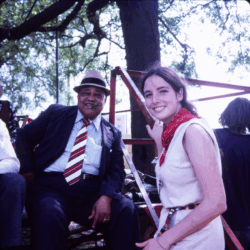
Photo by Sonny Faggart. Courtesy of the Jazz & Heritage Archive
Allison Miner with Roosevelt Sykes at the 1971 Louisiana Heritage Fair in Congo Square.
January 7, 1996, was an unusually cold day in South Louisiana, but the second line rolling down North Carrollton Avenue was well attended and then some. The syncopations of the Rebirth Brass Band kept a sprawling who’s who of musicians, social aid and pleasure club members, and local music industry insiders warm on their march from Canal Street to City Park’s Pavilion of the Two Sisters, stepping lively and shouting into the frigid air. It was the day after Twelfth Night, the kickoff of the Mardi Gras season, but the procession wasn’t Carnival revelry—it was a jazz funeral, and one of the biggest in contemporary New Orleans history.
Elizabeth Allison Miner, the second-line honoree, was born in Baltimore in 1949 and raised in Daytona Beach, Florida. She was only forty-six when she died of multiple myeloma in New Orleans on December 23, 1995. But the work she did during her relatively short time in New Orleans continues to shape it meaningfully, decades later.
In fact, it was a TV program about jazz funerals that drew the teenaged Miner to New Orleans. In Reverence: A Tribute to Allison Miner, a short film portrait shot in the two years before her death, she told filmmaker Amy Nesbitt that watching Danny Barker explain the ritual in an interview convinced her that the kind of place where people did that was a place she wanted to be.
Miner was a singer in her own right. Back at Seabreeze High in Daytona, she was in a band called the Allman Joys, with her classmates Duane and Gregg. When she arrived in New Orleans at seventeen, though, she entered the music scene as a fan and a baby archivist, working as an assistant at Tulane’s Hogan Jazz Archive for its founder, Dick Allen.
Allison Miner’s contributions to Jazz Fest include both the mundane and the defining.
George Wein, the impresario behind the Newport Jazz and Folk Festivals, had been courted by New Orleans for years to bring a similar event to the city. When Wein decided in 1969 to take the city up on the offer, he asked Allan Jaffe, the founder of Preservation Hall, if he knew any young people with their ears to the ground who could help book the new fest. Jaffe sent him to Allen at Tulane, who recommended he meet with Miner, and Miner brought her boyfriend, Quint Davis.
Davis, who is now Jazz Fest’s producer, director, and figurehead, was at the time a Tulane student with a voracious appetite for local music; he had already brought the Wild Magnolias Mardi Gras Indians to perform on campus and gotten them to record a single, “Handa Wanda,” that married the traditional chants and percussion with amplified funk for the first time. For the first few Jazz Fests in the early ’70s, Miner and Davis booked acts from a payphone across the street from their apartment and often put them up on their sofa, talking late into the night over Miner’s home cooking after a long day on the festival grounds.
Miner took a hiatus from the festival that lasted from the middle of the ’70s to the middle of the ’80s, marrying a musician and academic named Andy Kaslow and raising two sons, for part of that time in Cleveland. She worked for other festivals (including Newport Folk) and community radio stations (including New Orleans’s WWOZ-FM) and managed artists including Professor Longhair, Bo Dollis, and the Rebirth Brass Band. Still, by all accounts, she never missed a Jazz Fest. She even took the stage once as a performer, singing with the Women’s All-Star Jazz Ensemble in 1982.
Allison Miner’s contributions to Jazz Fest include both the mundane and the defining. During the festival’s earliest years, she oversaw the program guides, coordinated volunteers and decorated the stages. When George Wein wanted to turn the Jazz and Heritage Foundation, which owned the festival, into a for-profit entity, Miner (who also did the accounting) insisted it remain a nonprofit instead. Over the years, the Foundation has disbursed festival revenue back into the New Orleans community through grants and educational programming to the tune of millions of dollars —an effort that came to define Jazz Fest in the public eye as much as the all-star concerts it presented.
But it was those late-night conversations in her living room that inspired her signature stamp on the festival. Miner’s oft-stated belief was that music fans were honor-bound to appreciate the musicians as human beings, and to that end, she shepherded along informal live conversations on the festival grounds. When she rejoined Jazz Fest in 1988, she officially established the Music Heritage Stage, a venue for historians and journalists to interview Jazz Fest performers in front of an audience, recorded for posterity in the Jazz and Heritage Foundation Archive—an institution she also founded, bringing her teenage career as an assistant at Tulane’s music archive full circle. In 2001, Jazz Fest formally named the stage after Miner.
When Nesbitt made Reverence, she’d intended it to be a documentary about all the festival’s backstage workers. But she was so captivated by Allison Miner’s efforts that ultimately she trained the camera solely on her. Miner had worked painstakingly to explore and reveal the creative process and the humanity of the artists, often seen as folk savants, whose talent built cultural phenomena like Jazz Fest. The documentary was a fitting tribute to someone who spent her life putting others in the spotlight.
Alison Fensterstock is the editor of How Women Made Music: A Revolutionary History from NPR Music (Harper One, 2024) and the co-author of a forthcoming biography of New Orleans cartoonist and music writer Bunny Matthews (Historic New Orleans Collection Press, 2026).
Listen Up is funded in part by a grant from the New Orleans Jazz & Heritage Foundation.