Winter 2025
A Short Tour of Louisiana Jambalaya
Origins & proliferation of Louisiana’s popular rice dish
Published: December 1, 2025
Last Updated: March 1, 2026
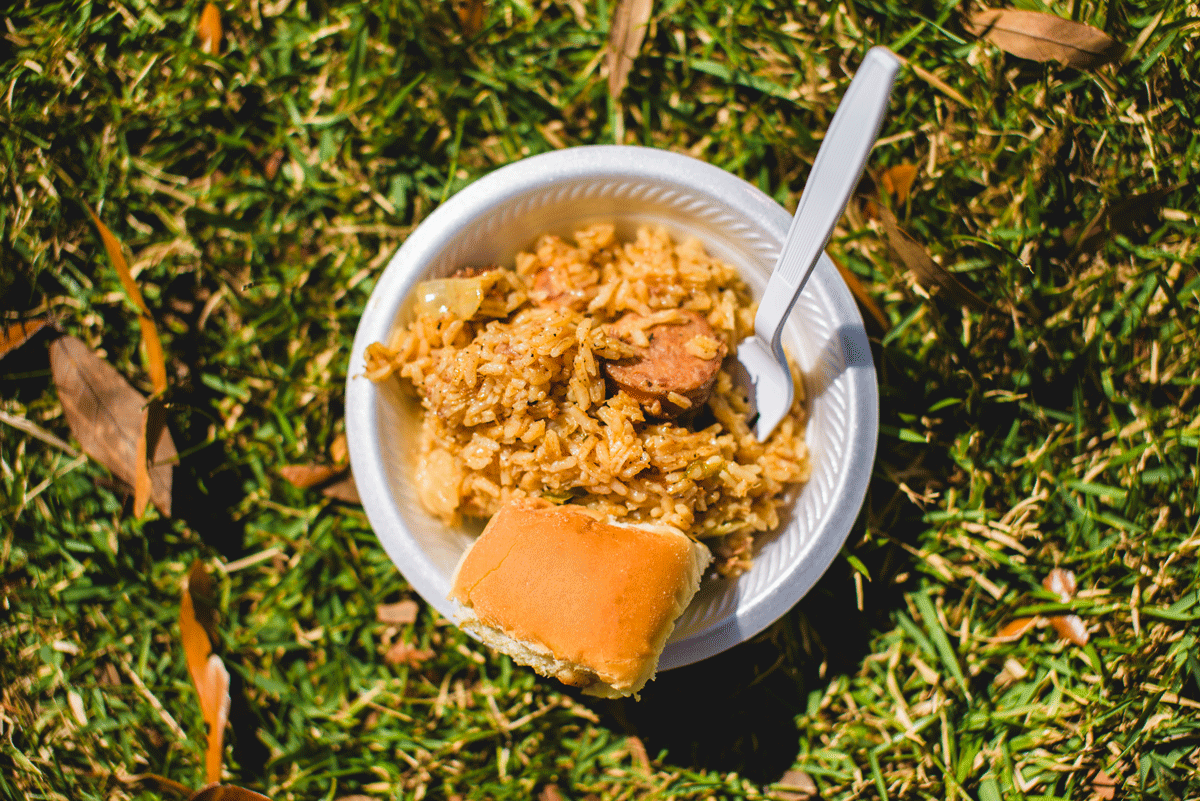
Photo by Christie Matherne Hall
Jambalaya is arguably Louisiana’s quintessential party food. While plenty of jambalaya can be found simmering on kitchen stoves on weeknights, there’s at least an equal number of comically large cast-iron pots full of the dish perched over propane burners in backyard family gatherings or along parade routes. Jambalaya is often the centerpiece of special occasions, and it’s a common plate sold at fundraisers. It’s no mystery why: jambalaya is a fairly easy and somewhat cheap way to feed a lot of people.
The dish has a base of white rice, plenty of onions and bell peppers, and usually an assortment of different meats—typically smoked pork sausage, pork roast, chicken, or hen, with the occasional shrimp, duck, or rabbit mixed in. Lots of versions are very meaty, but if you only have a small amount of meat, you can stretch it far in a pot of jambalaya. Jambalaya, generally speaking, comes two ways—and the line dividing the two types is drawn in tomato red. “Brown” or “Cajun” jambalaya uses rendered animal fat to achieve its brown color. “Red” or “Creole” jambalaya isn’t much different, but it incorporates the color and acidity of tomatoes or tomato paste. It’s not clear which one came first.
Origin stories of jambalaya, in both the culinary and etymological senses, have long been plagued by assumptions that seem obvious from the surface, but don’t quite make sense from a linguistic standpoint. In fact, some of jambalaya’s linguistic and historic clues are misleading in themselves, such as the 1878 French-to-Provençal dictionary entry listing “jambalaia” and its variants as derived from Arabic, when they are not. Food historians have puzzled over the topic in recent decades, and in 2016, scholar Anthony Buccini submitted a paper to the Oxford Symposium on Food and Cookery, published in the 2017 book of proceedings from the symposium, attempting to trace jambalaya’s history. His paper, “Un Vrai Jambalaya—‘A Real Mess,’” builds upon other work, including the 2007 sleuthing of culinary historian Andrew Sigal, and the paper landed a “Highly Commended” award from the 2017 Sophie Coe Prize judges’ panel. Ultimately, Sigal and Buccini suggest and conclude, respectively, that the word and the dish most likely originated in southern France, and the inclusion of rice made it a variation of peasant soupo courto, rather than taking ricey influence from other cultures, like Spanish paella, as is often assumed. (It’s also interesting to note that across both historians’ research, two of the earliest published jambalaya recipes came from publications printed in Mobile, Alabama, and one included tomatoes. But let’s not start a war.)
No matter where jambalaya came from, it ended up in Louisiana. Virtually every Louisiana church cookbook printed in the 1900s contains a handful of jambalaya iterations, and every Louisianan has eaten numerous fundraiser Styrofoam plates of the stuff. And we all know the song. In July 1952, Hank Williams forever crowned Louisiana as the place to get jambalaya with his earworm of a hit, “Jambalaya (On The Bayou).”
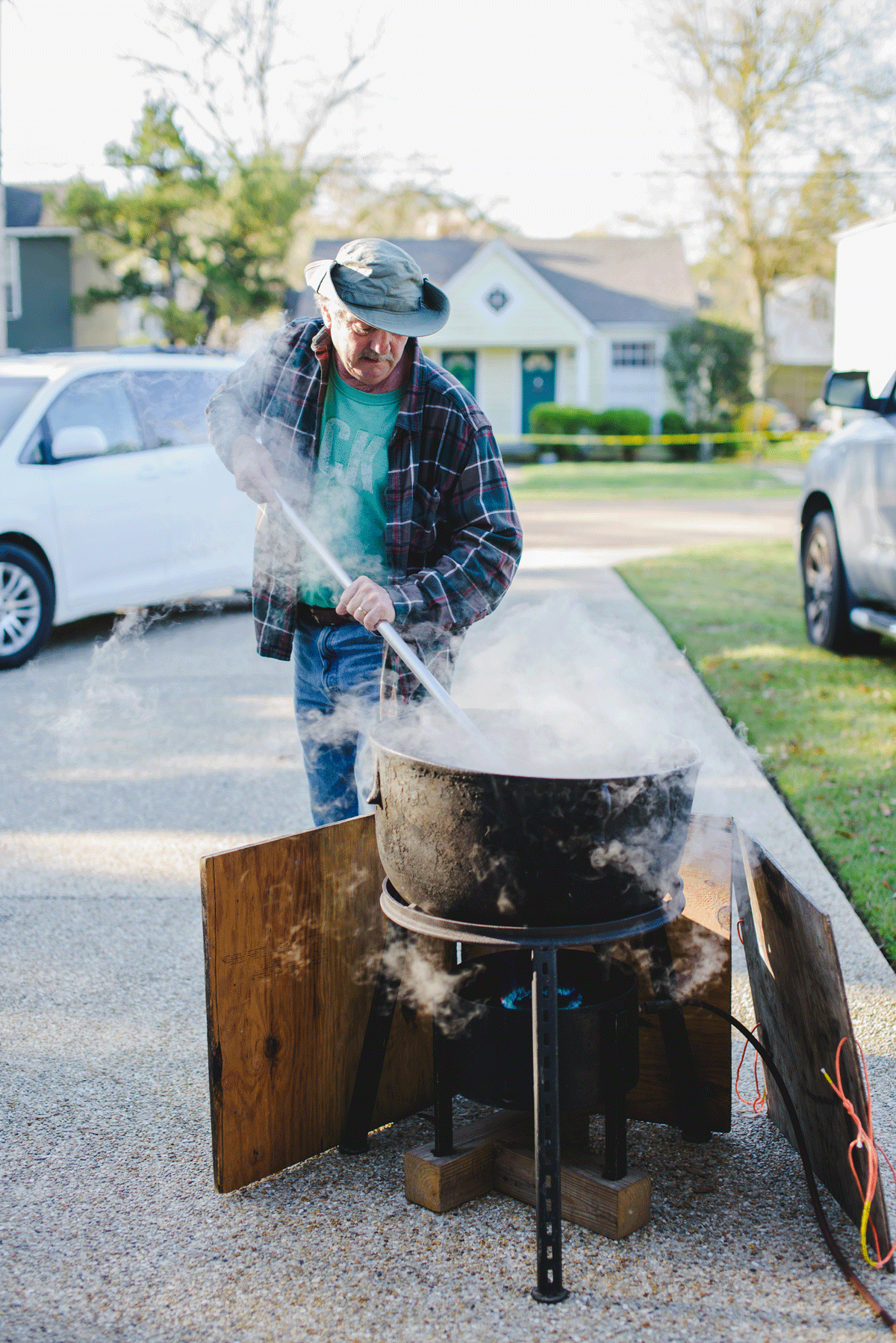
The author’s father, Gerard “Gerry” Matherne, who makes a giant cauldron of his pork and sausage jambalaya for various local events. Photo by Christie Matherne Hall
GONZALES JAMBALAYA FESTIVAL
There may be some variation in jambalayas across the state, but not in Gonzales, which declared itself the “jambalaya capital of the world.” At the Gonzales Jambalaya Festival, which takes place annually on Memorial Day weekend, the dish is a brown monolith to be preserved. If you sign up to compete in the cook-off, leave all your ingredients at home. The rules for the cook-off are strict and the conditions are difficult. Cooks pay an entry fee and are required to use the same groceries, which are sourced and distributed by the festival organizers. No off-site ingredients or seasonings—including water—are allowed in the jambalaya pots. Though the festival has plenty of chicken and sausage jambalaya for sale to the public, the cook-off rules allow only for chicken—no pork, no sausage. All entries must be cooked over a wood fire.
“That’s just to go back to tradition, back in the old days, you know, people ate what they had handy,” Jambalaya Festival Association president Mike Gonzales explained. “The chicken we use is not a fryer. It’s an older hen, we cook it as chicken on the bone, and it takes a longer time to get it tender. I know most people don’t even care to eat chicken on the bone, but if you ever got a good one, you’d like it.”
The scene at the cook-off area of the Gonzales Jambalaya Festival is intense. Each cooking bracket, or “heat,” is timed and features a dozen or more wood fires blazing (or smoldering) under an open-air pavilion. Sweat drips from the face of each paddle-wielding cook as they repeatedly scrape the bottom of the pot, while another team member tends the fire below. The pavilion is stacked with piles of firewood at the front, and the cooking area fills with smoke and spectators. Folks position their folding camp chairs in front of the fenced-off stall of their favorite team, sipping from koozied cans and cheering on the cooks. Nobody leaves the pavilion without moderate dehydration and the tell-tale scent of a campfire. And when they get hungry, they can mosey over to the food court to purchase a Styrofoam-clamshell plate of what’s been cooking, plus an obligatory white bread roll.
No matter where jambalaya came from, it ended up in Louisiana.
After each heat, the teams each pack an ice chest with their jambalaya to hand off to a courier, who ferries the jambalaya to the judging area. The judges never set foot in the cooking pavilion so that they can avoid matching familiar faces with cook-off submissions. Each ice chest is submitted with a copy of the team’s ticket, while the original ticket stays with the team, so the submissions are only identified by a number. Once the judges have scored each heat on a particular day, they pick the highest-scoring teams from that day, which then proceed to the next day of the cook-off. By Sunday, there are only twelve teams left. The cook-off judges are looking for that perfect, traditional, brown jambalaya flavor.
Gonzales himself won first place at the 2006 Jambalaya Festival. He’s been cooking jambalaya since his twenties, taught by a neighbor named Ferril Gautreau. “He never cooked in competition, but he cooked a lot for churches and weddings and family and friends, and he always cooked over a wood fire,” Gonzales said. “One day, he had five pots going at one time in his backyard, and I just walked over to help him. I bought my first pot after that.”
The way Gonzales was taught to cook jambalaya—and what he says makes a winning pot—hinges on how the chicken is cooked. “When you’re browning your chicken, you want it to kind of stick to the pot, and make that gratin on the edge of the pot. That’s where you get your best chicken flavor from.” (These crispy browned bits of chicken fat and skin at the bottom of the pot are also sometimes referred to as gradoux.)
When he was learning the ins and outs of jambalaya under Gautreau’s supervision, Gonzales said they’d go back and forth on the gratin level. “Ferril would say, ‘You think it’s brown enough yet?’ and I say, ‘I think it’s brown enough.’ He said, ‘Well, it ain’t.’”
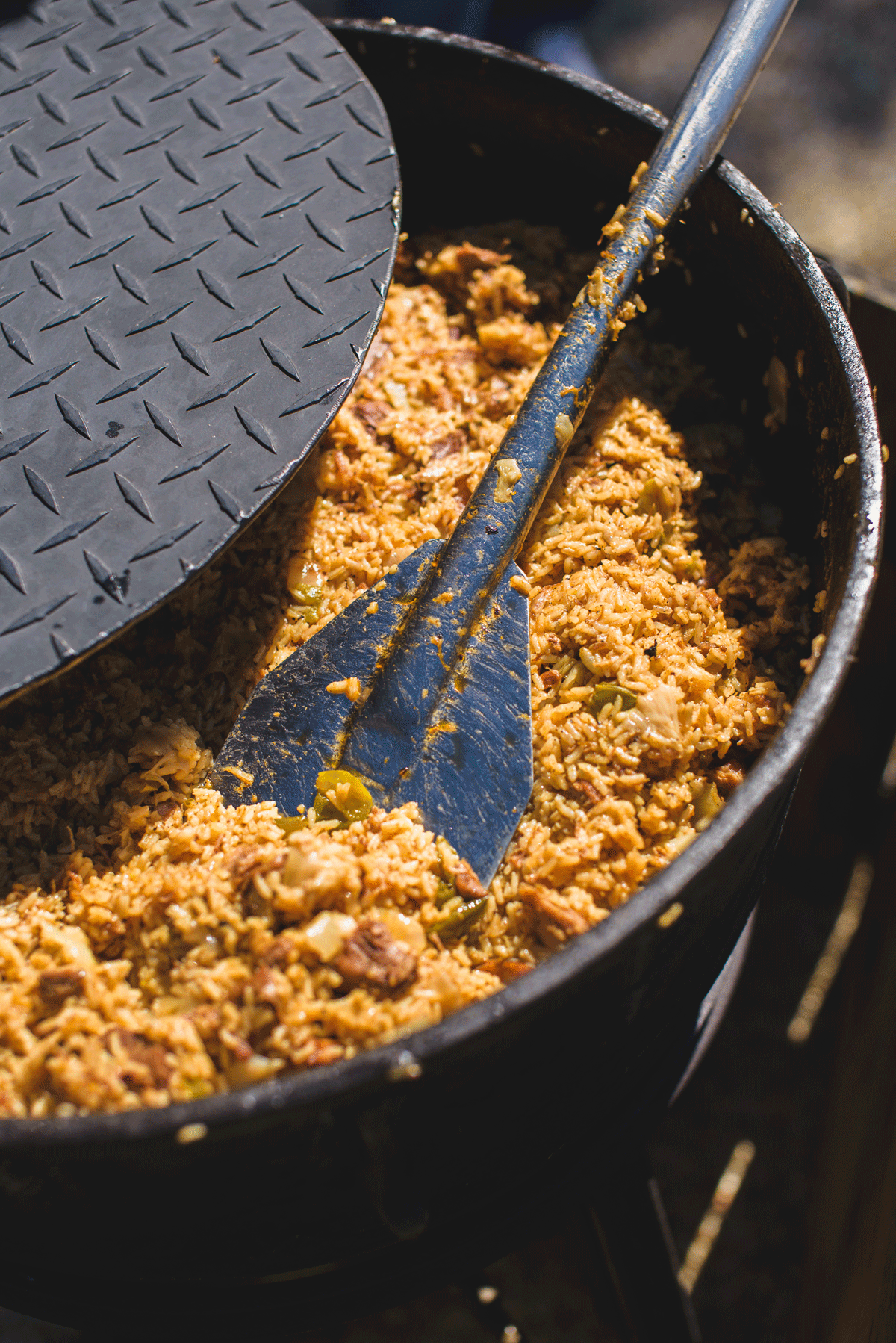
Photo by Christie Matherne Hall
DAD’S PARADE JAMBALAYA
For over twenty-five years, Gerard “Gerry” Matherne—occasional jambalaya caterer and father of three, including myself—has cooked a huge cauldron of his pork and sausage jambalaya for a family friend’s annual “Wearin’ of the Green” St. Patrick’s Day parade party on Hundred Oaks Avenue in Baton Rouge’s Garden District. The gig requires a 6 am call time for Dad, partly because he needs to get to the house before the roads get barricaded.
He has cooked untold vats of this signature jambalaya for weddings (including mine), funerals, birthday parties, parade gatherings, and graduation celebrations, with an occasional construction worksite lunch sprinkled in. Most of the jambalaya I’ve eaten in my life has been scooped out of the same giant cast-iron pot (complete with welded crack) that Dad uses today.
“You were three or four years old when I bought that pot,” he told me, “and I bought it from an antique store so who knows how old it is. It has a nice, smooth bottom, and a lot of new pots don’t have that.” (For reference, I am now forty years old.)
If you don’t know how to make a good jambalaya, consider asking your neighbor. Like Mike Gonzales, Dad learned how to cook jambalaya from a former neighbor, Larry Bueche of Baton Rouge. Like Gonzales, Bueche uses hens for his jambalaya, so Dad did, too, until someone requested a boneless jambalaya, and Dad ended up making a pork and sausage version he liked better. Plus, it was harder to source and butcher hens.
“It seemed like nobody missed the chicken, or the bones,” he said, and added that the pork gradoux (gratin, to Mike Gonzales) is just as tasty. These days, Dad prefers using all Boston Butt pork roast and smoked pork sausage.
If you don’t know how to make a good jambalaya, consider asking your neighbor.
A day or two before every event for which he is supplying jambalaya, Dad takes a full day to prep his vegetables and meats. He dices onions and bell peppers, trims and cuts Boston Butt pork roast, and slices up smoked sausage. Pork roast releases more water than chicken, he explained, so the pork roast goes into the pot first without any oil preceding it, and he lets the water boil out. By the time the water evaporates, the fat has begun to render, and it’s more than enough oil to brown the chunks of pork roast. The sliced sausage goes in the pot to brown, and he removes some fat after that, leaving just enough to cook the onions and bell peppers. Then the water is added, along with the seasonings. He tastes the water to make sure it’s “too salty”— he says if the water tastes “good,” the jambalaya will turn out bland—then adds the uncooked rice, brings it to a boil, and lowers the fire to a simmering temperature.
Years ago, I asked Dad to write down the recipe for me. When he finished laughing, he gave me proportions to use per six-to-eight people instead of static amounts or yields, and suggested I just watch him do it, which I had done many times by that point. In the end, the whole process made for a rather short paragraph. Along with my lifetime of watching him circle the same pot, browning the same pork roast, stirring with the same paddle, the paragraph gave me just enough information to do it myself. A lot of time and technique goes into a jambalaya, and some of that gets skipped in the traditional format of a recipe.
RED JAMBALAYA
The boundary between the two broad jambalaya categories is strong—to the degree that a native Louisianan who grew up eating only brown jambalaya may not even be aware of red jambalaya’s existence. When they do become aware of the red side of jambalaya, they may express confusion or offense, or perhaps think you’re talking about a Creole étouffée. Meanwhile, the red jambalaya folks are quite aware of the popularity of brown jambalaya. The red variety seems to appear in New Orleans and the coastal southeasternmost parts of the state. You’ll even find them on restaurant menus in some of those areas, but they’re harder to find than brown jambalaya in most of Louisiana these days.
If you want red jambalaya, you can certainly find it in New Orleans. Coop’s Place, tucked into a hidey-hole on Decatur Street in the French Quarter, sells a delicious rabbit, chicken, and sausage jambalaya, tomatoes and all. Order the Jambalaya Supreme plate and you’ll get the rabbit jambalaya above plus crawfish, shrimp, and tasso. You won’t have to ask a neighbor how to make this one; Coop’s Place sells a cookbook with the jambalaya recipe inside.
Christie Matherne Hall writes about foodways, culture, travel, and natural disasters for 64 Parishes and Country Roads. She is also a podcast producer for the Western Colorado Writers’ Forum and enjoys helping people write their memoirs through the Story Terrace platform.
