Magazine
An Ambassador of Louisiana’s French Music
Michael Doucet is the 2026 Humanist of the Year
Published: June 1, 2026
Last Updated: September 1, 2026
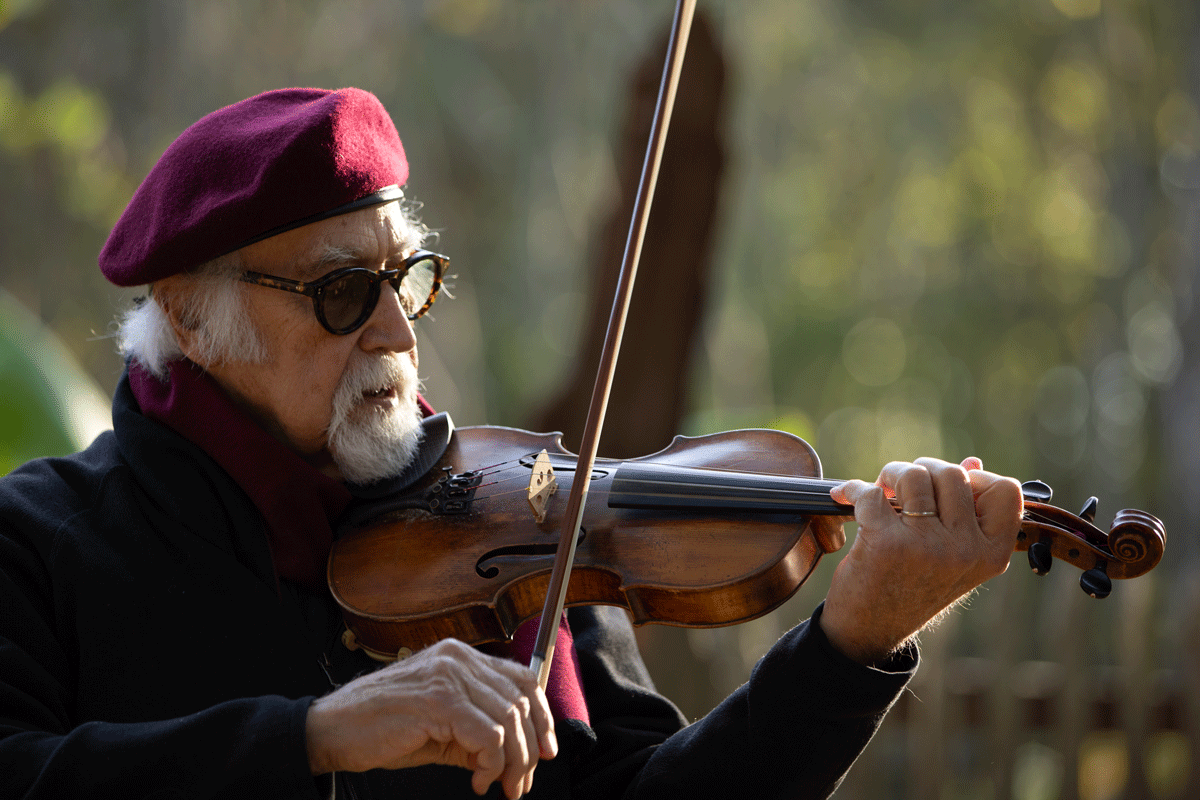
Photo by Brian Pavlich
Michael Doucet, frontman of the band BeaauSoleil, is the 2026 Humanist of the Year.
Timing, talent, and purpose compelled Michael Doucet, the leader of BeauSoleil for fifty-two years, to “Cajunize” the United States. Performing in every US state and 19 other countries, BeauSoleil avec Michael Doucet spread Cajun music vast distances beyond southwest Louisiana’s bayous and dancehalls. During the band’s half-century of travel, Doucet accumulated two-and-a-half-million miles on merely one of the airlines he flies.
Doucet has recorded twenty-six albums with BeauSoleil, five with the Savoy-Doucet Cajun Band, and a handful of solo releases. With BeauSoleil, he claimed two Grammy Awards from the band’s eleven nominations.
The Louisiana Endowment for the Humanities has named Doucet the 2026 Humanist of the Year. The honor recognizes Doucet’s revitalization and preservation of Cajun music and the globe-circling exposure he brought to southwest Louisiana’s Cajun-French culture.
Doucet sees his Humanist of the Year award as an honor not so much for himself but for BeauSoleil, the band. He didn’t make worldwide impact standing alone on stage. “I don’t consider this a personal award,” the singer, songwriter, fiddler and bandleader said. “It’s for the group, too, because they were there. I was their guide, I know, but there’s got to be somebody who does that. I did it. It was fun, and I did it the best I could.”
“Sometimes the beautiful old music needs a sparkling star and a creative eye to bring it forward into vision of the time. . . . Michael’s youth and rock-oriented take on old songs caught on like wildfire.”
The Humanist of the Year award is the latest of many honors Doucet has received over the past five decades. Other honors include an honorary doctorate from his alma mater, the University of Louisiana at Lafayette (ULL); the National Endowment for the Arts National Heritage Fellowship in 2005 (the highest honor given to folk and traditional artists); the United States Artists Fellowship in 2007; and the lifetime achievement award BeauSoleil avec Michael Doucet received at the 2020 Folk Alliance International conference in New Orleans.
Musician, writer, and photographer Ann Savoy performed with Doucet and her husband, Marc, in the Savoy-Doucet Cajun Band for thirty years. The traditional Cajun music trio released albums on Chris Strachwitz’s roots music-dedicated label Arhoolie Records. Doucet is to Cajun music, Savoy said, what Mick Jagger is to American blues and Richard Thompson to British folk music.
“Sometimes the beautiful old music needs a sparkling star and a creative eye to bring it forward into vision of the time,” Savoy said. “Michael’s youth and rock-oriented take on old songs caught on like wildfire.”
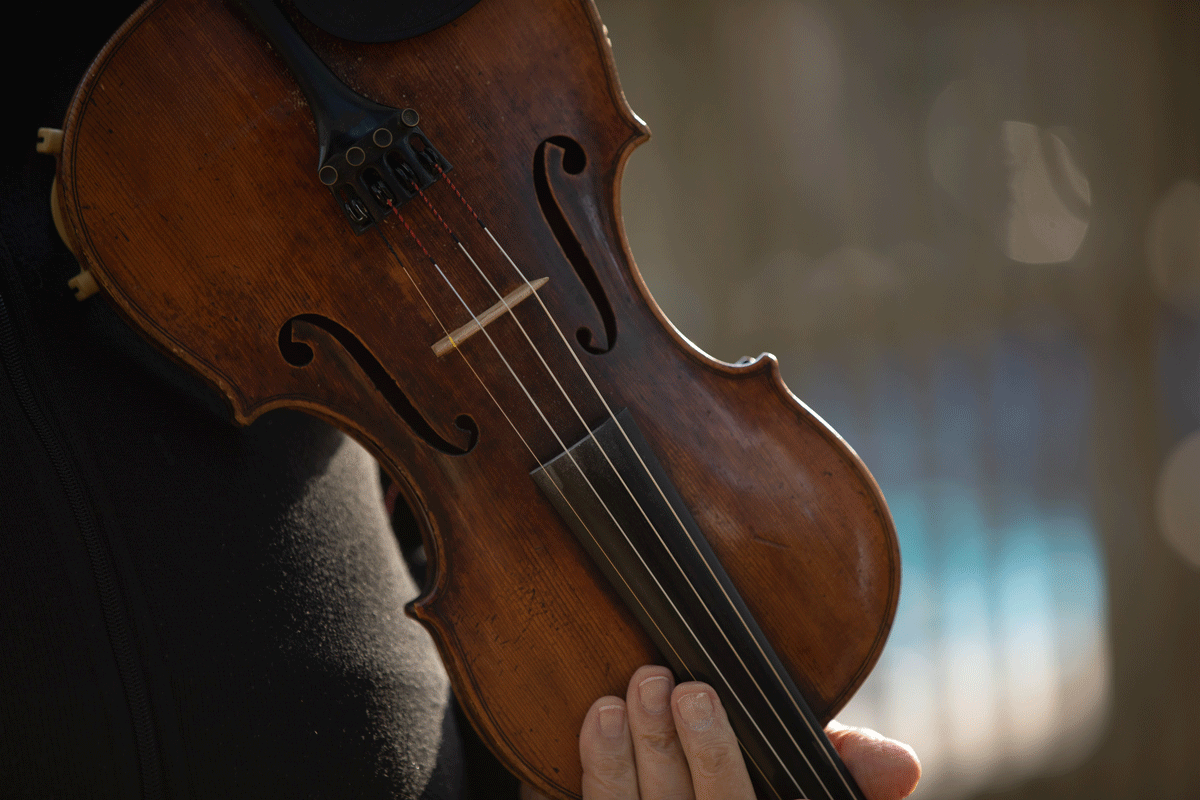
Photo by Brian Pavlich
Barry Jean Ancelet, ULL’s first director of the Center for Acadian and Creole Folklore, spoke at Doucet’s honorary doctorate ceremony; he described the singing fiddler as a prophet for Cajun music, history, and culture. “For Michael, Cajun music has always been more than a series of notes,” said Ancelet. “It is a language, the cultural expression of his roots. In its style and poetry, one finds the story of the people who have played it and listened to it and danced to it over the centuries.”
Doucet didn’t study and perform his native Cajun music and culture in hopes of being fêted. “All of them are good,” he said early this year at his home in Lafayette Parish. “And they’re all a surprise. But I don’t do this for the awards, and that includes the Grammys.”
In 1974, Doucet and his cousin, Zachary Richard, billed themselves as Le Bayou Des Mystères for a performance at Festival De Saint-Laurent. The trip inspired him to study Cajun fiddle and traditional Cajun and Creole music.
“We go to France and I’m playing lead guitar with Ralph [Richard],” Doucet recalled. “I liked the style [the festival’s French folk musicians] were playing, because it wasn’t affected by the country music we had in Louisiana. People our age at the festival were singing ballads that my aunts sang, that we had learned. That’s what I wanted to study.”
Doucet found more inspiration in a film screened at Festival De Saint-Laurent. Dedans le Sud de la Louisiane, a documentary shot in southwest Louisiana in 1972 by French filmmaker Jean-Pierre Bruneau, features Dewey Balfa, Canray Fontenot, Dennis McGee, Bois Sec Ardoin, and other Acadiana musicians. As Doucet watched the film, screened on a bedsheet hung between trees, he said with no small amount of surprise: “These are my neighbors.”
“It’s a magic about this place, our culture, the music. I still play music. I don’t think I can ever stop doing that.”
After the festival, Doucet abandoned his plans to attend graduate school, dropping Romantic British poets in favor of la musique Acadienne de la Louisiane. Having heard Cajun fiddle all his life, he found the instrument came naturally to him. “People told me I couldn’t play violin because I’m deaf in one ear. I didn’t listen to them.”
Doucet’s first award, a 1975 apprenticeship grant from the National Endowment for the Arts to study with Acadiana’s traditional fiddlers, set the foundation for much that followed. Cajun fiddlers Dennis McGee and Dewey Balfa and Creole fiddler Canray Fontenot were among the old masters he sought out. Doucet has since donated the cassette recordings he made of them—including one-hundred-fifty-six songs from McGee—to the ULL’s Cajun & Creole Music Collection.
McGee—who recorded with the Creole singer and accordion virtuoso Amédé Ardoin in the 1920s and ’30s—knew a vast repertoire of two-steps and waltzes as well as ballads and dances that linked France to rural nineteenth-century Louisiana. “That’s what drew me to Dennis,” Doucet said. “He was playing these old songs associated with France that nobody else was playing. But these people who I learned from gave me more than music. I wasn’t only interested in music.”
One of the lessons Doucet learned from Balfa, the fiddle master from Basile, came when Doucet, his brother David, and Balfa performed together at the 1982 Festival of American Folklife in Washington, DC, held on the National Mall. Balfa told Doucet not to be intimidated by the technical brilliance demonstrated by other musicians at the festival.
“Here in south Louisiana,” Doucet said, “we get the feeling, we get dancers moving. It’s a community thing. Dewey was adamant about how vibrant our music is. He told me plainly, ‘Don’t be swayed by these people playing all these notes. Just play what you know from your heart.’”
McGee counseled Doucet about living an artistic life versus a commercial life. “I asked Dennis why he wasn’t performing during Mardi Gras,” Doucet remembered. “He said, ‘No, I don’t do that anymore. They’ll come a time when you get a choice, to do it for money or to play from the heart what you really love. You’ll come to that crossroads.’ And Dennis was right. I chose not to be an egotist—but things happened for us anyway. We seemed to do it right, and we’d paid homage to the people we learned from.”
Balfa, like his protégé, Doucet, knew that Cajun music must evolve. “Some of the changes I’m not crazy about,” he wrote in his National Endowment for the Arts biography for the 1982 National Heritage Fellowship, “but I know that if something doesn’t change, it doesn’t grow, it doesn’t stay alive.”
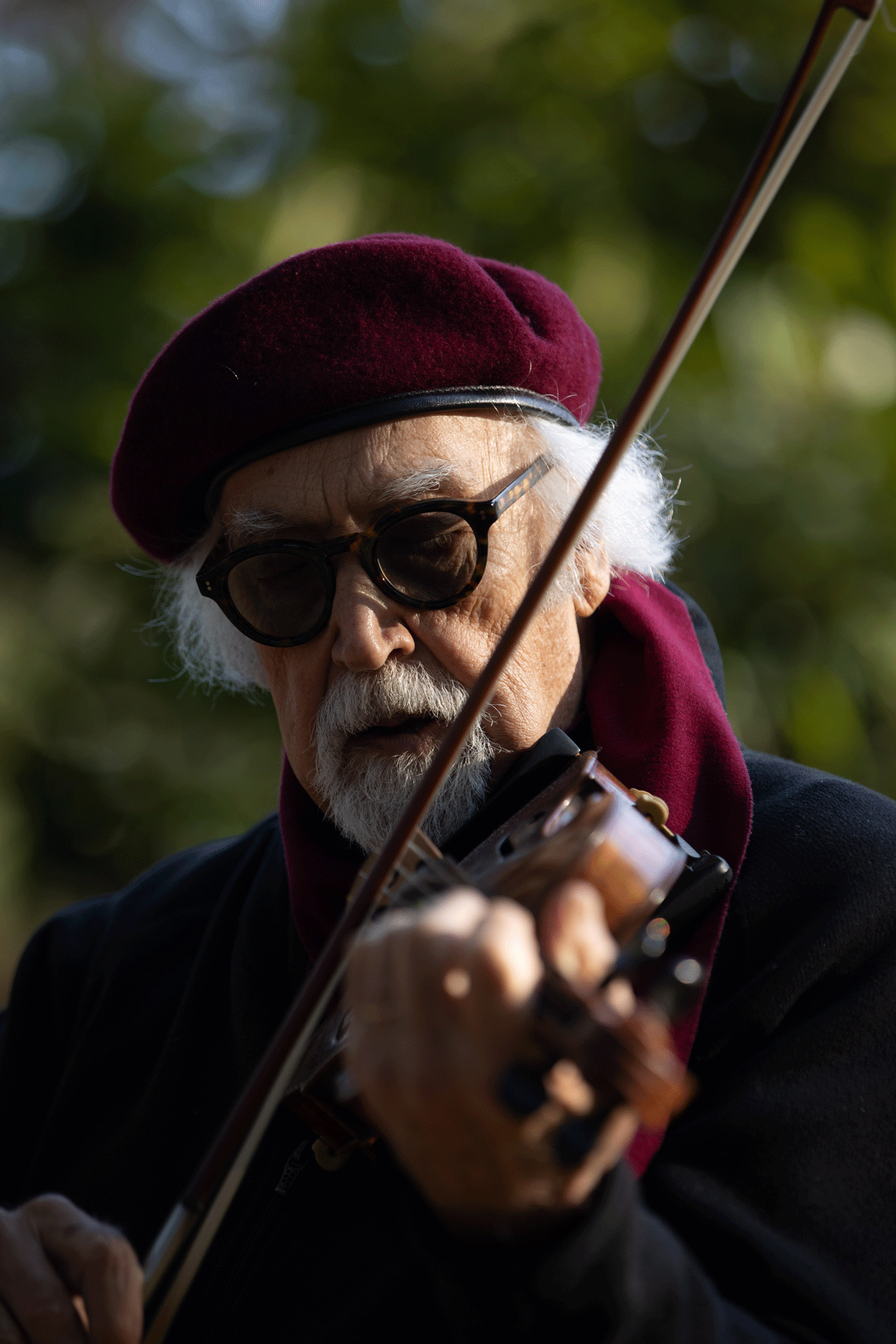
Photo by Brian Pavlich
“When Dewey taught me a song,” Doucet said, “he’d say, ‘Don’t play like me. Play like you.’ In our music, the notes are in the air, and you have great liberty to play and perpetuate them. That’s what I wanted to do. Dennis was like a grandfather to me. Canray Fontenot and I were close. I had the energy and the perseverance to go knock on their doors, introduce myself, and tell them how much I loved the music, and that I was doing this for them.”
Doucet also promoted pride in the long-repressed Cajun culture. That aspect of his work included three years of presenting programs at Louisiana public schools, often with Balfa. “Usually, we’d bring an accordion player, a ballad singer, a Creole or blues musician, to show the kids,” Doucet said. “We were refused by some schools. This was 1975. [Some administrators were] still prejudiced against Cajuns, and they didn’t want this in schools. We were trying to demystify the myth. I brought awareness of the treasure that we had, our music, to people in southwest Louisiana.”
In 1975, the same year Doucet received a grant to study with Cajun and Creole fiddlers, he formed the Cajun-rock band Coteau, a sort of Cajun Grateful Dead that preceded BeauSoleil. “It was a rock band, but I had a rendition of ‘La danse de Mardi Gras.’ People said, ‘Man, where’d you get that song?’ I said, ‘Well, it’s two hundred years old.’ And the older people came because they wanted to see us, and the younger people came every week. We played all over and made a good living.”
Doucet segued seamlessly from the short-lived Coteau to BeauSoleil. The band’s French moniker translates to “beautiful sunshine.” The name also honors Joseph Broussard dit BeauSoleil, the 18th-century Acadian resistance leader who led his exiled people to southwest Louisiana.
Things happened quickly for BeauSoleil. In April 1976, the band flew to Paris on a plane full of Louisiana dignitaries and musicians to participate in the Louisiana–France Bicentennial Celebration. A French record company executive who heard the band playing on a bateau on the Seine invited the young Cajun musicians to record an album. In January 1977, BeauSoleil performed at President Jimmy Carter’s inaugural ceremony in Washington, DC.
“We were at the right place, at the right time, with the right people,” Doucet said of those early days. “I never had a manager. I never tried to promote us. So, it’s been luck, but at the same time, we’d do this anyway.”
BeauSoleil didn’t become a fulltime band until 1986, when Doucet ended his seven years of teaching “French Music in Louisiana: Opera to Zydeco,” the course he created for ULL.
BeauSoleil recorded for a dozen record labels, including the legendary label Arhoolie. The group’s 1991 recording with country singer Mary Chapin Carpenter, “Down at the Twist and Shout,” reached number two on the Billboard Hot Country Singles & Tracks chart. Carpenter composed the song after attending a BeauSoleil show at a VFW hall in Bethesda, Maryland. The second highest-charting single in her career, which won her a Grammy Award in 1992. After that mainstream success, BeauSoleil joined Carpenter on the Grammy Awards telecast, country music awards shows, and the 1997 Super Bowl in New Orleans.
In February 2025, current and former BeauSoleil band members and many musician friends staged a two-night fiftieth-anniversary celebration of the band at the Acadiana Center for the Arts in Lafayette. “Let’s just do a last gig,” Doucet told the Baton Rouge Advocate prior to the shows. “That’s what the idea was—but then it grew into whatever it’s going to be. It’s going to be fun. We’ve never lost that.”
The anniversary shows weren’t a retirement party. BeauSoleil toured in 2025 and has many dates scheduled for 2026. The band’s 2026 lineup consists of Doucet; his guitarist-singer brother, David; accordionist Chad Huval; bassist Bill Bennett; and Doucet’s son, Matthew, playing fiddle and percussion. BeauSoleil returned to the studio in January 2026 to record a medley for a tribute album honoring the Balfa Brothers band, which featured Doucet’s mentor, Dewey Balfa.
“Our music here is so earthy,” Doucet said early this year at his home in Acadiana. “It’s a magic about this place, our culture, the music. I still play music. I don’t think I can ever stop doing that. I still write songs—but I’m more just doing it for me. And I’m not being selfish. I’ll teach anybody the songs.”
John Wirt is the author of the New Orleans music biography Huey “Piano” Smith and the Rocking Pneumonia Blues. He’s also written thousands of music and film features and reviews for newspapers and magazines.