Being Once Free
Excerpt from Invisible Blackness: A Louisiana Family in the Age of Racial Passing
Published: August 29, 2025
Last Updated: December 1, 2025

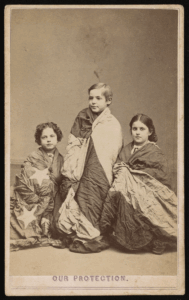
Courtesy of the Library of Congress, Prints and Photographs Division, Liljenquist Family Collection
Photograph of freed formerly enslaved children (from left: Rosina Downs, Charles Taylor, and Rebecca Huger) from New Orleans, taken by Charles Paxson in 1864 and used to promote the abolitionist cause up North.
Katy Morlas Shannon’s Invisible Blackness explores the complex lives of Creoles of mixed race born in Louisiana to enslaved women and the white men who enslaved them. Individuals such as Alice Thomasson Grice forged their own identities—and often reinvented themselves—within the increasingly strict racial order of antebellum and postbellum Louisiana.
 By the mid-1850s, Alexander Thomasson and his family had returned to New Orleans. Alexander probably liked the young clerk [Charles Grice] and decided to invite him to their home. His wife Milly and daughters Emma, Milly, Alice, and Sarah would certainly love to be regaled with stories of Jenny Lind. One of his daughters would find Charles’s affability and charms especially irresistible. No accounts written by Alice are extant, so we need to turn to letters written by contemporaries in similar circumstances to understand her excitement about Charles. Free woman of color Emma Hoggatt, living in New Orleans in 1857 just like Alice, also had a connection to steamboats; her husband and brother were both barbers on board riverboats. Emma described her sister’s infatuation with a man who worked on a steamboat: “And as soon as Tene knows that that man’s boats in and he don’t come to the house,” Hoggatt wrote her aunt, “she dresses herself and goes to see him and before she was acquainted with this man a month she went and gave him a daguerratype [sic].” Hoggatt was concerned about her sister’s behavior toward a man whose character might prove untrue. Fortunately for Alice, Charles Grice’s love for her remained steadfast for more than two decades.
After returning to New Orleans, Alexander became the captain of the Mary Matilda, a schooner that made trips across Lake Pontchartrain and to Biloxi, Mississippi. The family lived just across the river from the French Quarter in a neighborhood known as Algiers. Their home was near the Vallette dry docks, a fitting locale for a man who had made a living on the water. Unfortunately they arrived to find increased tensions and restrictions on free people of color. By 1857, Louisiana had prohibited the emancipation of enslaved people: no longer could anyone be freed in the state. State leaders discussed the possible expulsion of free people of color from Louisiana. Many members of that community in New Orleans left the state because of the discrimination and hostility toward them. Some went to Mexico. But the Thomassons had just come home and were reluctant to leave again.
The New Orleans’ city government by this time was more serious about enforcing the law that required free people of color born or freed outside the city to register with the Mayor’s Office. On September 6, 1859, Milly Thomasson and her eldest son Alfred were the first of the family to register. She presented an affidavit signed by her husband and stable keeper William Mish stating that she was free. She told the government official that she had first arrived in Louisiana around 1825 when she was about eight years old. Currently she was employed as a washer and ironer. Despite an exhaustive search through countless records, William Mish’s significance has yet to be determined; he may merely have been an acquaintance of the family and a willing witness. Alfred stated that he was around twenty-two years old and, when asked his occupation, replied “steamboating.” Clara Thomasson did not register; it’s quite likely that she either remained in Ohio or had died. The next four Thomasson siblings registered at the Mayor’s Office alongside their mother the following month. They presented a certificate from William Mish and their mother testifying to their free status. Sisters Emma, Alice, and Sarah Jane then worked as seamstresses. The youngest child, Edward O., was only five years old. The family members were assigned racial descriptors based mostly on phenotype, rather than ancestry. The government official looked at them and determined the proper racial descriptor based on their appearance. All the Thomassons were described as mulattoes, except for Alice.
Recorded as a nineteen-year-old “light mulatresse,” Alice stood five feet, three inches high, slightly taller than her older sister Emma. There are no known extant images of Alice, so these physical details are particularly valuable. Yet they do not capture her true essence. At the time, she was a new mother. Her first child, Robert Alfred Grice, had been born less than two months before. She was living as the wife of Charles Grice, a white man, and she was registering as a free woman of color in an official document kept by the city. She could not legally marry the man she loved or legitimize her child, rendering herself and her son vulnerable and without protection under the law. New Orleans society would scorn her and dismiss her as an immoral concubine who had seduced a white man. Like her father and mother, Alice longed for her family to have the same rights as other citizens. More than anything she wanted her relationship with Charles recognized as valid and her children acknowledged as his. It would take a Civil War with thousands of lives lost and a nation on its knees for her dream to be realized.
EXCERPT FROM: Invisible Blackness: A Louisiana Family in the Age of Racial Passing by Katy Morlas Shannon
Hardcover, $29.95; 220 pp.
Louisiana State University Press
March 2025