Winter 2025
Black Sunday
The runaway success of a fictional terrorist plot on Tulane Stadium
Published: December 1, 2025
Last Updated: March 1, 2026
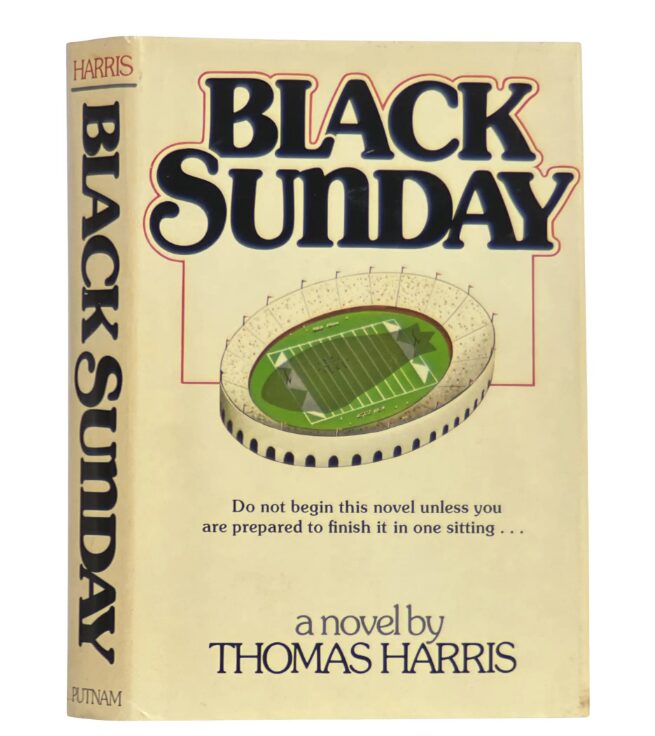
G. P. Putnam's Sons, first edition (1975)
Before gaining recognition for creating the character of Hannibal Lecter, Thomas Harris wrote an outlandishly gripping thriller about the Super Bowl in New Orleans.
1975 was a big year for football in New Orleans. After nearly a decade of construction delays and cost overruns, the instantly iconic Louisiana Superdome welcomed the New Orleans Saints to their new home turf. (Their state-of-the-art digs didn’t help much, as the franchise extended its losing streak to nine seasons.) On August 3, the same day the Superdome opened to the public, Tulane Stadium, the Saints’ original home field, was declared condemned. The local climate had reduced the upper deck of the world’s largest steel stadium to a haystack of dangerously corroded beams. Alarmingly, just seven months earlier, the stadium had hosted the Pittsburgh Steelers and Minnesota Vikings in Super Bowl IX.
Just days before that Super Bowl kickoff, an unhinged thriller arrived in stores, published by an up-and-coming master of suspense who’d used the upcoming game as the backdrop to his debut novel. Like today’s Super Bowl halftime shows, Thomas Harris’s Black Sunday is loud, overstuffed, and endearingly idiotic. Writing for the New York Times, the critic Harold C. Schonberg, moonlighting under the name Newgate Callendar, sneered that it includes “all the familiar ingredients . . . except literary ability.” (It would eventually become a bestseller.) Taking a cue from the disaster film trend of the 1970s, the novel’s plot simmers toward an explosive aerial terrorist attack. A group of suicide bombers plan to crash-land a blimp rigged with more than a thousand pounds of plastic explosives into Tulane Stadium, killing many of the 84,000 Super Bowl fans in attendance, including the President of the United States.
Though a commercial success in its day, Black Sunday is now seen as a mere stepping stone for Harris, a preseason scrimmage that led the way to his eventual big score: one of the most famous fictional psychopaths in literary history, Dr. Hannibal Lecter. And yet it’s Harris’s first novel that feels eerily prescient today.
Black Sunday’s terrorist plot revolves around three characters, all psychopaths in their own right. The leader is Muhammad Fasil, fictional architect of the very real 1972 Munich attack by the Black September Organization that murdered eleven members of the Israeli Olympic team. Fasil dreams of replacing Yasser Arafat as leader of the Palestinian liberation movement, on his way to becoming “the most prestigious guerrilla in the world,” his face decorating dorm room walls, Che Guevara-style. He’s in charge of obtaining the explosives, which he remolds and smuggles into the country as hundreds of dashboard Virgin Marys.
Like today’s Super Bowl halftime shows, Thomas Harris’s Black Sunday is loud, overstuffed, and endearingly idiotic.
His Manchurian candidate behind the blimp blitz is Michael Lander. A Vietnam War Navy ace, he now pilots the dirigible owned by Aldrich, a Goodyear-esque rubber manufacturer. Six years as a POW left Lander unstable and disillusioned. “He was a splendid machine,” Harris writes, “with a homicidal child at the controls.”
The last in Black Sunday’s terrorist trifecta is Dahlia Iyad, a ruthless militant and femme fatale whose sole purpose is seducing Lander. Despite her one-dimensionality, the character would go on to inform one of contemporary fiction’s classic protagonists. “I had always liked the character of Dahlia Iyad,” Harris reflects in a 2000 foreword to his novel Red Dragon, “and wanted to do a novel with a strong woman as the central character. So I began with Clarice Starling.”
Harris, who quit his job as a reporter for the Associated Press to write Black Sunday, relies on a handful of clichéd Big Easy set pieces throughout. Fasil makes pay phone calls in the Hotel Monteleone lobby. Major David Kabakov, the lead Mossad agent dedicated to uncovering the terrorist plot, makes plans with his lover for a post-game dinner at Antoine’s. Even the once menacing underbelly of the Mississippi River dockyards, in this case the Thalia Street Wharf, makes an appearance as the bomb’s short-term storage facility.
The local press mostly ignored the book’s release; the Times-Picayune reprinted a brief, middling review from the Chicago Daily News. And yet, Black Sunday’s runaway success—a New York Times bestseller late into the spring—couldn’t help but tether the book to New Orleans. The city went into full-blown Black Sunday fever once the big-budget Paramount Pictures adaptation was announced in May 1975. With John Frankenheimer, a veteran director of paranoid thrillers like Seven Days in May, Seconds, and, yes, The Manchurian Candidate, at the helm, New Orleans excitedly awaited another turn under the bright lights of Hollywood.
But the film Black Sunday would be set and shot during Super Bowl X, played at the open-air Orange Bowl in Miami. Blame the Tulane–Superdome switcheroo. A roofed stadium didn’t exactly make sense for a blimp-bomb disaster plot, a problem Frankenheimer foresaw. “My intention is to make it here,” he told the Times-Picayune on a pre-production scouting trip to New Orleans. “But if the Superdome is finished, I’m in trouble.” A moderate hit released in 1977, featuring a deliciously gonzo performance by Bruce Dern as Lander, the film’s box-office receipts would double its total budget.
The successes of Black Sunday, the book and film, would soon be overshadowed by Harris’s blockbuster franchise in waiting. His first Lector-centered horror-thriller, Red Dragon, appeared in 1981. A decade later, the Hollywood adaptation of that book’s bestselling sequel, The Silence of the Lambs, would sweep the five major Academy Awards categories, including Best Picture. Harris’s charming serial killer-cannibal would enter the literary and cinematic canon with liver-snacking aplomb.
Harris displays an early knack for gore in Black Sunday, which offers up a few sanguinary scenes that would make Lector proud. Suffering from wartime PTSD, Lander stuffs the family kitten in the garbage disposal. A rat nibbles holes in a terrorist lackey’s face. But in New Orleans today, in the wake of the recent Bourbon Street terrorist attack, it’s the bombing plot that remains the most chilling.
“Do not begin this novel unless you are prepared to finish it in one sitting . . .” the cover’s tagline reads. To be honest, it took me a half-dozen or so sittings, but Black Sunday did provide enough excitement and dread to make me want to skip next year’s Super Bowl.
Rien Fertel has been writing the Lost Lit column for eight years.