Magazine
Bringing People Together
Maaliyah Papillion blends Ishak traditions, Creole culture, connection to nature, and artistry to create unity and healing
Published: March 1, 2026
Last Updated: June 1, 2026
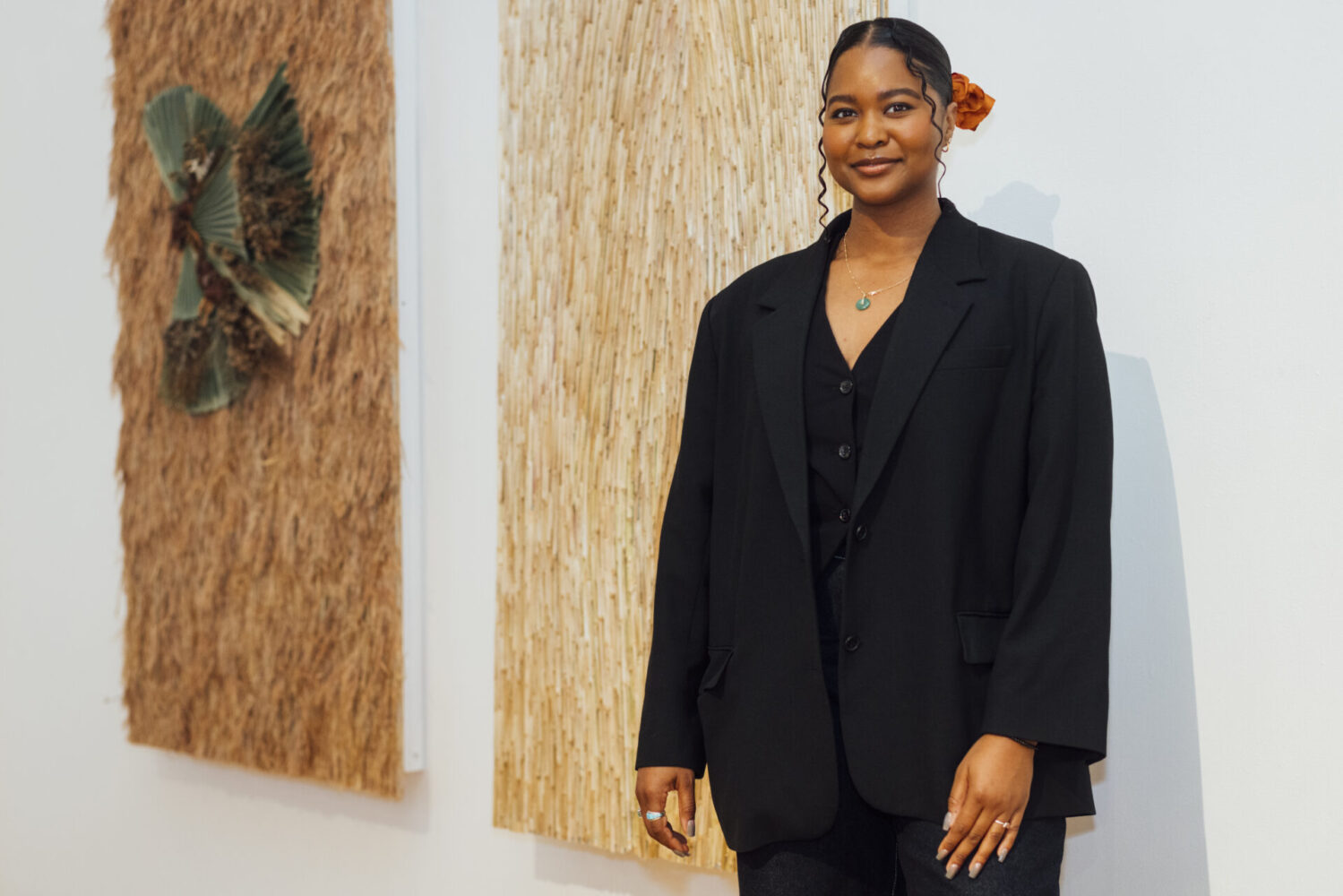
Photo by Brennon Fain, courtesy of Maaliyah Papillion
Maaliyah Papillion standing in front of her artwork on display at the Acadiana Center for the Arts as part of the 2025 exhibition Prairie Stories: Art and Ecological Restoration on Louisiana’s Prairies.
Maaliyah Papillion stands in her studio, intently focused, and deftly arranges thin, delicate reeds of foxtail prairie grass on her work in progress. She’s titled the piece My Prairie is a Portal. Papillion forages her artistic medium from Louisiana fields and forests, transforming palmetto fronds and magnolia blossoms into stunning works of art.
Papillion is a Louisiana woman proud of her Afro-Indigenous heritage, and defines herself as Creole. She’s a thirty-one-year-old businesswoman, a Level 2 reiki practitioner, an actress, a model, and a filmmaker who loves singing grunge rock. Both strikingly beautiful and talented, Papillion represented the Bayou State as Miss Louisiana from 2016–2017. Now a student at the University of Oklahoma, she is mid-way through their Master of Legal Studies in Indigenous People’s Law program and serves her tribe, the Atakapa Ishak Nation, as an advocate for the preservation of their culture and their quest for state and federal recognition. But the role Papillion is most enthusiastic about recently is that of artist.
Papillion’s artistic objective is to help people appreciate their natural surroundings and to see the beauty in nature. Through her creativity, she honors her Ishak/Creole heritage, her relationship with the land, and the memories that are stored in plant material. “Plants carry the stories and history of people and animals who have lived here,” she said. “Working with plants is, for me, a way of working with my ancestors and people in general. I tune into their vibes, and I never know what’s going to happen or what story they’ll want to tell. Plants have their own energy and agenda. That is how my work comes together.”
Born and raised in Lake Charles, Papillion said she’s always loved art. “My creativeness is what stands out to me from my childhood, whether through art or baking. Art was one of my favorite subjects in school and what I most enjoyed after school,” she said. “I played sports. I participated in pageants. But life always brought me back to art.”
“Sure, I’m an artist, I’m Creole, I’m Ishak,” she said. “But the work that I’m doing—art, film, creativity, and my work through Chrysalis—is for the collective ‘we,’ so we can all heal together.”
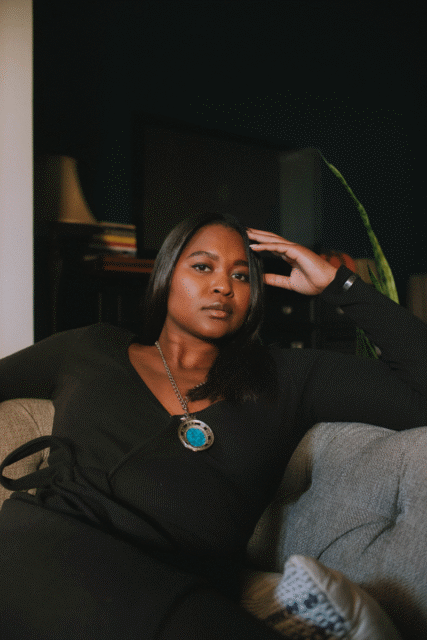
Photo by Taylor Hunter
An Advocate for Indigenous Peoples
Though Papillion was educated in Catholic schools and continues to carry that influence, she says her upbringing as a Creole played a major role in the person she is today. As a child, Papillion preferred the roller rink over attending powwows, but her father, Shawn Papillion, the Ishak tribe’s medicine man and spiritual leader, persisted in reminding her of her roots within the tribal community. “It wasn’t until I was older that I began to really appreciate the cultural and spiritual significance,” she said. “Yet it was always an integral part of who I was and am.”
Papillion attended McNeese State University in Lake Charles, where she graduated with a degree in general studies and a minor in psychology. She enrolled in the OU master’s program in 2024 to learn more about Indian law and how those laws impact residents both Native and non-Native. The curriculum takes students from the beginning of Indigenous history—first contact, assimilation, relocation, reservations—to present day and the pursuit of many tribes, including the Ishak, of federal recognition. “The program has been eye-opening,” she said. “I feel there is a real gap in advocates for Native American law. Indigenous peoples have experienced so much discrimination. We were here first, and we’ve gotten the short end of the stick.”
Because of this systemic bias, Papillion says we all suffer as a nation. “When you ostracize, abuse, and kill one group of people, it harms the whole. We are all connected through our human experience. No one group is better off if we’re not all better off.” In fact, a statement of unity among the Ishak is Hoktiwē—“We are together.” Along with their quest for formal recognition, the tribe works to preserve the Ishak culture and the Ishakkoy language.
Entwining Activism, Environmentalism, and Art
The Ishak believe their ancestors originated from the sea. With this cultural background, Papillion has always considered herself an environmentalist. In eighth grade, she served as her school’s science club president; the club tracked methods to improve coastal wetlands and mitigate erosion. Today Papillion is passionate about environmental law, specifically water law, which is complicated in Louisiana. She sees herself potentially pursuing a career as an advocate for the environment, whether as an attorney, a legal consultant, or a lobbyist. “It’s something that’s been with me since I was young,” she said.
Papillion will complete the law program later this year. Meanwhile, her advocacy for nature and her desire to upend racial inequalities are expressed through her art. “I want to overcome bias by being the best I can be in my career creatively, with my art, through my films and my music, and to educate people through my art,” she said. “My advocacy looks like my art and working with plants. When you take a natural element and turn it into a mosaic, people see the beauty. We take nature for granted, but when we see nature in an artful way, it changes our perspectives.” Last year, Papillion was an artist-in-residence through a nine-month program at Imperial Calcasieu Museum in Lake Charles. Residents are provided studio space and opportunities for public showings; they conduct art workshops with students through a partnership with McNeese State University. Papillion spent her time in residency experimenting and creating some large-scale pieces.
In 2023, Papillion produced and directed the documentary ISHAK. In this film, available to watch on YouTube and on PBS.org (Reel South Season 10, Episode 1003), she relates the Tribe’s history, their struggle for recognition, and why it is so vital to protect the environment. “We recently gained access to a farm in on our traditional territory that will allow the tribe to come together to share traditional knowledge and to grow plants,” she said. This inspired a documentary sequel titled The Land that Never Forgot. Scheduled for release this summer, the film further demonstrates how the Atakapa Ishak Nation, with around one thousand members, is working with the land.
Advocacy Through Art and Healing
Inspired by her godfather, who is a reiki practitioner, Papillion opened a wellness company in 2019 called Chrysalis Transformative Healing. She recognizes how people, especially those in the entertainment business, are burned out; fatigue is normalized and even encouraged. Papillion has helped hundreds of clients through reiki cleansing and sound bathing, as well as coaching them on ways to heal themselves at home. She places particular emphasis on rest in all its many forms—physical, mental, sensory, emotional, social, creative, and spiritual.
This concept of rest is where Papillion intersects her enthusiasm for art and healing. In 2025, she hosted an exhibit at The Front in New Orleans called Ritual Rest, which facilitated collective rest and healing, promoting rest for its own sake rather than a means to an end. For that social experiment, Papillion converted a gallery space into a meditation room with approximately two hundred people participating in spiritual, communal, and physical rest. “Artful rest is intentional, and it’s a big deal,” she said.
When talking about her life’s work, Papillion strives to bring the collective “we” into her story. Again, hoktiwē. “Sure, I’m an artist, I’m Creole, I’m Ishak,” she said. “But the work that I’m doing—art, film, creativity, and my work through Chrysalis—is for the collective ‘we,’ so we can all heal together.”
Angie Kay Dilmore is a freelance writer, editor, and children’s author in Lake Charles. Her debut picture book, Bedtime Lullabayou, celebrates Louisiana’s unique culture and natural beauty. Find her at angiekaydilmore.com.