Magazine
Décimas of St. Bernard
Irván Pérez championed Isleño folk music
Published: September 1, 2026
Last Updated: September 2, 2026
Courtesy of Karen Perez Scott
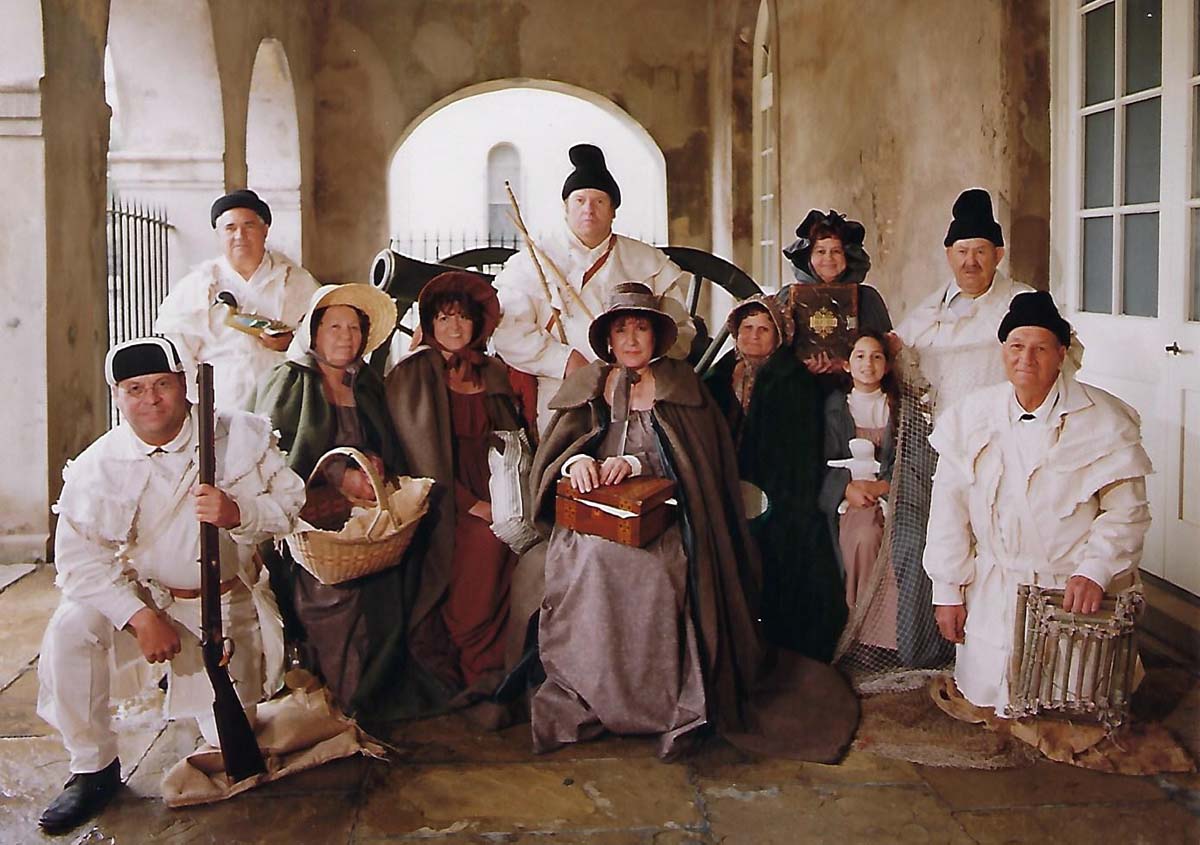
Members of Los Isleños Heritage and Cultural Society of St. Bernard wearing traditional clothing, Irvan Perez back left.
Décima singing is among the most significant cultural legacies of Louisiana’s years as a Spanish colony, circa 1760–1801. In 1778 the colonial governor Bernardo de Gálvez encouraged mass relocation from Spain to further populate the territory that it had recently acquired from France. Many such émigrés, known as Isleños, came from the Spanish-governed Canary Islands, off the western coast of Morocco. Some of these people settled in the semi-aquatic realm of lower St. Bernard Parish, southeast of New Orleans, which was then a remote area.
The Isleños formed a tight-knit, self-contained ethnic enclave where the prevailing language was an eighteenth-century Spanish/Canarian dialect. They primarily subsisted on farming, fishing, trapping, and selling muskrat pelts to furriers. Isolation from the outside world prevailed until the late 1930s. As the renowned décima singer Irván Pérez (1923–2008) told the producer Tika Laudun of Louisiana Public Broadcasting, “I started school when I was six and I didn’t know any English.” Pérez’s monocultural experience was typical of that era. As a result, décima singing survived into the twenty-first century, until St. Bernard Parish was ravaged by Hurricane Katrina in 2005 and many of the surviving residents dispersed.

Isleños decima singer and preservationist Irvan Perez duck hunting. Courtesy of Los Isleños Heritage and Cultural Society of St. Bernard
Décimas are sung a cappella; typically each verse has ten stanzas, which gives the form its name. Some décimas date back to medieval Spain, while others were created by Isleños in Louisiana as a form of community entertainment, fresh gossip, and historical narrative. Irván Pérez explained to Laudun:
Whatever happened in the community, come Saturday night, if a décima singer [or] composer heard of it, he would make a décima out of it . . . People would go to dances [and the band] would play until 12:30 or 1 . . . [Then] everybody would eat and the singers would sing. Everybody was interested because it was like a newspaper [for us]—we never had newspapers . . . You didn’t get mad regardless of who they were singing about. It didn’t matter if a woman went astray and they sang about her. If a man did something he had no business doing, they sang about him. . . . The [singing] . . . wouldn’t stop until 6:30 the next [morning]. Sometimes the elderly people would demand, at 3 or 4 am when the children were sleeping, that the singers sing the songs that were on the raunchy side. They would sing [those] but [first] they would run the children off.
Some décimas, however, were quite serious and somber. Such contemporary community commentary in music is found in diverse cultures worldwide, including the tradition of griot singers in West Africa, which also has links to Louisiana.
Much like the French-speaking Cajuns and Creoles, the Isleños and their culture and language were often condescended to and marginalized by mass-culture media. In his doctoral dissertation for the University of Chicago, “Recollecting Isleño Décimas: Louisiana’s Lost Tradition of Spanish Ballad,” William D. Buckingham recounted that, in 1915, the newspaper reporter Minnie Howell Storck visited the then far-flung village of Delacroix. In an article entitled “L’Isle, or De La Croix Island Is Peopled by a Strange Mixed Race With Spanish Dominant,” Storck reported hearing “a Spanish song” and commented, “It is not a little remarkable how much of native dignity there is among these simple folk . . . nothing in their lives but labor, yet withal they are cheerful, kindly and contented.”
Such ethnocentric patronization put décimas—along with Cajun and Creole music sung in French—in danger of obsolescence and extinction through much of the twentieth century. But the 1970s saw a dramatic resurgence of these and other South Louisiana traditions, as celebratory pride replaced decades of shame triggered by mainstream disparagement. In this revitalized climate, décima singing began attracting listeners outside the Isleño community, and Pérez emerged as one of its best-known performers and advocates.
While folkloric music at times sounds rough-edged by conventional standards, Pérez’s soulful, lilting décimas were exquisitely delicate and melodic, comparing favorably to the work of major national-level vocalists singing in English. Pérez performed at the World’s Fair in New Orleans and at the New Orleans Jazz & Heritage Festival. He sang décimas for the King and Queen of Spain, traveled to the Canary Islands with a delegation of Isleños, received a prestigious National Heritage Fellowship from the National Endowment for the Arts, and performed at Carnegie Hall on a concert produced by the folklorist Nick Spitzer, host of the public radio program American Routes. In an email to this writer, Spitzer recalled that “when Irván sang Isleño décimas for our Folk Masters series in 1991, he really enthralled New Yorkers from a variety of Spanish-speaking nations who were hearing variations from an old Latin American song and story repertoire that they associated with their great-grandparents.”
This year Los Isleños Heritage & Culture Society celebrated the fiftieth anniversary of Los Isleños Fiesta, a popular event held in the community of St. Bernard. The Society’s museum has presented such contemporary cultural torchbearers as the prolific author and musician Johnette Downing, who demonstrated Canarian folk dancing while dressed in traditional attire. Downing also played the traditional instrument known as the timple. In an email to this writer, Downing explained, “I am a Louisiana descendant of the Canary Islands. I received a grant from the New Orleans Jazz & Heritage Foundation to further my research into the décima as the musical connection between the Canary Islands and Louisiana. I was commissioned by the government of the Canary Islands to write the book The Spanish Tinge: Louisiana Music Pioneers of Canary Islands Descent, which was published in Spanish.” This title references a term coined by Jelly Roll Morton that credits Afro-Spanish rhythms as a key component in early New Orleans jazz. It underscores the broad historical influence of Spain upon Louisiana music.
Ben Sandmel is a New Orleans-based drummer, folklorist, and the author of Ernie K-Doe: The R&B Emperor of New Orleans. He produced and played on the Hackberry Ramblers’ Grammy-nominated Deep Water. In 2018 the LEH honored Sandmel for his Lifetime Contributions to the Humanities. Sandmel has an MA in musicology from Tulane University.