Magazine
Ground Work
The Tunica–Biloxi Tribe of Louisiana is growing organically, and with determination
Published: March 1, 2026
Last Updated: June 1, 2026
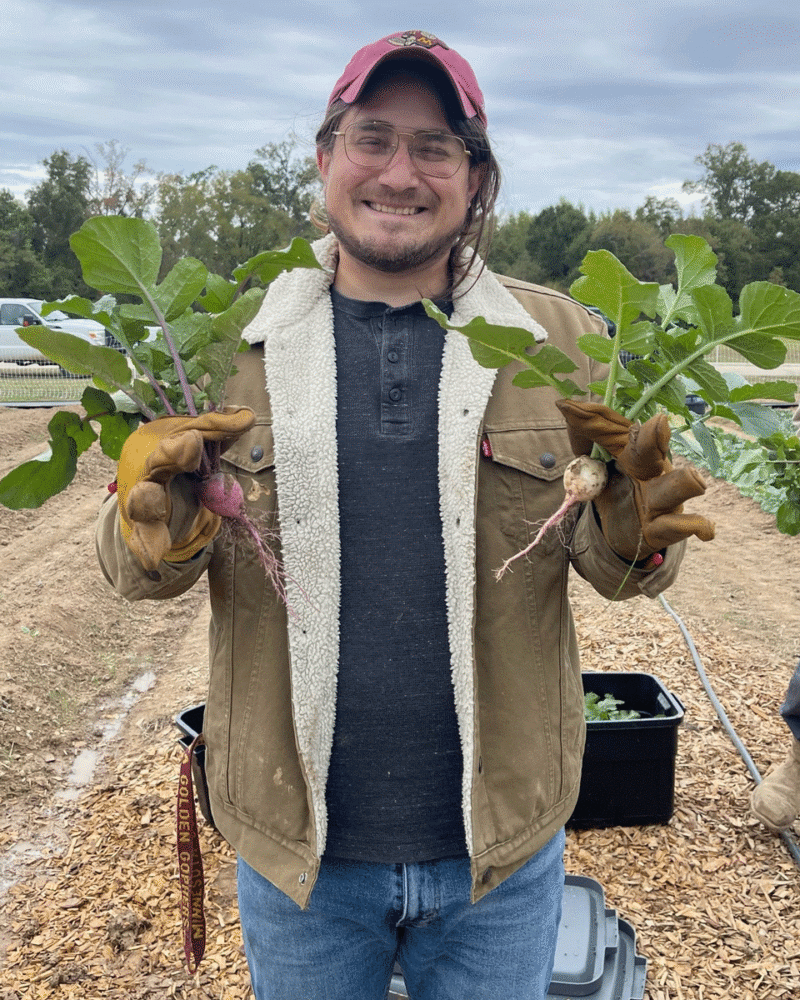
Courtesy of the Tunica-Biloxi Tribe of Louisiana
Sammy Velasquez brandishing turnips at Tahch'i Farms, the only certified organic farm in Avoyelles Parish.
After farming garlic, chickens, Black Angus cattle, and Berkshire hogs in Wisconsin and Illinois for more than two decades, Louis Medina moved down to Louisiana in 2023. He’d been tasked by the Tunica–Biloxi Tribe of Louisiana to turn a patch of land on the Marksville reservation into an organic farm. “My mother lived here on the res when she was young for a while, until everybody had to move for work,” said Medina. “So that’s how they ended up in Illinois. My role right now is getting this going and hopefully to teach and pass what I know.”
Louisiana is hotter and more humid than Wisconsin, of course, though he says the difference is less stark now thanks to the changing climate. Heat plagues his Midwest plot too.
In Marksville, Medina has spent the past couple of years documenting management practices on the property—“showing that I’m using organic seed, organic fertilizer, anything that the National Organic Program allows us to do.” And now the fruits and vegetables of his labor: the new Tahch’i Farms, the only certified organic farm in Avoyelles Parish, produced thousands of cucumbers, zucchini, and watermelon in summer 2025. A strawberry patch, in the process of becoming organic, is available for community picking with plans to expand. Freshly plucked produce is first distributed to the Tunica–Biloxi elders and then the rest of the tribe. “We like to take care of our elders,” said Medina. “People are starting to really appreciate what we’re doing here when we hand out all this food and it’s fresh. You hear from them that they like organic, and that they’re trying to live a healthier life.”
For the younger set, weekly classes teach agricultural practices, bringing the sustainable mindset to the skills that will sustain Tahch’i beyond Medina’s tenure.
In addition to the edible, the site is also producing cane, for basket weaving, with seeds sourced from the Chitimacha tribe. Longleaf pine is cropping up too. “We planted like a thousand in one section. Hopefully we’ll have nice little longleaf pine forest in so many years here.”
Longleaf pine takes patience, but more dizzying momentum can be seen in the Tunica–Biloxi’s other economic development efforts. Last June, the tribe held a summit, “Preserving, Protecting, and Strengthening Tribal Sovereignty,” in which thirty tribal leaders and US officials convened at the Tunica–Biloxi reservation in Marksville. “Through collaboration and determination, we aim to shift the balance of power, ensure tribal communities are no longer overlooked, and secure our rightful place at the table of progress,” said Chairman Marshall Pierite in a statement at the time. That progress can be seen just in the past year in initiatives like Tahch’i Farms; the acquisition of GovStrive, a federal human resources consulting firm; a new justice center; and affordable housing developments.
“We are reclaiming our connection to the land and our ancestors’ agricultural tradition. It is about more than growing food; it is about promoting health, sustainability and community pride.”
In September 2025, on the forty-fourth anniversary of its federal recognition, the Tunica–Biloxi shared this commemoration on social media: “Federal recognition has given us the freedom to preserve our culture, protect our traditions, amplify our voice, and create opportunities for our people to thrive. It has allowed us to grow through new resources, strong partnerships, and a future shaped with intention for generations to come. We stand in solidarity with Tribal Nations still fighting for recognition and honor their ongoing work. We are grateful to our federal and state partners whose support over the past four decades has helped us build stronger pathways forward.”
In addition to stronger pathways, Tahch’i Farms is looking into a stronger fence. “We’re at the point where we have to start to think a little bit bigger,” said Medina. “But one of the factors is that we have a wild hog problem here. We’re getting quotes to try to fence the whole eight acres in so we can start opening up and grow a little bit bigger without our electric fences where we can expand, which is the vision of the chairman and the vision of actually myself and everybody involved here.”
A planned high-tunnel greenhouse will allow for a longer growing season and insulation against the tumultuous climate.
“The [tribal leaders] want us to get a little bigger, so we can always provide on a continuous basis for our tribal members, the community, help get them involved with organic produce and maybe sell to the restaurants in the casino,” Medina said. (Paragon Casino Resort, in Marksville, was established by the Tunica–Biloxi in 1994 as Louisiana’s first land-based casino.)
Future facilities are planned to process, package, and distribute food to a wider audience. “We hope to have our own store eventually, maybe markets once or twice a month,” added Medina. “We’ll invite the public in and let ’em know we’re here and we’re growing good, healthy food.”
Chairman Pierite sees the tribe’s ability to grow its own food as essential to his long-term vision for independence and self-reliance. “Through Tahch’i Farms,” he said, “we are reclaiming our connection to the land and our ancestors’ agricultural tradition. It is about more than growing food; it is about promoting health, sustainability and community pride. By producing our own crops and teaching our people, especially our youth, how to cultivate and care for the land, we are strengthening both our sovereignty and our sense of identity.”
“Watching the crops grow and seeing families come together around what we have harvested together is incredibly meaningful,” he added. “It reminds us that sovereignty starts at home, with the ability to provide for ourselves, protect our land, and pass down traditional knowledge. Tahch’i Farms is a symbol of that resilience and growth.”
Lucie Monk Carter is a writer and photographer in Baton Rouge.