Magazine
Headliners
A new exhibition spotlights paintings related to New Orleans music culture
Published: March 1, 2026
Last Updated: June 1, 2026
They called him the Two-Winged Preacher. With a huge pair of white wings on his back and an electric guitar in front, Elder Utah Smith led popular tent revivals throughout Louisiana from the 1940s through the 1960s. Like Sister Rosetta Tharpe, Smith used the emerging medium of electric guitar to glorify the Lord and work congregations into joyful worship, becoming a pioneer of the instrument in the process. A glimpse of his magic is visible in a 1949 painting by J. Haynes Smith, one of fourteen artworks in the exhibition New Orleans Musicians in Art: Selections from the Permanent Collection, now on display at the Historic New Orleans Collection (HNOC).
“There are so many examples of art inspired by music that have been produced here in New Orleans, and these paintings are but a few examples from our permanent collection,” says HNOC Chief Curator Jason Wiese. “We have many more—works on paper, such as art prints and posters—but these paintings are striking and impactful as artworks, and I hope they convey to our visitors a sense of the music and musicians they depict.”
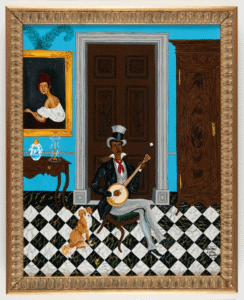
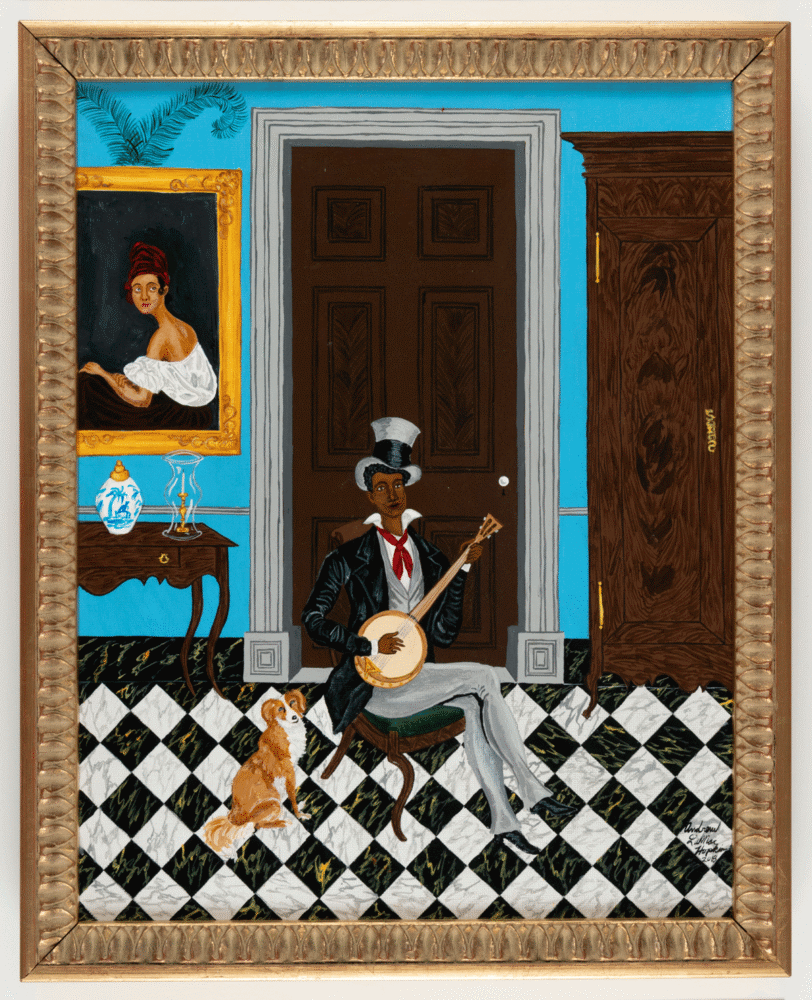
The show focuses on representations of the city’s Black music traditions, from gospel (as seen in the Utah Smith painting) to jazz and even the banjo. Contemporary artist Andrew LaMar Hopkins imagines himself as a 19th-century musical dandy in French Quarter Banjo Player or Self-Portrait of the Artist with Belle. The piece gives a nod to the undersung but important role of African Americans in popularizing the banjo during the mid-1800s.
Three paintings celebrate New Orleans’s much-loved parading traditions: In The Saints Going Marching In, James Thomas shows a group of ghostly white figures filing through a New Orleans cemetery, set off by stark, bare trees. Herbert Singleton’s depiction of a Black funeral procession is painted atop a wood-relief carving, bringing earthy heft befitting the subject matter. While Singleton’s work captures the somber gravity of the dirges typically played at the start of a procession, folk artist Bruce Brice, in his painting of a New Orleans funeral procession, shows the celebration of life that takes place after the body is “cut loose.” Brice, who created the first Jazz Fest poster, was a fixture of the festival for over four decades and is now honored as one of its “Ancestors.”
New Orleans’s music history is rich and diverse, but the city is best known as the birthplace of jazz, and much of New Orleans Musicians in Art pays homage to that distinction. Jane Nulty Bowman shows trombonist Louis Nelson mid-performance, while Jacques van Aalten’s rendering of Louis Armstrong captures the star at his heady peak. Other works depict clarinetist Louis Cottrell, pianist and composer Jelly Roll Morton, and bassist and guitarist Alcide “Slow Drag” Pavageau.
Four of the paintings on display were completed by artist Noel Rockmore during his affiliation with Preservation Hall. During the early days of the venue, Rockmore, a denizen of the French Quarter art scene, would paint the jazz masters as they played on the bandstand. His Original Jazz Band, which depicts Louis Nelson (trombone), Joe Watkins (drums), Ernest “Kid Punch” Miller (trumpet), “Papa” John Joseph (bass), George Lewis (clarinet), and Dolly Adams (piano), shows the group swinging in dimly lit splendor.
Music is but one facet of the robust history of New Orleans and the Gulf South. Other exhibitions now on view explore the French Quarter’s storied past, the cultures and changing environment of Louisiana’s coast, and the firsthand narratives of local civil rights pioneers. Connect with our region’s fascinating history at the Historic New Orleans Collection, a free museum and research center in the heart of the French Quarter.
Learn more at hnoc.org.