Magazine
An Irish Republican in Louisiana
The life and legacy of J.F.X. O’Brien
Published: March 1, 2026
Last Updated: June 1, 2026
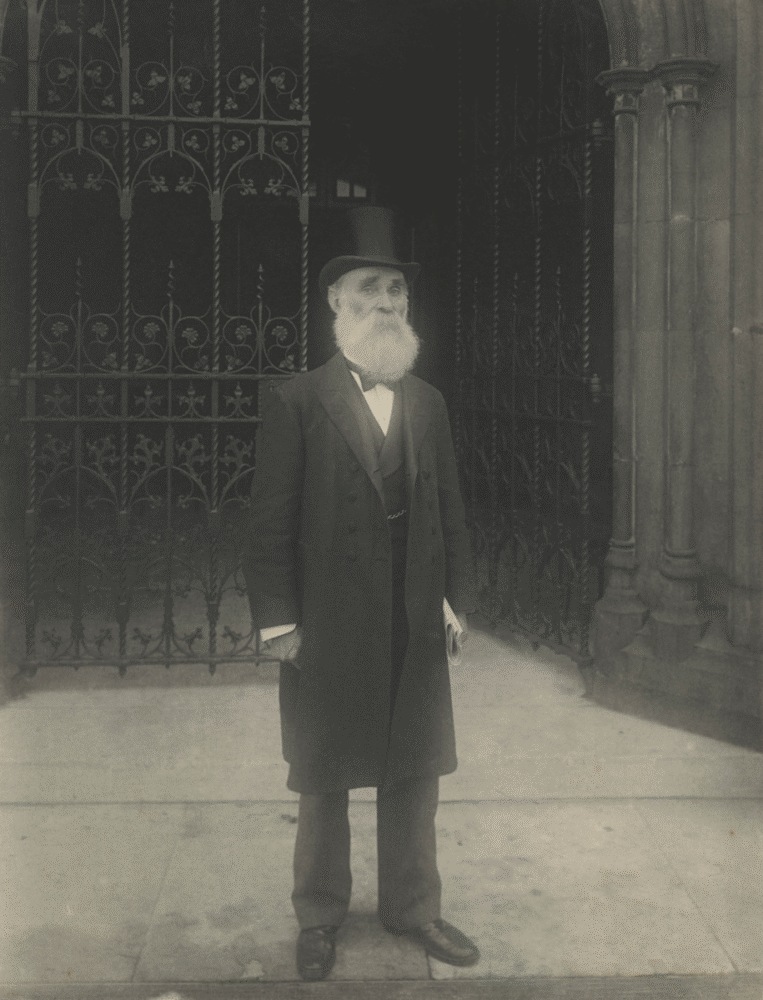
National Portrait Gallery, London
A platinum print portrait by Benjamin Stone of Irish nationalist James Fracis Xavier O’Brien, who lived in Louisiana from 1857-1862.
Dublin’s Glasnevin Cemetery is home to some of the giants of Irish Republican history, including Daniel O’Connell, Michael Collins, and Constance Markievicz, who tirelessly fought for independence from Great Britain. Each year, thousands of visitors tour the grounds and pay their respects to these architects of a modern Ireland. Nestled in a less-visited area of the lush cemetery, away from the grand monuments, a large Celtic cross marks the final resting place of a more obscure leader—James Francis Xavier O’Brien, a man who did little resting in his seventy-six years. The simple epitaph on his grave—“He loved God and served his country”—betrays James O’Brien’s remarkable life as a medical student, South American mercenary, US Civil War surgeon, President of the Irish Republican Brotherhood, political prisoner, and finally, elected Member of the British Parliament. From February 1857 until October 1862, O’Brien was also a resident of Louisiana, where he lived in New Orleans and Baton Rouge.
Though not published in his lifetime, O’Brien left behind a rough manuscript he intended to publish as a book. Written many years after his youthful journeys had ceased, O’Brien’s recollection of dates can be dubious, and notable events are often mentioned only in passing or are frustratingly vague. Though he mentions getting married in New Orleans, for example, he never mentions the name of his first wife, Maria Louise Cullimore, or those of his two children.
In 2010, the University College Dublin Press published his work, edited by Jennifer Regan-Lefebvre, under the title For the Liberty of Ireland at Home and Abroad. In it, O’Brien describes his many adventures and unceasing belief in Irish independence. The two chapters that he devotes to life in New Orleans and Baton Rouge are among the most detailed and enticing of his entire autobiography. Here, O’Brien records first-hand snapshots of everyday life in Louisiana during the mid-nineteenth century and provides glimpses into Irish contemporary thought on issues like slavery and the American Civil War.
Born around 1828 in the small coastal town of Dungarvan, County Waterford, in the south of Ireland, O’Brien came from a comfortable middle-class family. In recollecting his early life, O’Brien remembers reading stories of the mythical Irish folk hero Finn McCool and the great Brian Boru, the High King of Ireland, who gave his family its name. “I was proud of my name and descent,” O’Brien writes. “I felt that I had in my veins the blood of an old, illustrious race and the desire to do nothing unbecoming such a descent was always strong in me.”
After falling ill in Paris, a physician recommended that he take a break from his studies, or “knock about for a while,” as O’Brien records, and he set sail for New Orleans.
The O’Brien family owned a small fleet of merchant ships, insulating them from the worst of the Irish Potato Famine, which devastated Ireland from 1845 until 1852. Still, the effects of the blight were impossible to avoid in Ireland, and O’Brien records his memories of skeletal figures begging for food in doorways as Irish oats and wheat were loaded onto ships and sent out of Ireland. “I have seen the workhouse . . . a terrible encampment, each wretched family in a little group,” he writes.
The Famine radicalized generations of Irish Republicans who perceived the blight as a British-created disaster aimed at ridding Ireland of its native population. It clearly planted within a young James O’Brien a distaste for British rule of Ireland, which would define his life. By the time he began attending university at St. John’s College, Waterford, he records that he and his classmates would often discuss the “Saxon foe,” and O’Brien quickly became involved in nationalist politics.
In 1848, a group of radical college students, including O’Brien, organized an armed uprising referred to as the Young Ireland Rebellion, which was quashed almost as soon as it began. Following the abortive Rebellion, O’Brien’s family thought it was best that he leave the country for a while. He quietly slipped out of Ireland and fled to Wales for several months before beginning studies in medicine, first at Queen’s College in Galway, Ireland and later in Paris. After falling ill in Paris, a physician recommended that he take a break from his studies, or “knock about for a while,” as O’Brien records, and he set sail for New Orleans.
If O’Brien was upset at the idea of leaving his medical studies in Paris for New Orleans, he does not indicate it in his writing. In late November 1856, O’Brien boarded the sailing ship Kossuth and began a “dull and uneventful” seventy days on the Atlantic. He landed at the mouth of the Mississippi near the end of January 1857 as a series of strong storms battered the ship, giving the young Irishman his first introduction to the tempestuous weather of south Louisiana.
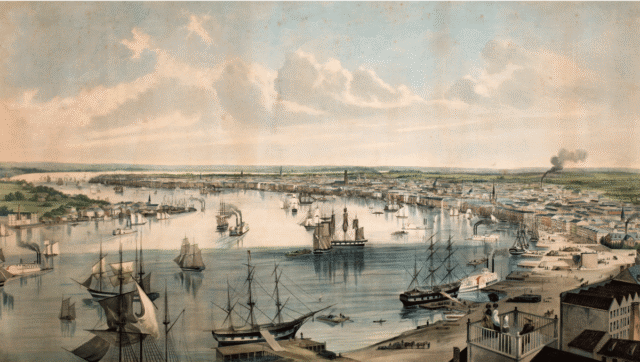
New Orleans from the Lower Cotton Press, 1852. HNOC
His arrival in the city occurred just after European migration to New Orleans peaked, with over half of the population being foreign-born by 1850. Earl F. Niehaus, writing on this immigration, records that between 1850 and 1855, some quarter of a million immigrants landed in the city. Among these fresh arrivals, O’Brien found a community of Irish, many of whom were exiled nationalists like himself. During his time in New Orleans, O’Brien never made much of an attempt at assimilation, the way that so many of his contemporaries did, choosing Irish boarding houses and neighborhoods.
In keeping his hope for an independent Ireland alive, O’Brien repeatedly sought out those Irish transplants in Louisiana with similar political ideologies. When he encountered those who had participated in the Young Ireland Rebellion of 1848, O’Brien proudly referred to them as “‘48 Men.” In New Orleans, he found men like John Maginnis, owner and editor of the True Delta newspaper, and Joseph Brennan, another Young Ireland political exile and a “leading journalist in New Orleans—a recognized political power” on whom O’Brien called on his first day in town. In Baton Rouge, he looked up Richard D’Alton Williams, “an old political friend” and a ’48 man, who had “practically lost all for Ireland’s sake.” Williams had been a physician and poet who published nationalist verses in Ireland under the name “Shamrock”; by the time of their reunion, Williams had become a teacher at a Jesuit school. He died of tuberculosis in Thibodaux shortly before O’Brien’s return to Ireland. O’Brien relates that during the American Civil War, members of an Irish Union regiment from New Hampshire, after discovering Williams’s simple headstone on their march through south Louisiana, replaced it with one honoring ‘his exalted devotion to the cause of Irish freedom.’”
Still a young man when he arrived in Louisiana, O’Brien’s Irish nationalism seemed to grow while he was in exile. When Irish Republican Brotherhood organizer James Stephens stopped through town in 1858, O’Brien joined the newly formed organization dedicated to Irish independence, but he also grew disappointed with the lack of political fervor in America. Around 1861, O’Brien wrote to John Mitchel, the influential yet controversial Irish exile living in Tennessee, who advised O’Brien to “attend to [your] own business and cease troubling about Ireland,” a response which “shocked and grieved” O’Brien, though he claims it did not deter his Republican ideology. “I had already observed . . . a disposition to condemn the spirit of unrest [in Ireland],” he wrote after reading Michel’s response.
Apart from his impressions of US support for Ireland, O’Brien recorded rich commonplace scenes of life in Louisiana. In New Orleans, he learned the rules to poker, described the peculiarity of above-ground burials, became acclimatized to yellow fever, slept beneath a “mosquito bar,” and quite possibly witnessed one of the earliest Carnival parades. New Orleans as he saw it is still recognizable today: O’Brien discusses the heat in the city, recalling a line from John Maginnis’s True Delta newspaper, in which the editor relayed his “fervent wish that he could lay aside the flesh and sit in his bones to cool himself.” On political life in the city, O’Brien recounted his impression that “the civic government was, I fear, very corrupt . . . the chief Police Officer . . . had committed two murders.” And like many early visitors to the city, O’Brien repeats the observation that the city was prone to yellow fever due to its adjacency to swampland; “the mosquitoes at night were a terror,” he recalled. Drawbacks aside, O’Brien recognized the special laissez-faire quality unique to the city: “There was more ‘free and easy’ in New Orleans than I have seen elsewhere . . . I was never in any place where people troubled so little about what their neighbor thought.”
It is difficult to fully comprehend O’Brien’s views on race given how often he recorded conflicting thoughts on the subject. He disagreed with the institution of slavery; he held openly racist beliefs. He notes, unapologetically, his reaction of “repugnance” in his first encounter with a Black person, a domestic worker in the home of “an official of some kind who lived at the mouth of the river.” He later writes, “I think I had read Mrs. [Harriet] Beecher Stowe’s ‘Uncle Tom’s Cabin’ before I went to America. But I saw so little of what that book describes that I consider it to have grossly exaggerated.” On the other hand, after spending some time in the city, he notes, “I have seen sales of slaves at auction room in New Orleans—very sad sights truly.” While he never mentions “repugnance” again, he never seems at ease with Black people, often taking a paternalistic tone when recording his thoughts. Yet when O’Brien encountered an enslaver in Louisiana, he was always more disappointed when he discovered that they were of Irish extraction. Reflecting on a discussion with an Irish friend who defended the institution of slavery, O’Brien wrote: “He spoke about the condition of the slaves as he saw it. He was almost defending the Institutions of slavery and I could not tolerate any word of excuse or defense and I condemned, in the strongest languages, the whole system—root and branch.”
In her introduction to For the Liberty of Ireland, Regan-Lefebvre describes the complex understanding of race that many Irish held in O’Brien’s day. “Nineteenth-century Irish attitudes towards non-white ‘races,’” she writes, “were flexible and racial language was often used as a metaphorical strategy to parallel nationalist positions.” However, this “flexible” language could also be used to justify narratives like the still popular “Irish slaves myth,” which inaccurately compares Irish treatment in America with that of Black chattel slavery. (This myth has been thoroughly refuted by historians; in 2016, more than eighty Irish and American scholars signed an open letter voicing their concern over its maintained prevalence in Irish-American conversation.)
The capture of New Orleans by Federal troops was the excuse O’Brien needed to make his return to Ireland, ending his youthful excursions in the Western Hemisphere. In October 1862, a nervous O’Brien received a pass directly from Union General Benjamin Butler and left the “city of the dead,” returning to his beloved homeland.
In the years that followed, O’Brien continued to organize and agitate for Irish independence. He reconnected with James Stephens, the man who inducted him into the Irish Republican Brotherhood many years earlier in New Orleans, and, in 1867, O’Brien was jailed for involvement in another failed Irish uprising. In recalling this arrest for treason later, O’Brien humorously notes that he was reportedly the last man sentenced to be hanged, drawn, and quartered by the British, a sentence which was later commuted. After his release from prison, he was elected to the British Parliament, representing Cork and Mayo in Ireland, where he continued his work, although through more legislative means than he had employed in much of his earlier career.
In 1905, O’Brien died in London as a result of a heart attack. In New Orleans, The Times-Picayune, noting his death, wrote: “While English newspapers have expatiated on the fact that J.F.X. O’Brien, who has just died . . . was the last man to receive, in 1867, the medieval sentence for high treason, to be hanged, drawn and quartered . . . none of them so far as I can ascertain, have made any mention of the fact that he lived for a number of years at New Orleans” (June 24, 1905). Those years clearly registered as significant to O’Brien as well, given the space he dedicates to them in his journal, written decades after he left Louisiana.
The document which O’Brien left behind, choppy, segmented, and incomplete as it may be, not only represents an important document in Irish history, but also that of an underutilized first-hand account of life in mid-nineteenth-century Louisiana. O’Brien did not live to see an independent Ireland, but his life and career laid the groundwork for the Irish Republicanism that boiled over in subsequent generations, culminating in the creation of the independent Republic of Ireland. His experiences in Louisiana also highlight the deep interconnectedness between the people of Ireland and those members of the Irish diaspora living in the southern United States.
Andrew R. Jones is a curator at the Tulane University Biodiversity Research Institute. He is currently a graduate student in the Museum Studies program at Harvard University.