Lady Nellie’s Legacy
Justin Trosclair is an oyster farmer for the twenty-first century
Published: August 29, 2025
Last Updated: December 1, 2025
Courtesy of Lady Nellie Oyster Farm
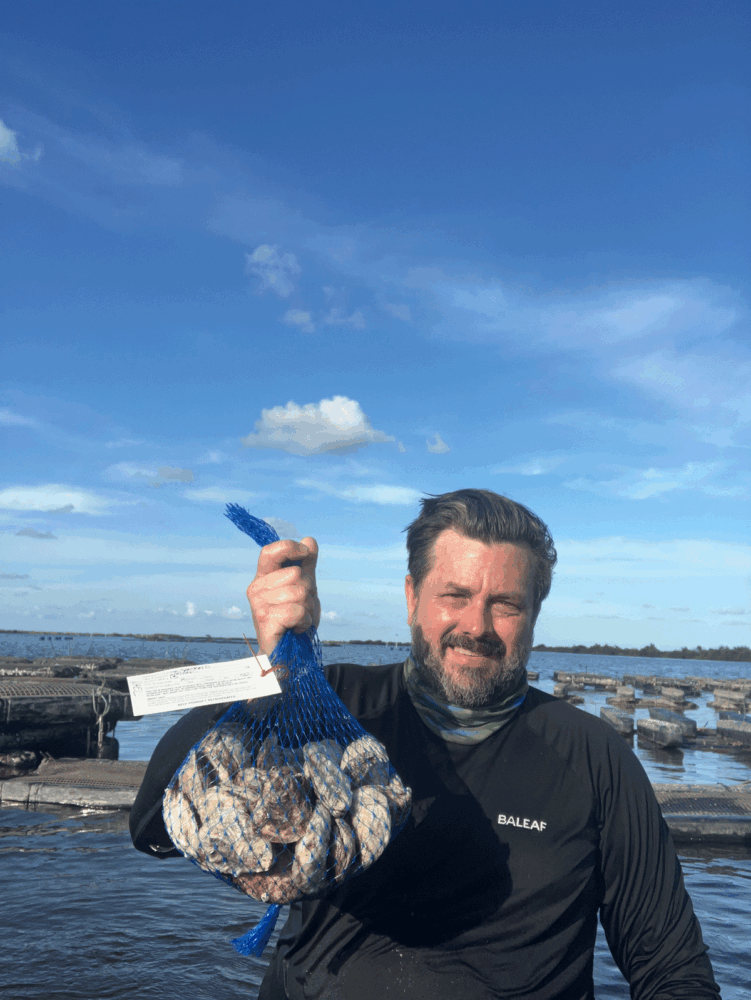
Justin Trosclair spends multiple eight-to-ten-hour days a week on his aquaculture oyster farm, Lady Nellie’s, to ensure his oysters reach ideal shape and size.
Editors’ Note 9/8/2025: A previous version of this article erroneously referred to a “Barataria Spillway.” This does not exist. That version also claimed that oysters thrive in “the saltiest water possible.” This is not the case; Oysters thrive in brackish water with a salinity level between fourteen and twenty-eight parts per thousand. These two sentences have been removed for accuracy.
To know Justin Trosclair is to know his passion for food. When Justin develops a culinary interest—whether that’s artisanal cheese-making or off-bottom oyster farming—there is no halfway. As his mother, Peggy Trosclair, said, “He has to do everything perfect.”
Justin grew up in Marrero, Louisiana, on the West Bank of New Orleans, where he developed an interest in food at a young age. Justin was a good student and an avid reader. School came easily to him, which left plenty of time to pursue his own interests. His mother recalls watching cooking shows on the Food Network with Justin, and him wanting to try the recipes as soon as an episode ended. His father, Terry Trosclair, remembers one weekend when Justin, still a kid, had been left to his own devices and wound up making cheese, smoking meat, and crafting a lasagna that Terry described as “awesome.”
The first Trosclair ancestors to emigrate to North America, Johann Georg and Marie Madeleine Troxler, moved from Alsace, Germany to the Lower German Coast (present-day St. Charles and St. James Parishes) of Louisiana in the early 1720s. Their descendants moved upriver to the Acadian Coast (present-day St. James and Ascension Parishes), and southwest into the bayous of Lafourche and Terrebonne Parishes, where they intermarried with Cajuns and the family name was gallicized to Trosclair.
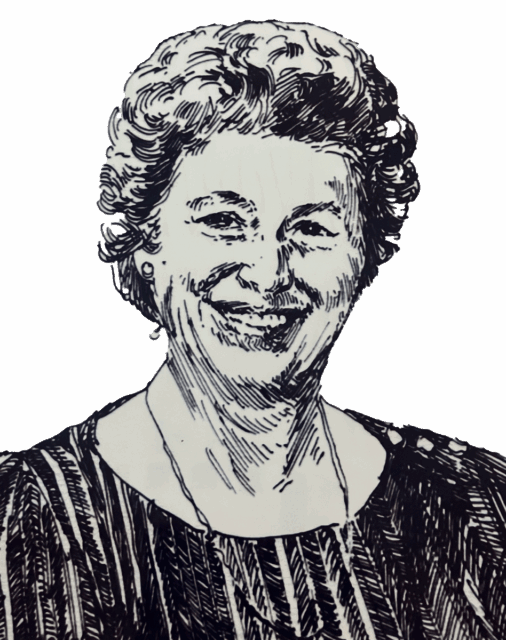
Justin Trosclair’s aquaculture oyster farm is named for his maternal grandmother, Nellie Trosclair. Courtesy of Lady Nellie Oyster Farm
Generations later, Bennie and Nellie Trosclair, Justin’s Cajun paternal grandparents, raised their family of six children, including Justin’s father, Terry, in Marrero. Bennie Trosclair began working on the water trawling for shrimp when Terry was an infant, and most of his kids tried their hand at the family business, with Terry and his brother Keith taking it over full-time for several years after Bennie retired. Bennie named his shrimping boat “Lady Nellie” after his wife, a family legacy Justin carries on with his Lady Nellie Oyster Farm. Nellie herself was a renowned home cook, famous for her chicken gumbo with sausage and hot dogs, even winning several Times-Picayune recipe contests for her original creations.
Working on the water is in Justin’s blood, and he descends from a long line of men who work hard and prefer to work for themselves. From the age of fourteen, Terry recalls spending his entire summer on trawl boats, from the day school let out to the day it was time to go back. Terry described it as some of the hardest work imaginable, often requiring shrimpers to stay awake for thirty-six to forty-eight hours at a time. Terry said, “When the boat leaves the dock, in a lot of cases, the motor don’t stop till you get back home, which could be anywhere from eight to twelve days. You work day and night, and there are times you virtually fall asleep standing up.” It’s not for most people, but he insisted, “I wouldn’t change my days on water for nothing under the sun.”
“Water to me is like air for most people. I can’t stand to be away from it.”
Justin remembers being out on his dad’s trawl boat as a kid, heating up cans of ravioli on the uncovered engine, and being fascinated by all the bycatch that would come up with the shrimp on the sorting deck: sting rays, sharks, Gulf toadfish fish with their hard jaws. He also has many happy childhood memories of going fishing with his dad, sprawled out on the boat, reading his Hardy Boys books. Nowadays, whenever he’s stressed, he imagines himself in one of his favorite Louisiana fishing spots to soothe his nerves.
Although Justin’s current devotion is off-bottom or aquaculture oyster farming, his first culinary passion was cheese. After Hurricane Katrina, Justin moved to Colorado and started working at Haystack Mountain Creamery, where he became their head cheesemaker and won an American Cheese Society gold medal for one of his artisanal goat milk cheeses in 2008. Upon returning to New Orleans, Justin worked as the cheese monger at St. James Cheese Company for eight years, during which time he traveled to Italy, France, England, and all over the United States to deepen his knowledge and expand his palette. He competed in the Mondial du Fromage in the Loire Valley in France in 2015 and won The Cheesemonger Invitational in New York City in 2013.
After a brief stint in Georgia, Justin returned to Louisiana in 2019 and took over his father’s Little Debbie delivery route, a stable job with reliable income. However, he couldn’t shake the idea that he wanted to start something of his own, more closely related to his love of sharing excellent food with his local community. After consultation with his fishing buddy Ryan Anderson, founder of Little Moon Oysters, an aquaculture oyster farm in Grand Isle, Louisiana, Justin bought his first round of oyster seeds and put them in the water in Lafourche Parish in July 2023. His first crop of oysters was harvested in December 2023, and this year, Justin hopes to almost double his count, with an estimated crop of 120,000. Justin’s farm is still small—by comparison, Little Moon Oysters, founded in 2022, is averaging over 300,000 oysters per year—but he is anticipating continued growth until he reaches a crop of 200,000 oysters.
Justin sells his delicious, plump, and briny oysters through multiple avenues: direct home delivery to clients for personal consumption or private events, wholesale to bars and restaurants, and at pop-up events in New Orleans. He was also paid the honor of being a vendor at Jazz Fest this spring, receiving a rave review from local food critic Ian McNulty and selling 23,000 oysters over the span of the festival. McNulty joined the hordes of Justin’s repeat customers in praising his signature fresh-squeezed citrus mignonette sauce, which is so good that many people slurp down what’s left in the cup.
Traditional oystering dredges oysters from the bottom of the seafloor. Off-bottom oyster farming was developed as an alternative method. Oysters raised on aquaculture farms are grown in cages that float in the top third of the water column; this happens to be where the greatest amount of algae and phytoplankton live, so they can catch the sun’s rays for photosynthesis. Off-bottom oysters thus have an abundance of nutrient-rich food, which contributes to their particular umami taste.
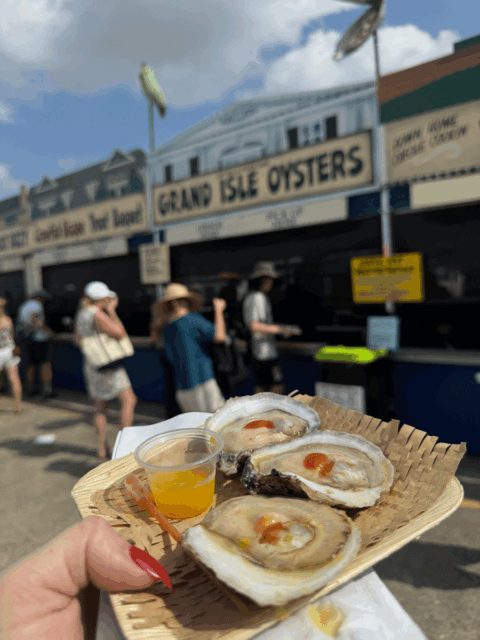
Lady Nellie’s Oyster Farm was among the favored new vendors at Jazz Fest in 2025, earning praise from food critics. Photo by Alexandra Kennon Shahin
Jules Melancon brought off-bottom oyster farming to Grand Isle in 2012 following the 2010 BP Deepwater Horizon oil spill, which destroyed the region’s traditional oyster beds. The off-bottom farming practice had been cultivated on the East and West Coasts of the United States as well as in Japan, New Zealand, and Australia, and has become increasingly popular not only because of the delicious, consistent oysters it produces, but also due to its net positive impact on the environment. Oysters’ filtration is excellent for waterways, and oysters reduce carbon in the atmosphere by sequestering nitrogen and carbon from the air to produce their shells.
Because off-bottom oysters grow faster than traditional oysters, it is a labor-intensive process for farmers like Justin and Anderson to produce the shape and size of oyster they want to bring to market for raw consumption. Left unattended, oysters will continue to grow in length, and their shells will become coated with bumpy barnacles. Justin’s ideal oyster is short and fat with a smooth, deep cup, and a flat top, with its hinge joint running parallel to the top so it’s easy to shuck. Justin and Terry spend multiple eight-to-ten-hour days on the farm every week, tumbling the oysters to prevent linear growth, sorting the oysters by size and splitting them off into separate cages to maintain consistent cage weight, and cleaning the cages to remove algae and barnacles through manual scraping and pressure washing. Harvesting oysters requires turning each cage out onto a platform, selecting which ones will go to market, pressure washing, and bagging them. Anderson emphasized the direct handling of off-bottom oysters as one of the qualities that makes them unique, estimating human hands touch each oyster six to ten times before it’s brought to market.
Justin’s oysters survived the abnormal snowstorm of January 2025, but Anderson said all the aquaculture oyster farmers got wiped out after Hurricane Ida in 2021. “Every year is a little gamble,” said Justin.
Despite the grueling work and the unpredictability of the environment, Justin, Anderson, and the cohort of small aquaculture farmers like them—including Nathan Herring with Bright Side Oyster Company, Albert Besson with Barataria Beauties Oyster Company, and Nick Waguespack with Wild Isle Oysters—are continuing a long tradition of nourishing the South Louisiana community with the bounty of its coastal waters. Anderson described the work as purposeful, and as the grandson of an oyster farmer himself, he is happy to be carrying on a family legacy.
As for the Trosclair legacy, Justin and Terry have been working together since Justin was fifteen, helping his dad with his delivery route. These days, they relish their time on the water together. Terry said, “Water to me is like air for most people. I can’t stand to be away from it.” Justin feels similarly. He is deeply invested in sustainably growing Lady Nellie Oyster Farm as an expression of his love for Louisiana. Anderson noted, too, how special it is to see people taste an oyster he has grown from seed, an experience many types of farmers never get. Terry put it this way: “It almost reminds you like raising children. We take these little bitty seeds, and we raise these oysters. It’s been a beautiful thing.”
Amelia Parenteau is a writer, French-to-English translator, and theater-maker based in Washington, DC. Her writing has appeared in American Theatre Magazine, Atlas Obscura, BOMB Magazine, Thrillist, and others.
