Magazine
New Orleans Noir
James Sallis’ The Long-Legged Fly
Published: September 1, 2026
Last Updated: September 1, 2026
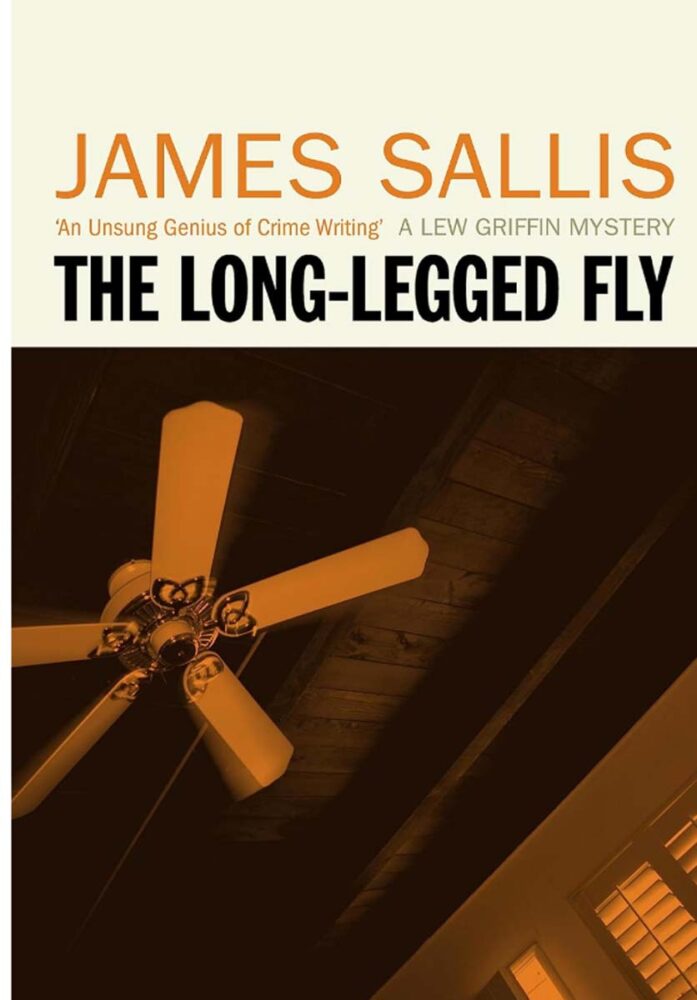
No Exit Press, 1996
If Los Angeles has Philip Marlowe, San Francisco Sam Spade, and New York the duo of Coffin Ed Johnson and Grave Digger Jones, then the New Orleans of noir literature surely belongs to Lew Griffin.
Star of a six-book series by James Sallis, who died earlier this year at the age of eighty-one, Griffin made his first appearance in 1992’s The Long-Legged Fly, a baffling, begrimed piece of feel-bad postmodernist detective fiction that is captivatingly fun to read. “What might have resulted if Raymond Chandler and Samuel Beckett had collaborated on a detective novel,” Sallis told the New York Times in 2001. Private investigator Griffin specializes in lost-persons cases and in losing himself to alcohol. He’s a high-functioning drunk—perhaps one of the highest in literature—and over the course of the book takes on four investigations, beginning in 1964 and episodically spread over the next three decades.
We first meet Lew stumbling into his office. It’s been a rough week. Whitney Bank account overdrawn. Father dying in a Memphis hospital. Cadillac impounded. And he just knifed the perp at the center of his last case. Ahh . . . but he’s left a half-filled tumbler of bourbon on his desk, a housefly bobbing in the booze.
He heads for Joe’s, a Decatur Street bar that hands out free lunch to its regulars: chopped canned ham sandwiches and hard-boiled eggs—“heavy on the hard.” There he lines up double bourbons like dominos. “How many of these was it,” he thinks to himself, “that had killed Dylan Thomas?”
Even when he succeeds in locating his missing person, Lew never transcends his own limitations. This inveterate barfly ruins romantic relationships, loses his apartment, and ends up in a halfway house. But he keeps on buzzing.
A bookish gumshoe, Lew can quote the lyrical Welsh wunderkind, as well as Auden, Gide, and others that reveal Sallis’s high-art leanings. “New Orleans natives accent the first syllable and allow the entire word only two: So-crates,” Lew explains. “God knows what we’d do with Asclepius.”
The book’s title purportedly comes from a poem of the same name by W. B. Yeats. The brief, gilded splinter of verse comprises a trio of stanzas, each detailing the life of a misunderstood genius of history, each ending with the refrain: “Like a long-legged fly upon the stream / His mind moves upon silence.”
On a subsequent stop at Joe’s, Lew receives his next case: Corene Davis, a radical Black feminist activist modeled after Angela Davis. She boarded her flight in New York and never arrived in New Orleans. What unfolds is less procedural sleuthing than a meditative study on a man struggling to hold on as life’s eddies threaten to pull him under. Yeats’s refrain comes to mind.
Lew looks for answers in, of course, the bottle—chased with countless cigarettes and cups of black coffee, in true noir fashion. His hangovers are epic; they induce fresh metaphors. “My tongue felt like someone’s dirty glove,” Lew observes. “Little men with jackhammers and earthmoving machinery were rebuilding the inside of my head.”
Miraculously, Lew puzzles his way to a resolution. Davis has caused her own disappearance. Got hooked on the needle, changed her name, bleached her skin with whitening cream. On a stormy drive across the lake, he finds her checked into a psychiatric hospital—restrained, her face locked in a silent scream, her fingers working “at the air nonstop, like the legs of an overturned insect.”
Not one to celebrate, Lew wraps up the case with terse prose: “Outside, the rain had stopped. The night was black like me.”
In electing to make his lead character Black, Sallis, who was white, has been alternatively criticized and praised. His Lew is never stereotyped, never fetishized. He is, Sallis told the New York Times, “the perfect window to write about American society in the late 20th century.” His creation is also heavily indebted to the work of Harlem hardboiler Chester Himes. “I began writing, as I always do, from a single image, a sense of a character, trying to draw this shadowy person out,” Sallis told the Guardian in 2001. “I was many pages into [the book] before I realized that Lew was African-American. So I went back and started over.”
Born in Helena, Arkansas, in 1944, James Sallis lived a life as circuitous as Lew’s casework style. He followed his older brother, John, to Tulane University before transferring to the University of Iowa, where he dropped out on his way to becoming a writer. Along with reams of speculative and detective fiction, he published poetry, biographies, essays, criticism, translation, and musicology (he was a virtuosic jazz and blues guitarist). A recently published complete collection of his short stories runs a whopping 800-plus pages. He supported his peripatetic jottings by teaching creative writing classes and, for a large swath of his life, working as a respiratory therapist in neonatal trauma wards. A neon-soaked film adaptation of his 2005 neo-noir novel, Drive, starring Ryan Gosling, introduced his name to a wider audience.
But it’s the New Orleans–set Lew Griffin series—which includes Sallis’s debut novel and five entomologically titled sequels (Moth, Black Hornet, Eye of the Cricket, Bluebottle, and Ghost of a Flea)—that would become an object of cultish affection and would forever link him to the city. Over the years, he repeatedly returned to live here, and even donated his papers to Tulane’s archives. “Inasmuch as I have a home,” he confided in a 2007 interview with the Compulsive Reader, “New Orleans is it.”
The Long-Legged Fly picks up again in 1970, with Lew tracking down a teenage runaway, before skipping ahead to 1984 and the search for a friend’s sister. Even when he succeeds in locating his missing person, Lew never transcends his own limitations. This inveterate barfly ruins romantic relationships, loses his apartment, and ends up in a halfway house. But he keeps on buzzing. “We aren’t angels, Lew,” one love interest offers as words of succor. “Angels couldn’t breathe the air down here. They’d die.”
In the book’s final section, set in 1990, Sallis finally grants his character a bit of grace. Lew teaches French and writing classes at Dillard University, while publishing a moderately popular detective series featuring a Cajun private investigator implausibly named Boudleaux. But then, at his desk, he receives a call. His own son, a Columbia English professor conducting research in Paris, has vanished. The case proceeds in true Lew fashion.
Sallis offers a deconstructed swerve in the book’s concluding paragraph. Lew is now at work on a new detective series centered on an original character: himself, “a man I know both very well and not at all.”
“It is midnight. The rain beats at the windows,” Sallis and Lew write together, echoing countless noir novels past. “It is not midnight. It is not raining.”
Rien Fertel is the author of four books. He has been writing the Lost Lit column since 2017.