Winter 2025
Reclaiming Ancestral Land
Dr. Joy and Jo Banner of The Descendants Project purchase Woodland Plantation
Published: December 1, 2025
Last Updated: March 1, 2026
Courtesy of The Descendants Project
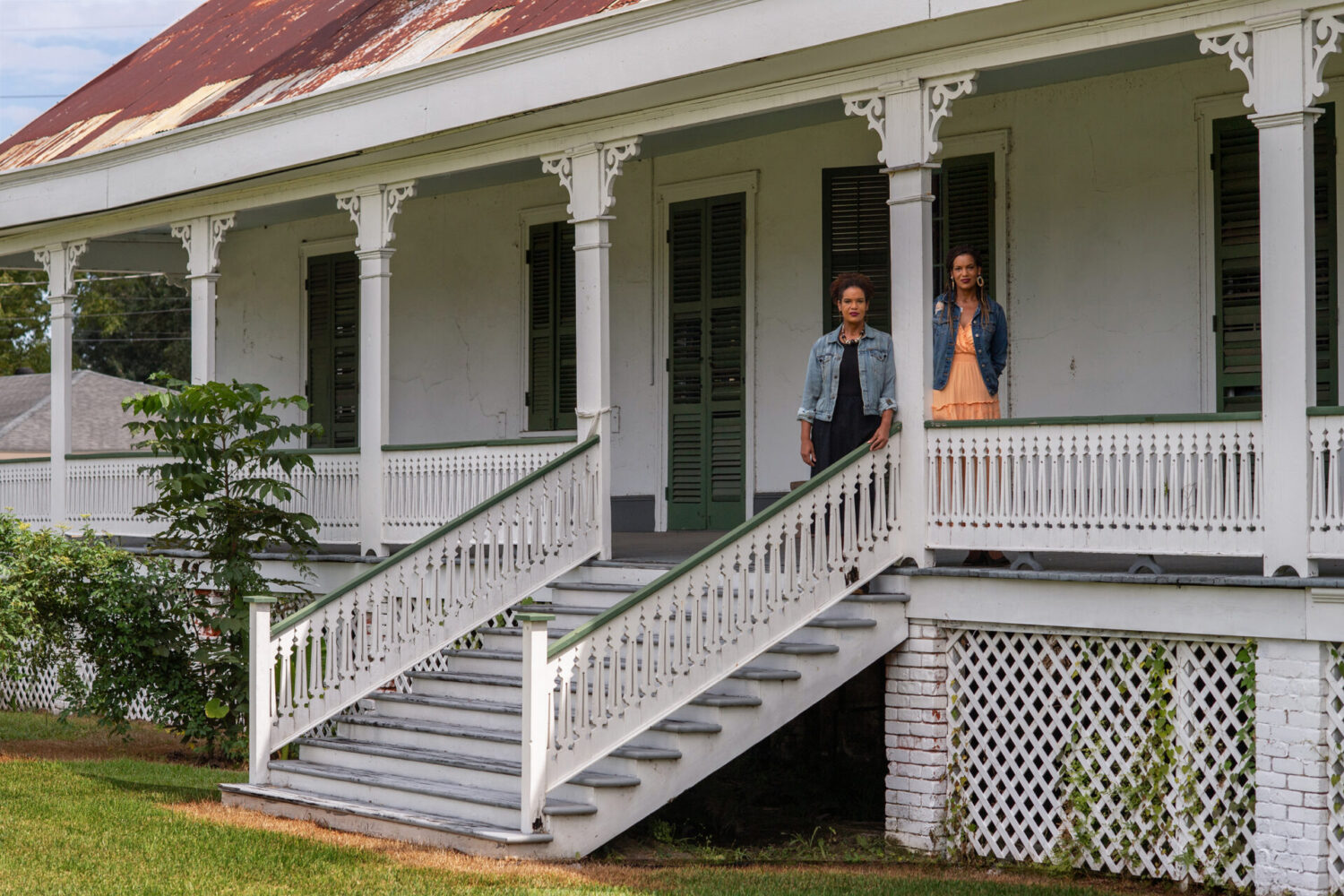
Descendants Project co-founders Jo and Joy Banner stand on the porch of The Woodland Plantation House.
On January 8, 1811, the largest slave revolt in North American history began at Woodland Plantation (formerly Andry Plantation) in St. John the Baptist Parish, led by multiracial enslaved driver Charles Deslondes. Historians estimate from varying eyewitness accounts that between one hundred and fifty and five hundred people participated in the rebellion, making their way down the Mississippi River towards New Orleans armed with cane machetes, axes, and other weapons; burning houses and recruiting additional enslaved people from other plantations.
During the early stages of the revolt, plantation owner Manuel Andry was wounded with an ax on the porch of his house, and his son, Gilbert, was killed. Jean François Trepagnier, owner of nearby Myrtleland Plantation, was also killed with an ax. In retaliation, Andry mustered a militia, supported by US military personnel, to suppress the uprising. At least forty rebels were murdered, with another forty-four tried and executed; their heads were cut off and placed on pikes along the Mississippi River as a warning against future uprisings.
In 2024, Dr. Joy and Jo Banner, through their organization The Descendants Project, purchased Woodland Plantation, making them the first Black owners of the property in its more than two-hundred-year history. “It was important for us to acquire Woodland to ensure that the history of the rebellion would be told and the house would be protected as a testament to resistance,” Dr. Banner said. “We also wanted to ensure that the house would be used to serve the local descendant community as a place of culture, heritage, education, and, most of all, healing.”
The Descendants Project is a nonprofit organization committed to uplifting the stories of the River Parishes’ African American and Creole descendants of those who were enslaved, as well as demanding action against social injustices. The project was founded in 2020 by the Banner sisters, tenth-generation St. John the Baptist residents descended from the first enslaved Africans trafficked to Algiers and the first wave of German immigrants to the area. The sisters were inspired to start the organization after working in local tourism for years and being frequently dissatisfied with how the stories of their enslaved ancestors were presented.
“We hope that our ancestors feel that we were able to obtain the liberation that they sought for themselves and future generations.”
“Our community of Wallace was established as a ‘Freetown’ community by people who self-emancipated, fought in the Civil War, and purchased land to establish their communities,” Dr. Joy Banner said. “Our neighborhood was founded by my great-grandparents over 125 years ago, and I grew up surrounded by my elders and extended family along the Mississippi River levee. I grew up listening to folklore and the stories of how my elders grew up. I learned about their foodways, customs, and cultural traditions.”

The Woodland Plantation House, built in 1793, was the site of the beginning of the 1811 Slave Revolt and the birthplace of early jazz trombonist Kid Ory. Courtesy of the Descendants Project
The Descendants Project has multiple initiatives that forward its mission to reclaim and regenerate the Black communities of Louisiana’s River Parishes. Besides facilitating intergenerational healing, The Descendants Project is making strides toward fighting factors of environmental racism still at play in their rural, majority-Black community, including help preparing for increasingly strong hurricanes from the Gulf. According to the Climate Vulnerability Index, St. John the Baptist Parish ranks first on the list as the area most vulnerable to climate risk in the United States. (Notably, half of the locations mentioned on the list are in Louisiana.) The Banners’ experience with Hurricane Ida inspired The Descendants Project’s Storm and Climate Resilience Hub. “After Hurricane Ida, we were practically alone for the first couple of days without access to water, power, groceries, and other necessities.” Dr. Banner said. “The Climate Hub will activate to provide instant support for people impacted by major weather events as soon as they happen. The hub will also be able to house volunteers who are supporting the community with recovery efforts.”
Through such community-support initiatives, The Descendants Project aims to be a healing vessel for ancestral veneration. Currently, the organization, along with Inclusive Louisiana, is suing Formosa Plastics to attain full access to the Buena Vista Plantation cemetery for enslaved people; demand the company release its ownership of the cemetery; and gain permission to place headstones at the burial sites.
“We hope that our efforts inspire a new vision of our community—processes, economy, and political leadership that uplifts the well-being of the community, especially the reduction of pollution and the preservation of history,” Dr. Banner said. “We are working to create a new infrastructure that demonstrates that healthy and sustainable small businesses are more beneficial for our communities rather than extractive industries.”
For the next two years, The Descendants Project plans to focus on reclamation, restoration, and environmental justice, which includes a contemplative garden called the Liberation Labyrinth, co-created with the Midlo Center for New Orleans Studies and Design Jones. “The Descendants Project worked with a community advisory committee to work with landscape architect Dianne Jones Allen to create three different designs for the community. We invited the community out to review the designs and offer their input to incorporate into the design,” Dr. Banner said.
Liberation Labyrinth, which the Banners are hoping to actualize by 2027, will serve as a memorial space for community members to share and enjoy historical photographs, documents, and artifacts, and to grasp what Black freedom meant to the enslaved. They wish to honor Native peoples, enslaved gardeners, Maroon communities, Union soldiers, and the founders of Freetowns, churches, schools, and their ancestors, while highlighting the Mississippi River’s pre-colonial landscape. “We had an archaeological dig on the site to possibly identify artifacts and built structures within the landscape. Dianne Jones Allen is an expert on maroonage and freedom seeking,” Dr. Banner said. “The Labyrinth is an extension of the story of enslaved men, women, and children who sought liberation in community with the Louisiana landscape.”
The Descendants Project requests that residents of the west bank of the Mississippi River digitally share photos and artifacts via an online form. These could include items related to family reunions, picnics, Wallace and Edgard Rosenwald Schools, levee protests, hunting and fishing, and people in their yards.
“We hope that our ancestors feel that we were able to obtain the liberation that they sought for themselves and future generations. Despite the events of the rebellion and the brutality of enslavement, the [Woodland] plantation house feels peaceful,” Dr. Banner said. “We feel connected to the site. We hope that visitors do as well.”
Quinn Foster is a proud Louisiana Creole living in Lafayette. He is a self-taught harmonica player, music artivist, Creole Traiteur through lineage and practice, community cook, and loves to travel and learn about his culture and other cultures.