Saving the Last Dance
Technology offers new potential for preserving Louisiana dance halls
Published: August 29, 2025
Last Updated: December 1, 2025
Utah Valley University Digital Media
A new project is preserving historic dance halls like La Poussiere in Breaux Bridge via technology like visual and audio mapping.
Alas, not every relic of the past can be saved. Historic buildings especially present difficult questions of triage: when is the war against termites, damp, and time lost? When are the resources put into one site more usefully reapportioned to places with a better location, less damaged foundation, more important historical paper trail? Louisiana dance halls, which everyone loves and almost no one can afford to repair and run, are a prominent local example. They dot the landscape of the state, and while some still thrive, many are derelict, and the only thing more heartbreaking than their eventual ruin is the thought of the contractors’ estimates. Fortunately for history enthusiasts and their consciences, advances in audiovisual recording technology offer the possibility of changing the definition of conservation.
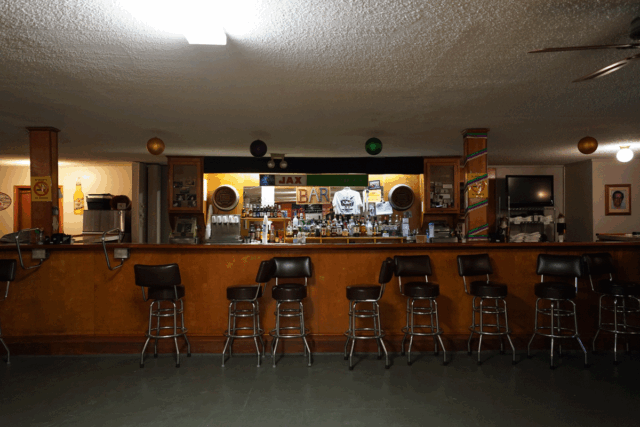
Jason Church, the chief of technical services at the National Park Service’s National Center for Preservation Technology & Training (NCPTT, headquartered in Natchitoches), accepts that a building must, in his words, “work for a living” as an active venue or historical site. If a notable building faces demolition or collapse, and rescue is not a realistic or feasible option, preservationists like Church can enter the site to create a 3D model of the space. Cameras with 360-degree visibility take detailed visual images and laser and GPS readings. The operator then moves the camera, the process repeats, and the software uses its mapping data to stitch the images together into a detailed visual model that users can then navigate within. (Church uses a suite called Matterport, but there are other, broadly similar programs on the market.) Recently, Church made an internal model of Bradford’s White Eagle, a former dance hall in Opelousas that he described as scheduled for demolition, but that may simply fall down in the interim. Eighty-one scans later, the interior of the building is preserved, down to an empty, wistful beer bottle on the bar. Other scans or drone photography of the exterior of the building complete the model. The Matterport virtual model can then have clickable links, sound files, images, or other media attached at different points, allowing users to explore the history and culture associated with the site.
If a notable building faces demolition or collapse, and rescue is not a realistic or feasible option, preservationists like Church can enter the site to create a 3D model of the space.
As visual as human beings are, however, most people didn’t go to old Louisiana dance halls just to look at them. These were and are venues for dancing to live music—neck and neck with Tabasco as Louisiana’s most cherished export—and technology is also exploring ways to capture the soundscapes of Louisiana dance halls. A recent project by students and faculty of Utah Valley University (UVU) recorded visual data and soundscapes from one active venue, La Poussiere in Breaux Bridge; and one inactive space, Hamilton’s Place in Lafayette, which is no longer a business but is still used by the Hamilton family for private events.
Bryan Sansom, a UVU assistant professor of digital media and digital audio, explained that the existing relationship between UVU and the NCPTT led him to think about ways to add a sonic component to visual digital preservation mapping. In some ways, the basic concept is similar: an array of sensitive microphones, sticking out like hedgehog bristles to capture sounds from various angles, is placed in the room. These mics record ambient noise as well as the results of sonic “sweeps,” in which the equipment emits rising and falling tones and uses their echoes to create data on how the geometry of the room affects sound waves. Sansom and his team also invited local musicians to play in the spaces to capture the room’s audioscape during a performance, with Corey Ledet playing at Hamilton’s Place and Chris Segura and Drew Simon performing in La Poussiere. Ledet’s performance was the first live music played in Hamilton’s Place since its 2005 closure.
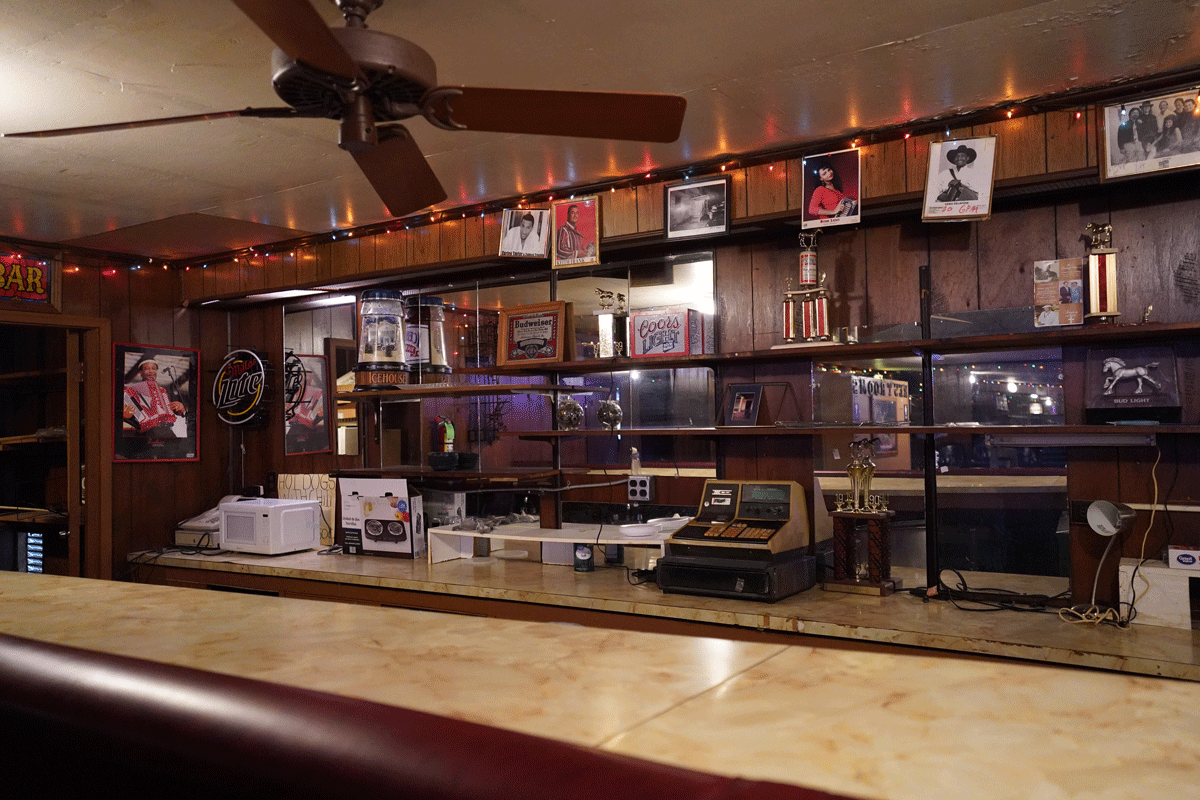
A glimpse behind the bar of Hamilton’s Place dance hall in Lafayette. UTAH VALLEY UNIVERSITY DIGITAL MEDIA
Per Sansom, audio scans of this type present technical challenges more intense than visual scans. The scans create gargantuan amounts of data that require titanic amounts of processing power to render into a format people without specialized equipment can use. One common and frustrating issue is lag, resulting in audio that doesn’t align with the visual data. Nevertheless, the data have been captured, and as computer processing abilities advance, they can be brought to bear on treasure troves like the scans of Hamilton’s Place and La Poussiere.
Sansom described the visit to Louisiana—his first—as a cultural baptism by fire, but he and his colleagues were in the more than capable hands of Pudd Sharp, the assistant director for research at the Center for Louisiana Studies at the University of Louisiana at Lafayette. Sharp is also a dance hall researcher and aficionado who curates the online depository of dance hall data at louisianadancehalls.com. Sharp approached the owners of La Poussiere and Hamilton’s Place to get their buy-in on the project, winning over an initially skeptical Hamilton family by explaining the technology and its applications for local preservation. (Family members later sat for interviews about the history of the site and their family’s connection to it.) Sansom commented repeatedly on the friendliness of the local stakeholders with whom he interacted, as well as the strange (to him) beauty of the swampy landscape and the eeriness of driving to Lafayette from New Orleans through a thick Atchafalaya fog.
Some of the interactive visual scans Church is creating will find a home at the emerging Louisiana Music Trail initiative of the Louisiana Department of Culture, Recreation, and Tourism, which will allow online visitors to explore key places and artifacts from Louisiana’s musical culture. Meanwhile, visitors to the physical sites can access multimedia through QR codes. Sansom predicted the creation of plugins that would allow musicians to overlay the sonic landscapes of various venues, allowing the production of music “as though played at La Poussiere.” This could even be joined with the visual data to create virtual concert videos, creating the opportunity for artists to perform in spaces they cannot book, either for logistical reasons or because the venue is no longer in operation.
These were and are venues for dancing to live music —neck and neck with Tabasco as Louisiana’s most cherished export —and technology is also exploring ways to capture the soundscapes of Louisiana dance halls.
As with most bleeding-edge innovations, ethical considerations of this archival strategy have begun to emerge. To take one example: to whom does the soundscape of a place like Hamilton’s belong? If a musician uses an overlay like the one Sansom predicts, will they—and/or should they—owe payment and credit to the Hamilton family? To the technicians who created the software filter? And do these considerations change if public or nonprofit money is used to gather the data? The ethics and etiquette around these and similar innovations are still developing—the context of iffy AI regulations and Big Data clouds enthusiasm even when the work is carried out by well-intentioned people with admirable goals.
While the technology and potential applications of such recordings are exciting, they don’t—and can’t—wholly capture the dance halls because they don’t capture the audiences. Fiddler Chris Segura pointed out that, while he’d enjoyed the experience of performing for the mics, the many dance halls still active in Louisiana are seldom, if ever, host to recital-hall style concerts like those the musicians created for the recordings. Instead, the venues host crowds of dancing, hooting, stomping revelers, who change the acoustics both by the simple physics of their bodies and by their enthusiasm. (Segura described the sound of a dance-hall audience as “loud as all get-out.”) The human energy is what completes the experience.
Perhaps for this reason, Church is not worried that virtual versions of surviving sites will keep people from visiting in person. Recordings capture and preserve information, and maybe the most advanced will permit the creation of replicas—but so far, there’s nothing like being in the crowd yourself.
Chris Turner-Neal, the former managing editor of 64 Parishes, is a writer and editor living in Buenos Aires.