Magazine
Screen Box of Fireflies
The “Intermittent Lightning” of Sheila Bosworth’s Almost Innocent
Published: March 1, 2026
Last Updated: June 1, 2026
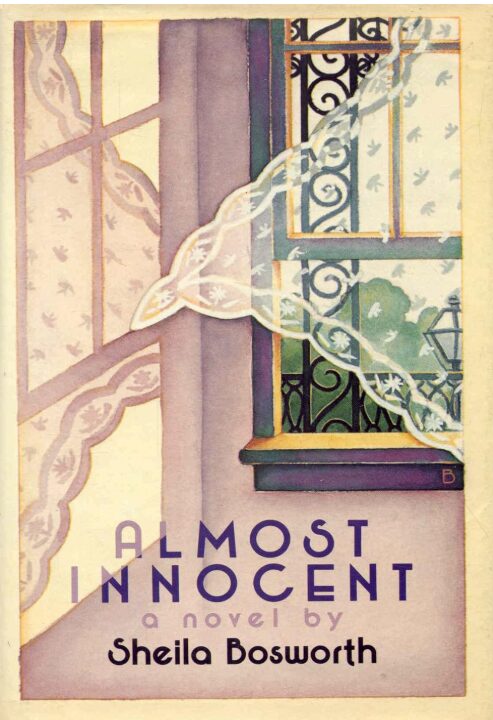
Simon & Schuster, 1984
People need each other, they’re made that way,” the German filmmaker Rainer Werner Fassbinder wrote. “But they haven’t learnt how to live together.”
No truer words could be said of Sheila Bosworth’s Almost Innocent, her heartbreakingly tragic and sneakily wry 1984 novel. The chronicle of a crumbling marriage in 1950s New Orleans, Bosworth’s debut tells the story of Rand and Lamb, a perfectly imperfect couple—note the slant rhymes of their names—products of Uptown New Orleans with disparate fortunes and fates.
Rand Calvert is a pipe-smoking, moth-eaten-sweater-wearing artist, the last in line of a long-squandered cotton fortune—a ne’er-do-well, in other words, content to fiddle with his paints and clay, as long as he can keep his family waiter at Galatoire’s.
He falls in love with Constance “Lamb” Alexander the night she, the daughter of a state supreme court justice, rules as Queen of Comus. She’s the type that “made people want to take her in their arms.”
Rand does exactly that, despite the objections of Justice Alexander. “The man’s a goddamned Communist,” Lamb’s father rails. “In addition to that, he’s an idler, with swamp gas in his blood.”
Swamp gassy or not, Rand has the chutzpah to rope his sweetheart into an elopement. The couple is forced to drive all the way to Selma, Alabama, to find a marrying judge that doesn’t recognize her family name and, in deference to her father, refuse to sign their matrimonial license.
Her father surrenders, but a few weeks later, after receiving news of his daughter’s pregnancy, he starts “howling like a Catahoula hound that had lost the scent of the hogs” before dropping dead. Owing to gambling debts, his estate is worthless, his lawyers delicately inform Lamb. Humiliatingly, she is forced to sell the family home to a “big gold buckle”-wearing parvenu from Texas, whose wife plans to—horror of horrors!—lower the ceilings and install central air. The newlyweds resort to slumming in Rand’s drafty shotgun double on Camp Street.
Their shared life, narrated in flashbacks by their daughter, Clayton-Leland “Clay-Lee” Calvert, proceeds exactly as unplanned. At first “there was about them that enviable air of two people whose chief pleasure lies in one another, for whom everyone, everything else, is only a diversion.”
Almost Innocent was an immediate hit. National newspapers lauded praise. Local bookstores rushed through copies. The Times-Picayune printed rumors of a movie adaptation.
Straight out of a Tennessee Williams play, Lamb relies on the kindness of strangers, a cast of characters who fill out the novel with biting humor. There’s Felicity Léger, her cousin and closest confidante, who missed out on reigning as Queen of Carnival after she couldn’t fasten the waist of her ballgown around her swollen belly. Felicity’s mother-in-law, the regal Lady-Sidonie, acts as godmother to the neglected Clay-Lee, bequeathing the young girl a cabin in Covington, perched along the Bogue Falaya River, named Rosehue. Over time, the Covington house becomes a respite and retreat from her parents’ downward-spiraling relationship.
Most memorable is Rand’s uncle Clement, a rascally sugar plantation owner who is chauffeured around the city via limousine. His charming nickname, Uncle Baby Brother, belies his many sinister intents. “Whiskey-scented sweat rose off him,” Clay-Lee observes, “like incense at a Satanic Mass.”
Uncle Baby offers Rand a devil’s bargain: an executive position, plus stock options, in the sugar business, and—with a few pulled strings—admittance to the Academy of the Sacred Heart for Clay-Lee, with full tuition paid through her senior year. Rand can’t help but accept, explaining his decision as a paradoxical life lesson to his daughter: “What I’m getting ready to do now is to spend our freedom in order to acquire money.” Despite how the old song goes, after relinquishing his freedom, it turns out Rand has plenty left to lose.
Almost Innocent was an immediate hit. National newspapers lauded praise. Local bookstores rushed through copies. The Times-Picayune printed rumors of a movie adaptation. Walker Percy, New Orleans’s then blurber-in-chief, compared Bosworth to Henry James, gushing that she had written “a remarkable first novel . . . a lovely achievement, a superior one.”
Bibliophiles of a certain Uptown milieu, it seems, were less interested in literary merit and more absorbed in deciphering which characters were drawn from their friends, neighbors, and fellow law firm partners. Nell Nolan, then as today the Picayune’s society columnist supreme, wrote that the novel “has legions flipping pages and looking for any roman a clef connections.”
Bosworth herself noted that though the novel was not autobiographical, many of the scenes were drawn from her life. Her follow-up, Slow Poison, released in 1992, expands on the themes of the first: gnarled family dynamics, the terrors of youth, the pressure cooker that is New Orleans, and the release the city’s exurbs might bring.
Decades later, Almost Innocent remains both outdated—the unquestioned privilege and casual racism of its characters is very much of its time—and universal. This is a story of bad decisions made and the ideals those choices betray. More than one lamb, innocent or not, is led to the slaughter. People crash cars and planes, die in child birth, and choke on a bay leaf and keel over at the dinner table—a truly only-in-New Orleans way to go.
This is Rien Fertel’s thirty-fifth consecutive Lost Lit column.
