Magazine
Second Sight
Poets Darrell Bourque and Peter Cooley write through vision loss
Published: September 1, 2026
Last Updated: September 14, 2026
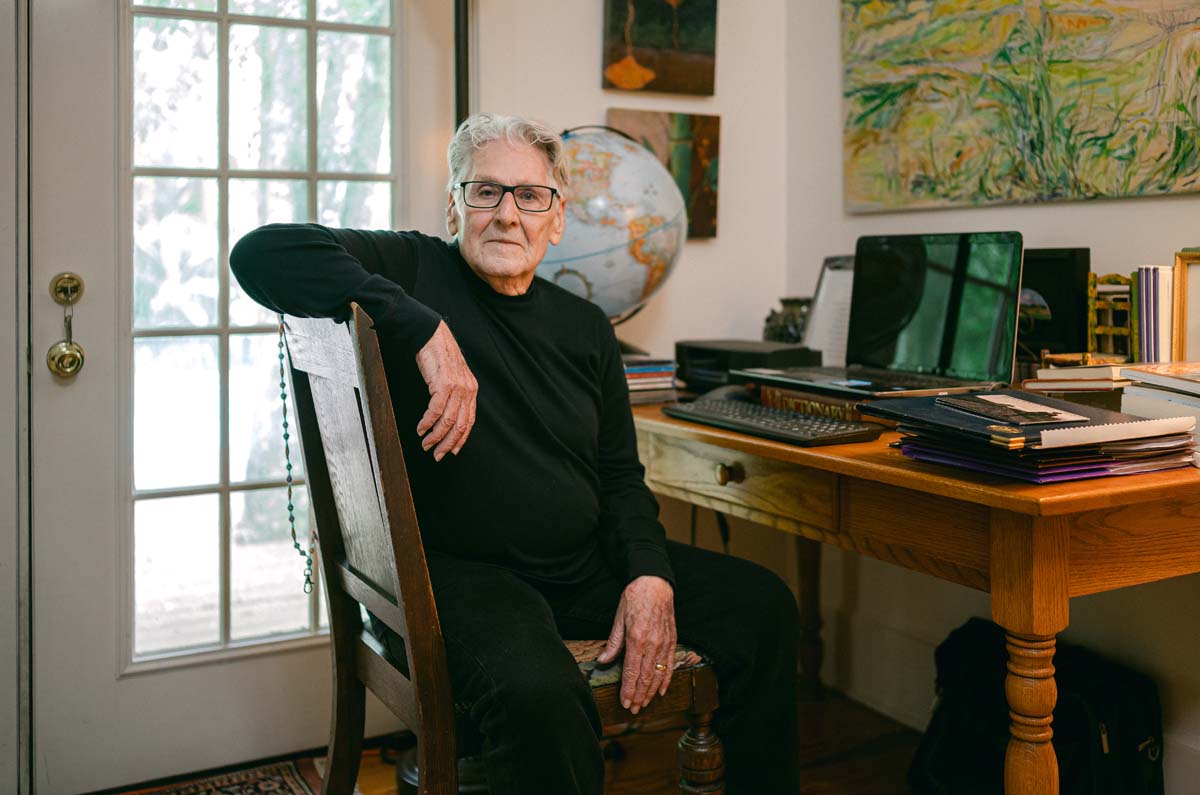
Photo by Katie Sikora
Poet Darrell Bourque at his desk in his family home near Church Point, Louisiana.
For years, Louisiana has had a special relationship with its poets: not only is the Pelican State blessed to have a great many of them living and working here today, but our state infrastructure also supports the writing and sharing of poetry in dynamic ways. Book festivals abound in our cities and parishes, MFA programs provide a home for teachers and budding practitioners, and in contrast to other states like Mississippi, the tenure for a poet laureate in Louisiana is only two years long, which has led to a proliferation of former laureates still actively writing and publishing.
In a strange twist of fate, however, in recent years two of these former laureates—Darrell Bourque and Peter Cooley—have begun to suffer from the same visual ailment, known as acute macular degeneration (AMD). AMD typically involves a slow loss of vision in one or both eyes over time. Spots appear on the visual field, peripheral vision begins to decay, and cloudiness and eventually total opacity sets in. Though certain treatments can stabilize the condition for a time, as yet there is no way to reverse it.
Writing in Quiet Days in Clichy, the novelist Henry Miller once observed that “For an artist bad situations are just as fertile as good ones, sometimes even more so. For him all experience is fruitful and capable of being converted to credit.” Both Bourque and Cooley have shown remarkable courage as they have grappled with this change, continuing to work through it and even allowing it to inform their creative work in unexpected ways. Bourque and Cooley are in good company: among those who have experienced the loss of their vision are some of the most celebrated writers in history, from Homer to John Milton to Jorge Luis Borges.
This summer, both poets graciously agreed to go on the record for the first time about their shared condition, speaking to 64 Parishes about this new chapter of their lives.
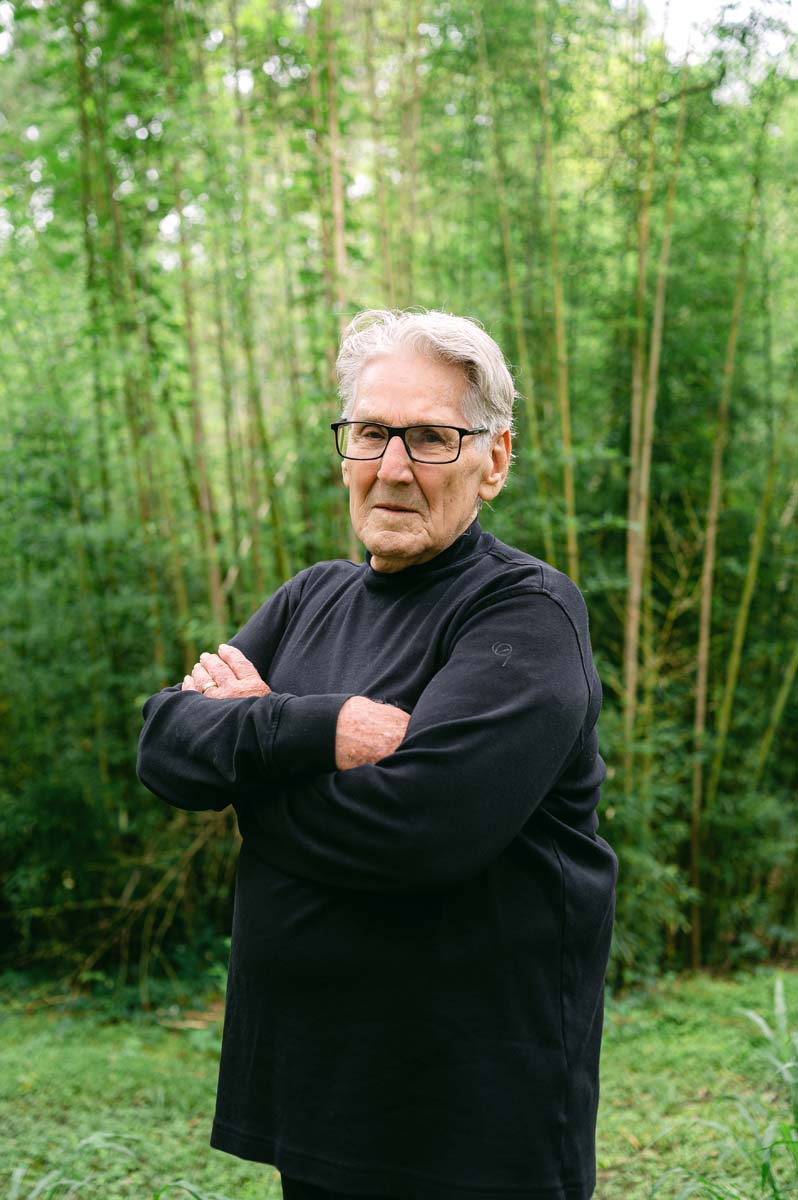
Darrell Bourque outside of his family home near Church Point, Louisiana. Photo by Katie Sikora
Darrell Bourque
Bourque, poet laureate from 2007–2011, first started experiencing symptoms in his left eye about six years ago. With no family history or prior indications of AMD, the condition came as a surprise; at this point, he has lost peripheral vision in the affected eye, has difficulty discerning shapes, and takes extra time to navigate through rooms with varying light levels. Retinologists administer shots to help stabilize his remaining vision, but the prognosis of diminishing returns remains the same.
A lifelong reader, Bourque said that the moment that his condition truly sunk in was in the middle of reading the novel Apeirogon by Colum McCann, about the Israeli–Palestinian conflict. “I had fallen in love with this story,” Bourque said—eventually writing his own work inspired by McCann’s novel, published in the collection Until We Talk—“but I realized I was reading a physical book for the last time.” From that point on he began to rely more heavily on Audible, as well as switching to reading and writing on his phone, whose light levels are more conducive to his vision than a computer’s.
Bourque’s peers attest that he is famously disciplined as a writer, at his peak spending upwards of five or six hours per day at the desk, whether in writing, reading, correspondence, or research. Events in recent years have slowed this productivity down slightly—both the vision loss and his duties as a caretaker for his wife, who suffered a stroke last year—but ever the driven soul, Bourque has found new ways to take in his daily diet of literature. He still receives regular poetry updates from the Academy of American Poets and the Poetry Foundation, and still reads as much as possible in the quiet hours of the early morning, when the light is good and the house is calm.
“Because my ancestry involves exile, that kind of generational memory is fascinating to me. Unlike Beausoleil Broussard I’ve never seen the land that was Acadie—but sometimes the things that you can’t see are what generate the work.”
It’s often said that when one of the five senses fails, the others become more acute to compensate. Bourque notes that he has experienced some of this phenomenon in hearing and touch, but the sense that has been most awakened in recent years is one more precious still: memory. Journeying deep into the past has become a more active pursuit; he draws on it like a reservoir. “There is memory that we were participatory agents in,” Bourque observed, “and then there’s historical memory—and I find myself increasingly interested in what shaped us from the 1830s to the 1900s. Because my ancestry involves exile, that kind of generational memory is fascinating to me. Unlike Beausoleil Broussard I’ve never seen the land that was Acadie—but sometimes the things that you can’t see are what generate the work.” Naming Dante and Ovid as fellow exiles, he added: “Sometimes the not-seeing is what activates the imagination—the handicap is what unbuckles the genius.”
Bourque’s own output has continued to grow, with a new volume of poems inspired by the life of Russian dissident poet Anna Akhmatova appearing next year from University of Louisiana at Lafayette Press. He also continues to support the nonprofit organization Narrative 4, a story-exchange initiative for young people that teaches listening, storytelling, and cultural cross-pollination, and despite his vision loss he still buys print books to support his fellow writers. He credits the rich community of Louisiana poets for keeping him engaged and active despite his condition. “We have these strong centers of writing all around the state,” Bourque said, “and they all work together. There’s a recognition of what each other is doing, and such a high premium placed on empathy and compassion.” No matter what new challenges come his way, he says, he knows that his peers will be there to lift him up.
In Louisiana, Bourque says, writers are more than just colleagues: “We’re a family.”
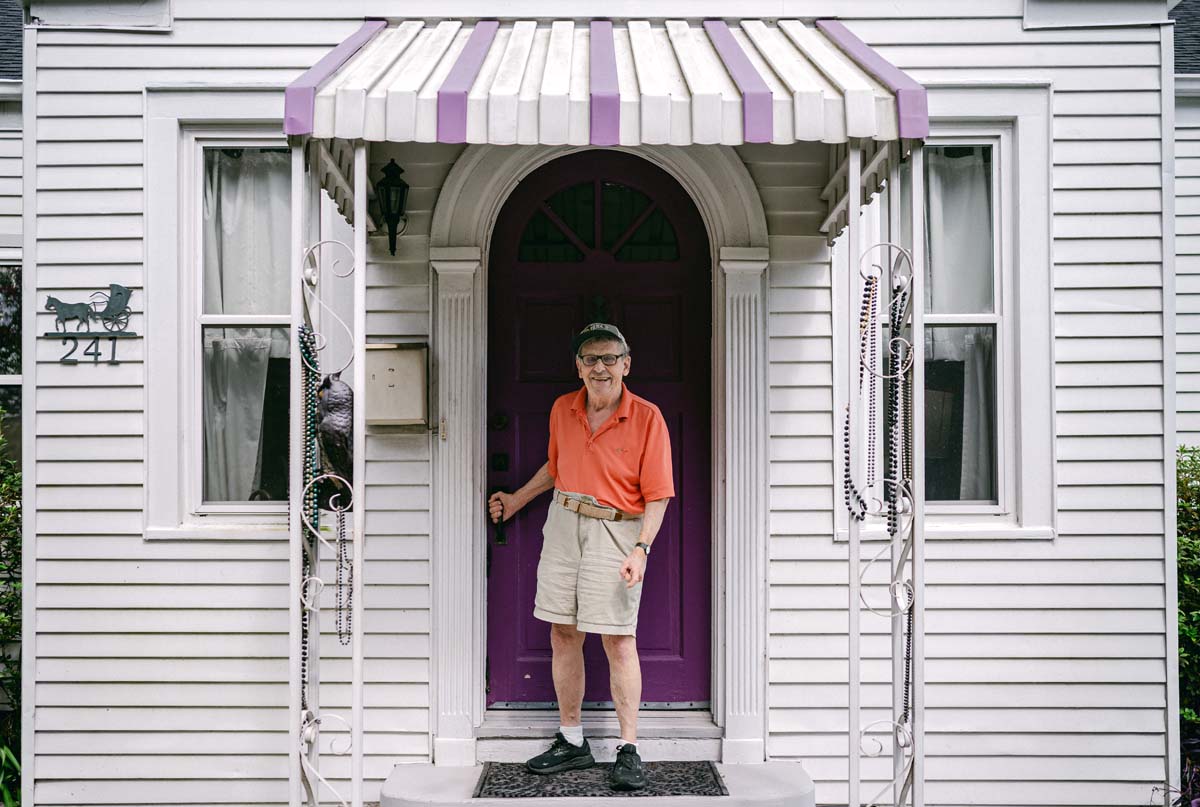
Peter Cooley standing at his front door in Jefferson Parish. “Purple is the color of the unconscious,” he notes. Photo by Katie Sikora
Peter Cooley
In 2017, coming back to New Orleans from a trip to his native Wisconsin, Peter Cooley had a strange experience. He turned to look at his wife in an airport, but she had disappeared from view—even though she was standing right next to him. Cooley, who served as poet laureate from 2015–2017, was eventually diagnosed with a form of AMD called ‘wet’ macular degeneration, in which blood vessels under the retina leak fluid, leading to abnormalities in vision. In Cooley’s case, there was a family history: Cooley’s mother had acquired AMD in her eighties and lived with the condition for nearly fifteen years.
Cooley reports that his left eye is still functioning, but his right eye has degraded to the point where most figures are indistinct, and like Bourque he is increasingly sensitive to contrasts between light and darkness; he gauges most rooms he enters by the amount and type of light they contain, taking extra care in rooms with uneven saturation and carrying spare sunglasses wherever he goes. Though he too receives injections on a regular basis to stabilize his symptoms, his eyes fatigue faster than before, reducing the amount of time he can read or write.
The irony here is as acute as the disease: longtime readers of Cooley’s work know that light is one of his central concerns as a poet, that his poems are always seeking to capture the unique quality of light in a given place or on a given journey, that “certain Slant of light” that Emily Dickinson wrote about nearly two centuries ago. “One of my favorite things about Louisiana in general and New Orleans in particular is the light,” Cooley said. “It changes all the time, which is hazardous for me now but it is also fascinating—every time I go out on a walk I study what the light is doing. I can’t help it—it’s one of my favorite subjects.” In a recent poem called “The Morning’s News on Facebook,” which meditates on learning about the death of his friends via social media, Cooley describes:
“The light
between the live oaks
My back yard
Just after my near-death
Pneumonia three years back.
That light—
Lifting the trees
Into another life
They had no right to ask for.
That near-death experience Cooley describes in the poem added another dimension to his work. Though ultimately he recovered, Cooley said that it imbued his poetry with an urgency he had not foreseen—recall Henry Miller above—and led to his next collection of poems, Little Everlastings, which Carnegie Mellon University Press will publish in 2027. “That book started while I was delirious in Ochsner Medical Center,” he said with a laugh. “For so long I just assumed that I was going to go along the way I always did—but now I’m trying to capture what I can when I can.”
“After I nearly lost my life,” Cooley observed, “I went after it again in pursuit.”
Like Bourque, Cooley still keeps his disciplines, even if his condition has required some adjustments. He tries to write every day, first thing in the morning—“over that very first cup of coffee”—writing longhand first, then transcribing his poems onto the computer. Still able to read for an hour or two before fatigue sets in, he has not yet made the switch to audiobooks, but he recognizes the day may come soon. This devotion to his practice has led to the exploration of new forms, such as the tripartite line found in the poem excerpted above, an innovation in his work he credits to William Carlos Williams, who used it to great effect in his book The Desert Music and Other Poems (1954).
“The recognition of mortality gives you second sight. . . After that, the poem itself says it all.”
Community, too, keeps Cooley working and experimenting as a poet: he is a member of two writers’ groups in Louisiana, one of which has been meeting for over twenty years, and he occasionally collaborates with his daughter Nicole, also an accomplished poet. Even if travel to book launches and literary festivals is not always possible, Cooley is far more concerned with his poems themselves than with praise for them. “It’s important to be a little stupid, to not overthink what you’re doing,” he said. “If I thought too much about myself, I’d never get anything done. I try to approach each poem fresh with all its possibilities—the poem you write today is the cousin of the poem you wrote yesterday.”
Asked how his vision loss has affected his writing practice, Cooley paused. “The recognition of mortality gives you second sight,” he eventually replied. “After that, the poem itself says it all.”
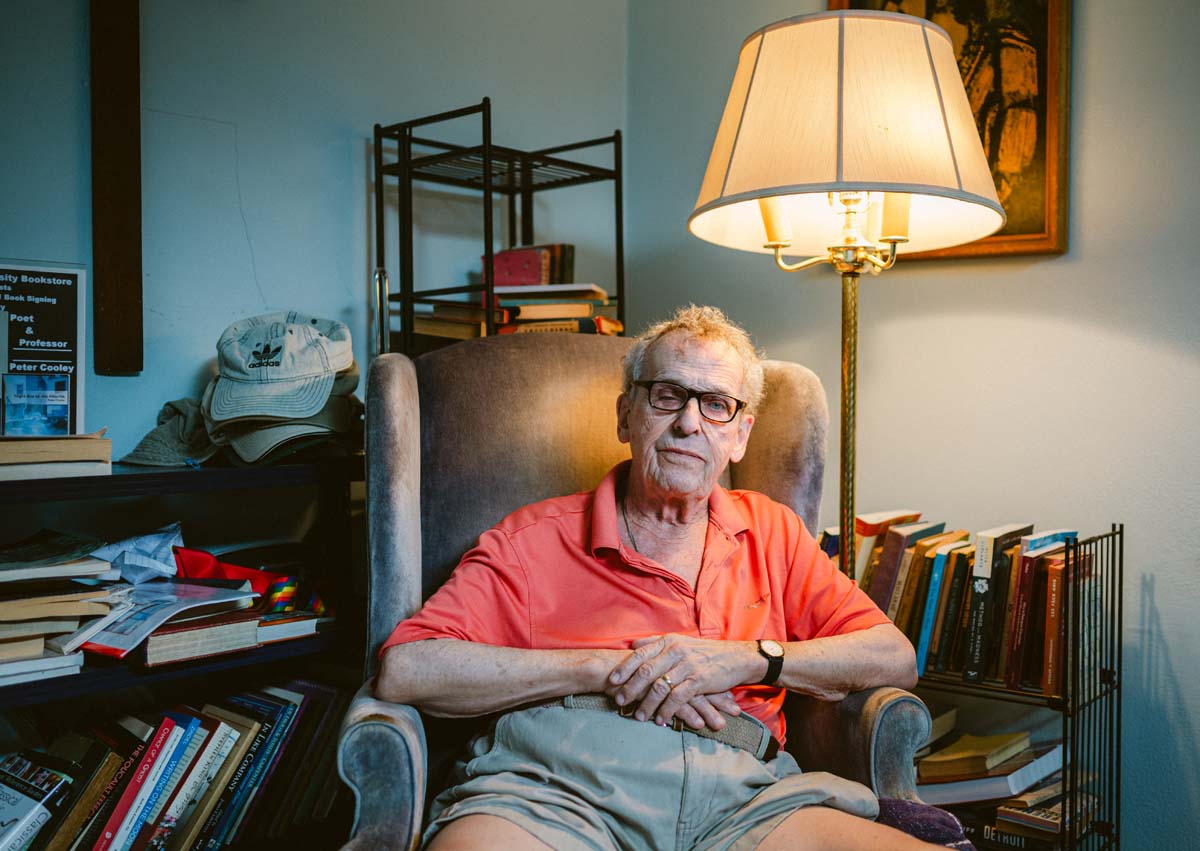
Poet Peter Cooley in his office in Jefferson Parish. Photo by Katie Sikora
Second Sight
Since time immemorial, the task of the poet has always been to see differently, to see through their subjects rather than to merely look at them. Poets such as Elizabeth Bishop, Lucille Clifton, Ada Limón, and Jericho Brown are all credited for their unique vision in their work, both the way they frame the world beyond its visible surfaces and how they offer new vocabularies for the things they apprehend. Illuminating the hidden structures to things and charting the subcutaneous geographies of the heart: to honor this calling goes beyond the lenses in the eye, and always will. In that sense, poets do not acquire the second sight of which Cooley speaks: they are born with it.
Illuminating the hidden structures to things and charting the subcutaneous geographies of the heart: to honor this calling goes beyond the lenses in the eye, and always will.
When asked, both poets show less fear than curiosity about what awaits them on the road ahead, trusting that, as Bourque puts it, the arts will help to make a way through whatever thickets rise up. “Literature has that magical property of releasing us into a world that offers us insights that the day-to-day story-less world does not offer,” he observed. “You go into the dark woods in order to find out who you are, because there things don’t always measure the same way.”
Cooley agrees, returning to his most recent poems as an indication of where his current thoughts—and where his future ambitions—lie. “I have always wanted every book of mine to be different from the other ones,” he said. “I’m simply trying to obey that sense of urgency when it comes.”
Always searching, always reaching, always pursuing the next poem: clearly for both poets their best work is yet to come. But perhaps the last word belongs to one of their compatriots, Jorge Luis Borges, who wrote extensively about his loss of sight both in poetry and nonfiction, and who famously described Paradise as “a kind of library.” In his “Poem of the Gifts,” Borges writes,
No one should read self-pity or reproach
into this statement of the majesty
of God, who with such splendid irony
granted me books and blindness in one touch.
A writer and researcher, Benjamin Morris is the author of a book of nonfiction and multiple books of poetry, most recently The Singing River (Belle Point Press, 2025).
The following resources are available for those in Louisiana living with vision-impairment: