Magazine
See You at the Fest
Don Marshall is the 2026 Lifetime Contributions to the Humanities awardee
Published: June 1, 2026
Last Updated: September 1, 2026
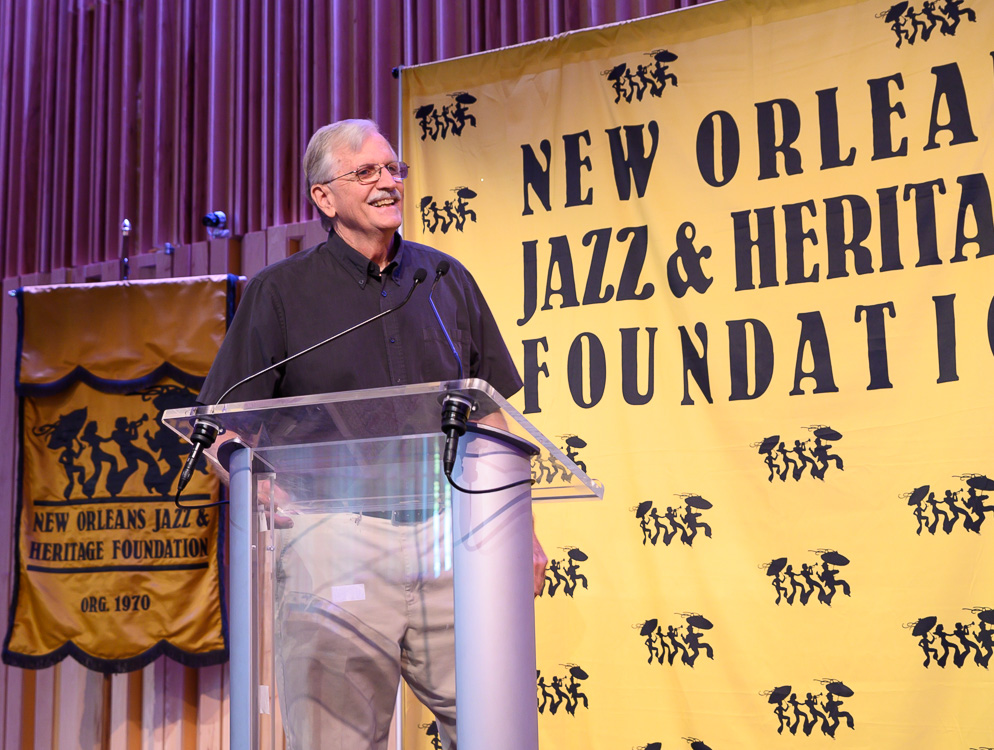
Photo by Eric Simon, courtesy of the New Orleans Jazz & Heritage Foundation Archive
2026 Lifetime Contributions to the Humanities awardee Don Marshall served as Executive Director of New Orleans Jazz & Heritage Festival for twenty years before his retirement.
It will come as no surprise to hear that the genealogy of the arts in New Orleans is often literally familial, with parents and children and siblings and aunts and uncles seemingly passing the creative spark around the dinner table, or under the Christmas tree. Don Marshall, the LEH’s 2026 honoree for Lifetime Contributions to the Humanities, emerged from an artistic family himself—and luckily for the city, it was a family that was in the arts business. Growing up, Marshall gained the confidence and vision—and crucially, the practical, administrative know-how—to spend his professional life founding and leading lasting, sustainable efforts across multiple arts disciplines. Without Don Marshall, the landscape of New Orleans music, visual art, literature, theater, and even Carnival would be much different, and much poorer.
Marshall’s mother Naomi Damonte Marshall was by all accounts an extraordinary New Orleanian. At sixteen, she won a swimming race by crossing a mile-wide stretch of the Mississippi River in just over fifteen minutes (and living to tell the tale). Less dangerously, she went on to found both the Dixie Art Supply store and the Downtown Gallery, where major local twentieth-century artists like George Dureau, Noel Rockmore, and Clementine Hunter exhibited. Alongside local repertory theater and opera, she took her son to jazz performances at the newly opened Preservation Hall, a few blocks from the gallery, and to visit Hunter where the self-taught painter lived and worked on Melrose Plantation in Natchitoches.
Don worked at both of his mother’s businesses, first as a part-time high-school job and then more seriously as a manager after graduating from Washington & Lee University. Behind the counters there, while shaping his own taste in art, he was also absorbing nuts-and-bolts details about the kind of institutional support artists needed—space, funds, promotion—to make their work. Providing these resources in his hometown would become his own life’s work.
He dutifully fulfilled the studio requirement for the fine arts component of his degree—“I came down one summer and took ceramics at Tulane and threw the heaviest pots ever thrown”—but Marshall knew practically from the start that what he wanted to do was build infrastructure for artists, not join them on the stage. “It was all the business of the arts and the love of the artist and the musicians, and the awe I have for those who are talented in that area,” he said.
“I’d always go somewhere like San Francisco or New York and come back and say, why don’t we have this? Why doesn’t New Orleans have a film festival? Let’s start, you know, we have no money and we’ll figure out a way to do it.”
“I wanted to do that because I wanted to employ musicians and promote them and celebrate them. . . . That’s what I believe in heavily, doing these events year-round to support our musicians.”
One of Marshall’s first great successes in this mode was the Contemporary Arts Center New Orleans (CAC). The collective of artists that began dreaming it up in 1976 was inspired by the New York City–born artists’ space movement, which envisioned artist-run, multi-use venues for innovative contemporary art across multiple media. When the CAC opened in a historic thirty-thousand-foot warehouse in a semi-derelict industrial neighborhood in 1977, Marshall was its founding executive director. Over his ten years there, he curated thirty exhibitions and established the CAC as the cornerstone of the new Warehouse Arts District, attracting galleries to Julia Street and launching the now-traditional tipsy, celebratory coordinated monthly openings that draw nearly as many revelers to those streets as Carnival parades. (He also helped start a significant one of those. In 1978, Marshall was a founding member of the irreverent, artsy CAC-based Krewe of Clones, which completed its evolution into Krewe de Vieux in 1987.) “I mean, gallery openings are basically cocktail parties,” he said, “so it became the cocktail party to go to, and then you had this growing audience for the arts.”
Operating two theater spaces at the CAC prepped Marshall for a new role, beginning in 1986, as executive director of the historic Le Petit Theatre du Vieux Carre. Also in the late ’80s, he found time to both co-found and chair two other institutions that are now venerable leaders: the Tennessee Williams & New Orleans Literary Festival and the New Orleans Film and Video Festival. After moving across the lake, Marshall focused his considerable energies there, serving as the executive director of the St. Tammany Art Association from 1992 until 1995.
The turn of the millennium saw Marshall sharing his decades of experience in the role of educator, teaching arts administration, museum studies, and preservation at Southeastern Louisiana University and the University of New Orleans. In a roundabout way, that prepared him for what would become arguably his most impactful job of all.
In 2004, Don Marshall took the reins as executive director of the Jazz and Heritage Foundation, the nonprofit fiduciary arm and owner of the New Orleans Jazz and Heritage Festival. He’d first worked for the festival in his twenties, in the early ’70s, manning a booth for the Louisiana Craft Council. After his first year as executive director, he thought he had just helped steer the fest safely through its most challenging era since its inception in 1970. They’d lost nearly a million dollars on that year’s event due to a combo of heavy rain and scant cash reserves. But the ship had been righted—or so they thought—because they’d been able to retain founding producer Festival Productions and its creative boss Quint Davis alongside international event production juggernaut AEG Presents. The 2005 festival went off great. Then came summer 2005, and Hurricane Katrina.
“At UNO, I taught a festivals class,” he explained. “I actually had Quint [Davis] come and talk to them, but also I threw out, okay, your class project this semester is to develop a festival, and here’s some examples of festival ideas, here’s a blues festival, here’s a Cajun and zydeco festival. So I had all these festivals in my mind.” These were back-pocket ideas. When Marshall, barely in year two of a brand-new gig, was faced with not just one threatened festival but a real, existential threat to the cultural ecosystem that had inspired and sustained it, he reached in that back pocket.
Establishing and finding funds for free Foundation events like the Blues and BBQ Festival or Tremé Creole Gumbo Festival did not literally save the New Orleans music scene (and all the workers whose labor supports it) but it did a lot to keep the culture going, and to send the message that Jazz Fest would be there for the community year-round, not just one weekend in April and another in May. Increased events, grantmaking (to the tune of over two million dollars annually now), and archival work all became hallmarks of Marshall’s tenure at the Foundation, which lasted over twenty years.
“I wanted to do that because I wanted to employ musicians and promote them and celebrate them,” Marshall said. “That’s what I believe in heavily, doing these events year-round to support our musicians.”
Alison Fensterstock is the editor of How Women Made Music: A Revolutionary History from NPR Music (Harper One, 2024) and the co-author of a forthcoming biography of New Orleans cartoonist and music writer Bunny Matthews (Historic New Orleans Collection Press, 2026).