Should Sugarcane Sing
Louisiana’s most notorious crop resists automation
Published: August 29, 2025
Last Updated: December 1, 2025
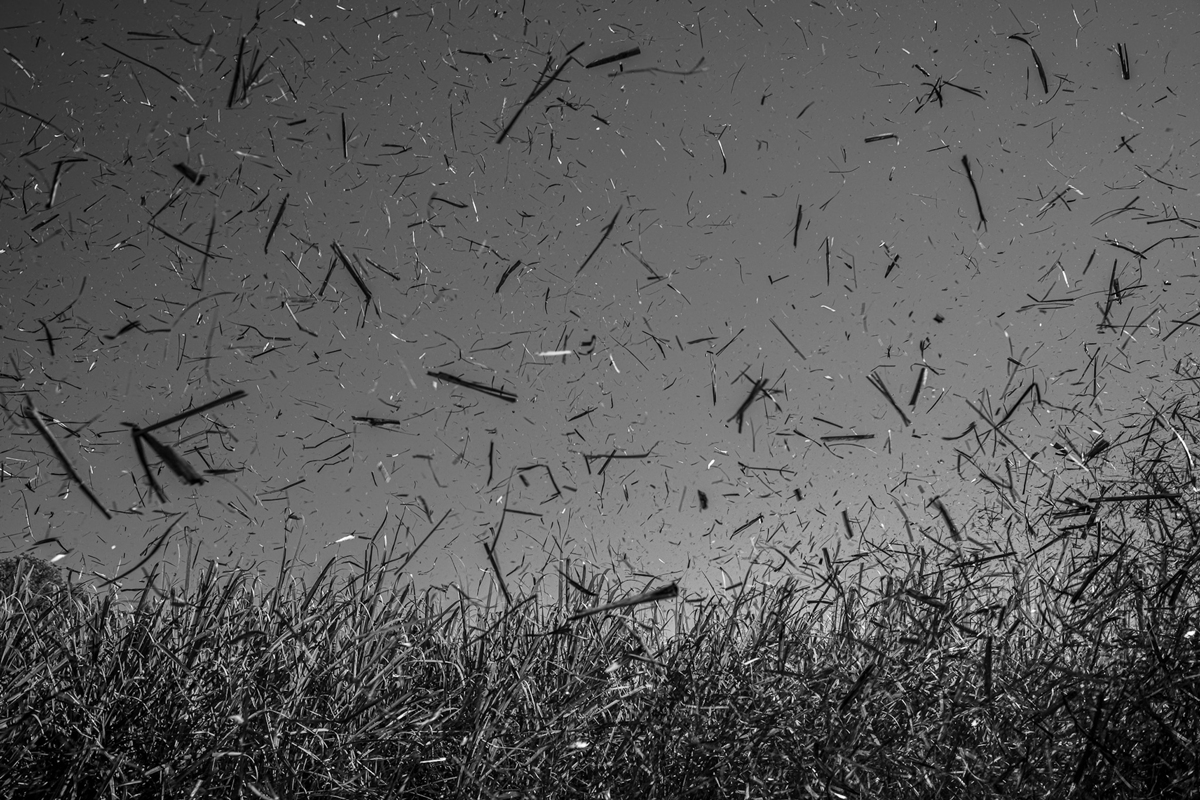
Photo by Kevin Rabalais
Sugarcane chaff flies in the air, much like confetti, during the harvest.
Consider this time—the start of sugarcane season—sanctified. If you would bow your head, a priest is ready to issue a blessing for this crop, and for all those who live by its whims. Farmers, mill workers, and laborers—not to mention the families and friends of a region defined by Louisiana’s most notorious crop—need every blessing they can get.
Because this tropical, Indonesian plant should not grow this far north of the equator, where freezes are almost certain every new year. Try to grow sugarcane in Louisiana and you are faced with the shortest harvest season in the world: three to four months. And in those quick months, you must pump out any standing water—an inevitability in South Louisiana—and harvest in mud and muck.
Time-honored traditions from Loreauville to Jeanerette, and the spirit of those people who are most interested in doing something after they are told it is impossible to do that something, have allowed farmers to overcome these odds year in and year out. But now, rumor has it, sugarcane is experiencing revolution. That’s why we are here, to learn whether the era of automation can overtake pure stubborn determination, whether machines can replicate centuries of Cajun ingenuity, whether religion will ever give way to robots.
Come find your way here by sound: listen for the rumble of combines entering fields, the screech of eighteen-wheelers in waiting, the sputtering roar of a mill grinding for the first time in months. Bend your ear to the steady hiss of over sixty thousand acres of leafy, twelve-foot-tall waving blades that define the breeze. Gather round the banks of Bayou Teche, beneath a sprawling oak canopy on the outskirts of St. Martinville, and you may witness this form of devotion: the act of handing your whole life over to what is well beyond your control.
Around the third Hail Mary, those of us gathered begin to sway along with the stalks. As the blades just near us crash into one another, a gospel hymn performed by Mahalia Jackson comes to mind, the chorus a meditation on being tuned to the divine.
—
I’ll be somewhere listening.
Somewhere,
somewhere listening.
I’ll be somewhere listening for my name.
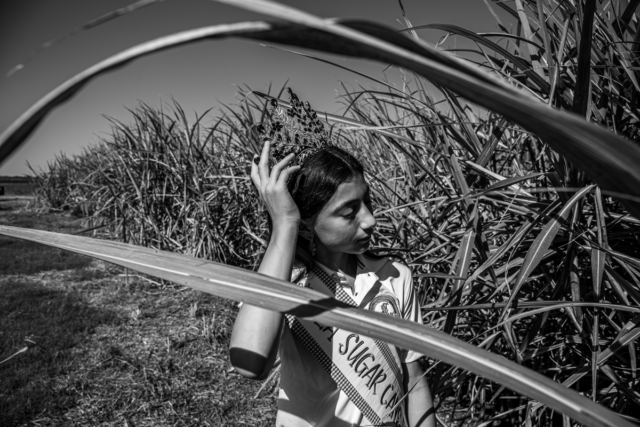
Sixth grader Cooper Becnel was the 2024 Louisiana Sugarcane Festival Queen. Photo by Kevin Rabalais
Around a curve of Highway 86 just outside New Iberia, the Andre brothers are arguing. This time it’s about which genetic variety of cane will be the most productive, or which ripener to spray when, or which brother looks oldest. But what they argue over is no matter, really. What matters is that Hugh, Mike, and Chris wake up each morning determined to fight together.
HMC Farms is rare in that these brothers are first-generation farmers in a region where sugarcane has been a family tradition since before the 1900s. Their father and grandfathers may not have farmed cane, but the Andre brothers—born and raised in rural, working-class Louisiana—are no stranger to the work ethic sugarcane growing and farming requires. Mike was only twelve years old when Hugh started the farm—and he snuck in grinding time between two-a-day football practices. Though their eleven thousand acres is proof of success—starting as the farm did with only seventy-five acres—their operation pales in comparison to the monolithic farms in Florida, some of which grow over 190,000 acres of cane. In this, Louisiana sugarcane farming is unique: every operation is as much about family as about field.
. . . rumor has it, sugarcane is experiencing revolution. That’s why we are here, to learn whether the era of automation can overtake pure stubborn determination, whether machines can replicate centuries of Cajun ingenuity, whether religion will ever give way to robots.
As only a twenty-seven-year-old operation, HMC Farms is considered “new.” Because we are hoping to understand what lessons might be used to train automated machines one day soon, we talk to the Andre brothers, who themselves had to learn these lessons not too long ago.
“Let me learn you something” becomes the running joke of our time sweating together as the sun warms our skin. Mike slices through a stalk in one swift chop, and we learn that sugarcane is a ratoon crop, like potatoes, which means that future plants grow not from seeds but from buds that emerge from the hard-lined nodes of this very stem. Hugh cracks the stem in two, and we learn about bagasse, the dry, straw-like fiber that surrounds the juicy sucrose inside the plant. We ask about brown spots on some of the leaves, and learn about insects and fungi that can ruin entire fields of cane.
Maybe a machine could learn to diagnose the plant’s disease or measure the fiber content of a given plant variety without help from a human hand. But good luck getting a self-driving tractor to navigate short fields buttressed by levees, ditches, and oak groves. A tractor can be automated to run straight and follow repeatable patterns in the state of Iowa’s long, drawn-out terrain. But here, fields are too irregular, obstacles too frequent. And what would a robot do if a downpour descends, sucking combine tires into the mud? Programming requires consistent, repeatable patterns—Louisiana cane offers only idiosyncrasies.
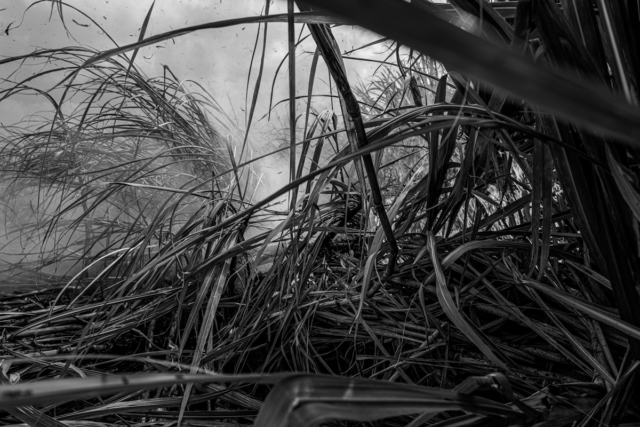
Each year sugarcane is burned prior to the harvest to remove dead leaves and increase ease of harvesting the stalks—whether manual or by machine. Photo by Kevin Rabalais
When we ask the Andre brothers what they are still learning, we hear about all that human hands can’t fix, let alone human technologies. “You wake up in a corner every morning,” Mike says. “You wake up fighting Mother Nature.” You fight solar farms and hurricanes. You fight drought and bank lenders. “Every day, you fight a challenge.”
Hugh asks us to rise the next morning like a farmer, before sunrise. In oil black morning, we crunch dried-up stalk sticks beneath our feet and jump up to catch the ladder rungs of the combine. We drive, and spinning steel teeth slice the base of the stalks. Long leaves of green and yellow swish into a tall, spinning blade, and billets of cane spit into the wagon by our side. Behind us, chaff catches the wind.
We still do not understand real sugarcane farming, though, Hugh points out. Because air-conditioned cabs and laser-guided field leveling almost make modern farming comfortable. Talk to older-generation farmers like Hobson Champagne who remember harvesting by hand. Listen to stories about how, if you were young and too short to reach tractor pedals, your grandpa would put a wooden two-by-four board between your shoe and the accelerator—no height limit for harvest.
Hobson further explains why—even though every facet of harvest is aided now by machines—some farmers still plant sugarcane by hand. The buds on the plant stem nodes that take root and become next year’s crop? The older generation calls them “eyes.” And you want the eyes laid just right in the ground. Let a machine plant, and you must go back and straighten out your stems.
—
Sometimes I’m up,
Sometimes I’m down,
Sometimes leveled to the ground.
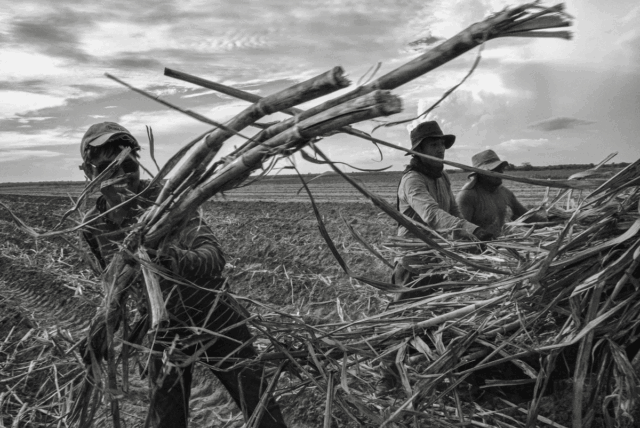
Sugarcane planting in Avoyelles Parish. Photo by Kevin Rabalais
The eyes are more than nodes. Ancestors look up from this soil that contains a history not worth celebrating, the number of unnamed, unmarked bodies therein unknown. There is no story of sugar without the violences of slavery. Prior to the Civil War, over three hundred thousand individuals were forced to labor on Louisiana plantations. The war may have ended slavery by name, but conditions for cane cutters improved hardly at all. In 1887, when workers attempted to better industry conditions in Thibodeaux by enacting a labor strike during grinding season, dozens of unarmed Black workers were killed.
Even now, there is no sugar without migrant labor, without visa holders who stay in Louisiana for a hundred days of grinding, then return to their home sugarcane fields in Central and South America. Not many locals wish to work the twelve-hour days, seven days a week, rain, shine, or sleet. But it’s what harvest requires, given that Louisiana produces nearly half of the nation’s sugarcane each year. So farmers and mill workers sweat alongside those with whom they share no language.
Millworkers at LASUCA (Louisiana Sugar Cane Cooperative), though, swear that speaking in different tongues is no language barrier. “Work is a universal language,” Nolis Champagne tells me from his experience training mill workers at LASUCA for over forty years. As a co-operative owned by sixty-two growers in and around St. Martinville, LASUCA mill is held accountable by every hand involved in the process: grinding, coring, boiling, crystallizing, storing. Haste is a shared vernacular, where the work of sugarcane is concerned. The minute cane is cut, its sweetness begins to deteriorate. Leave it uncut too long and risk ruin—sugar turning into sour vinegar. Last year, LASUCA sent 484 million pounds of sugar to be refined for our consumption. Their process is proven: cut, transport, hurry, separate sugar from bagasse, boil, spin, repeat; quickly now.
But cane may have another message to offer. Outside LASUCA, we catch Maxium “Rock” Davis, who drives cane from field to mill all day, every day, during grinding season, to ask about the lessons of harvest. Instead, he attunes to the growing season: how slowly the stalks come up, how much of the year is spent waiting. “Think about that,” Rock prompts, “Nine months to grow. Three months to harvest.”
Nine months of every year. The time it takes to grow new life. Not much else for Rock to explain, really: “Sugarcane teaches you how to live.”
—
If I live right,
I know I’ll answer.
If I live right,
One day I’m going to answer.
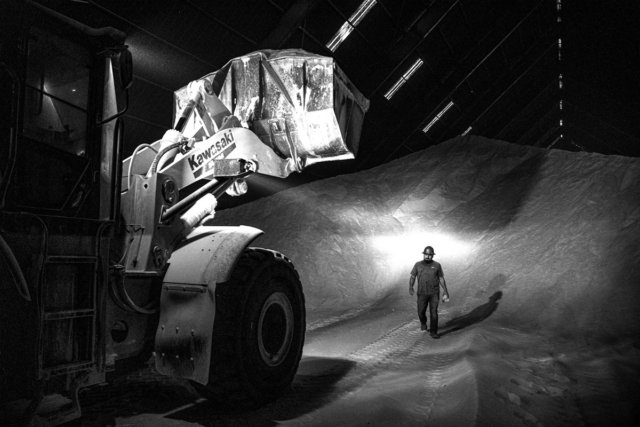
Mill worker Zac Lancon stands before what is affectionately referred to as “Sugar Mountain”. Photo by Kevin Rabalais
Robots do not need these lessons in living, we suppose. Perhaps that—the absence of a soul that relies on soil, sweat, brother, sister to survive—is what convinces every sugarcane worker with whom we speak that automation may take over other agricultural industries in Louisiana, but not sugar.
Sugar is a calling. Much like the ministry, some farmers spend years running from the call. So it was with Kassi Berard Leger, one of Louisiana’s only female sugarcane farmers. Degrees in marketing and business from Lafayette, years of experience on the road for pharmaceutical sales, and a nagging pit in her stomach that she should be back in Breaux Bridge farming 2,900 acres of cane.
The side of sugar Kassi understands more than most is political. Through a youth leadership program, she lobbied for the American Sugar Cane League in DC. When politicians responded to her pitches with “My constituents have nothing to do with agriculture,” Kassi would think, “Your constituents never eat?”
Sugar offers Kassi purpose, a form of peace. “Your whole soul is in the farm,” she says. “It’s in the land. It’s in waking up early. It’s all your hard work. It’s being there 365 days a year. It’s never shutting down. It’s the work never going away. It’s having to prove yourself day in and day out.” And not just for profit or sweets. Sugar is in biofuels, cleaning products, and children’s medicines. So, she gives herself over to sugar, never certain of what sugar will give back.
And what would a robot do if a downpour descends, sucking combine tires into the mud? Programming requires consistent, repeatable patterns—Louisiana cane offers only idiosyncrasies.
Lessons in uncertainty seem to be the essence of sugarcane growing and farming. On Tee & Sons Farm, a fourth-generation enterprise of father, son, nephew, and brothers-in-law, we learn why. Looking out over 3,400 acres, about 800 of which were just planted, André Blanchard reminds us: “We won’t know how this crop will do until next year.” What is harvested this year was planted months, if not years, ago, which means farmers know something about faith that those of us accustomed to immediate gratification struggle to learn.
Blanchard’s son, Brayden, a researcher who specializes in sugarcane breeding and genetics at Louisiana State University’s Sugar Research Station, must wait longer still. Twelve years from now Brayden will learn whether SucroX, a software program his lab developed using artificial intelligence to help determine what plant varieties are ideal for breeding, was successful. Twelve years is the time it takes to progress new sugarcane varieties through the breeding program, from pollination to planting to multi-year, multi-location testing.
Such extensive breeding and testing of plant varieties is required because, genetically, sugarcane is one of the most complex species scientists know—each plant holding in itself over three times more DNA than us humans. A mistake Brayden will never make is assuming from the lab what will work for the farmer in the field. Uncertainty in the lab tastes different from uncertainty on the farm. He returns to St. Martinville from Baton Rouge often to remember as much, to witness how growers perform their own experiments.
We ask the three generations gathered with us on the Blanchard farm how everyone handles living with so much uncertainty. Brayden puzzles over the question. These are not lessons in uncertainty, as he understands it. Or the crop would teach as much if your only marker of success were harvest. But that’s not how growers and breeders think. Every day, there’s something to check on, something to fight, something to appreciate.
—
When he calls me,
I will answer.
When he calls my name,
I will hear.
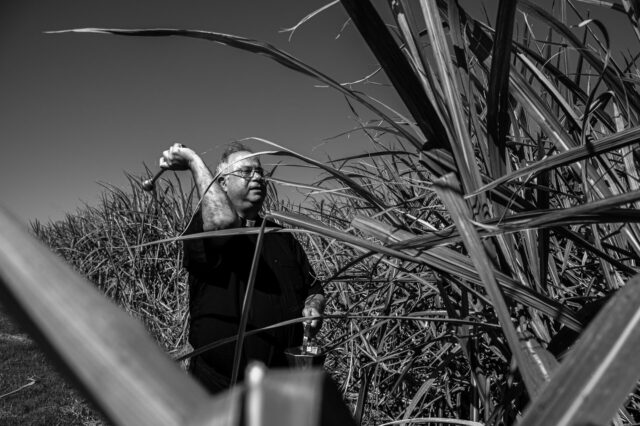
The Sugar Festival in Iberia Parish kicks off each year with Father Keith Landry’s “Blessing of the Crop”. Photo by Kevin Rabalais
Soon, the song of harvest will fade into smoke, farmers setting fire to stray stalks, the ground once again receiving this ashy inevitability. But for just a moment longer, these stalks still sway. And we’re still here, listening.
Should sugarcane sing, should symphony ever spill from these stalks, this song would call our name. This song would remind us of all the ancestors who labored in these fields. This song would show just how many hands it takes to feed us.
The hands of Brayden and the Blanchard’s. The hands of Kassi. The hands of Nolis. The hands of Rock. The hands of Hobson. The hands of the Andre brothers. The hands of thousands of mill and refinery workers. The hands of hundreds of migrant workers who leave their families to enrich ours. Should sugarcane sing, and should we be still enough to listen, we would consume differently. Carefully. Respectfully. Maybe reverently.
Of course, you don’t have to listen. You may scrunch up your nose at the odors coming from the mill, grumble over the potholes vibrating your back side, honk at the combine hogging the road. Even still, this song is for you.
Megan Poole was born and raised in Southwest Louisiana. She is an assistant professor at The University of Texas at Austin where she specializes in rhetoric, writing, and environmental communication.
Anurag Mandalika has experience working with stakeholders in agriculture and researching the dairy industry in Wisconsin and the sugarcane industry in Louisiana. He is an Assistant Research Professor at the Center for Energy Studies at Louisiana State University.