Winter 2025
Tugs and Lines
Working from home, on the river
Published: December 1, 2025
Last Updated: March 1, 2026
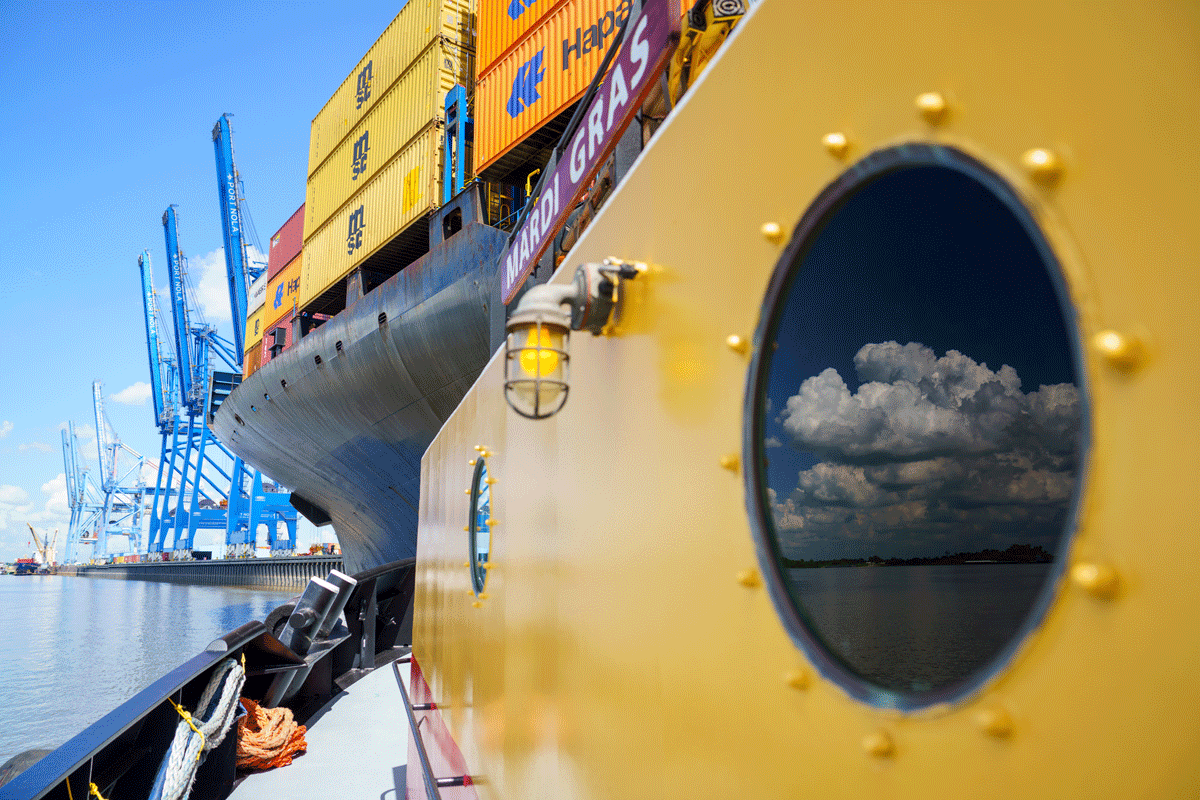
Photo by Zack Smith
The Mardi Gras, the flagship vessel of the Crescent Towing fleet in New Orleans.
Work on the Mississippi never stops. Cargo ships enter and leave at all hours. However, these massive vessels were designed for the open ocean, not a bending river. To get to where they are going, they need help docking, undocking, and otherwise making their way around the Port of New Orleans and cargo facilities up and down the river.
To facilitate this round-the-clock work, tug and line service providers have increasingly adopted multi-day work schedules, dispatching crew members and operators for assignments lasting for two-, three-, or even seven-day stretches. These multi-day shifts present new challenges for centuries-old blue-collar occupations. Being “on call” at all hours produces its own kind of stress and fatigue.
But those who can learn how to sleep on demand and manage tight living quarters are rewarded with a perk once only available for white-collar jobs: fewer commutes per workweek. Since the COVID-19 pandemic, there has been a rapid rise in the number of office jobs that have allowed employees to work from home some or all of the time, saving them both time and money. Most blue-collar jobs deemed “essential in-person” occupations have largely been denied these flexible work opportunities, but tug and line crews on the river demonstrate how it can be done. Before these operators can tap into the benefits, though, they must master both the hard skills of their craft and the soft skills required to make the river their home for days at a time.
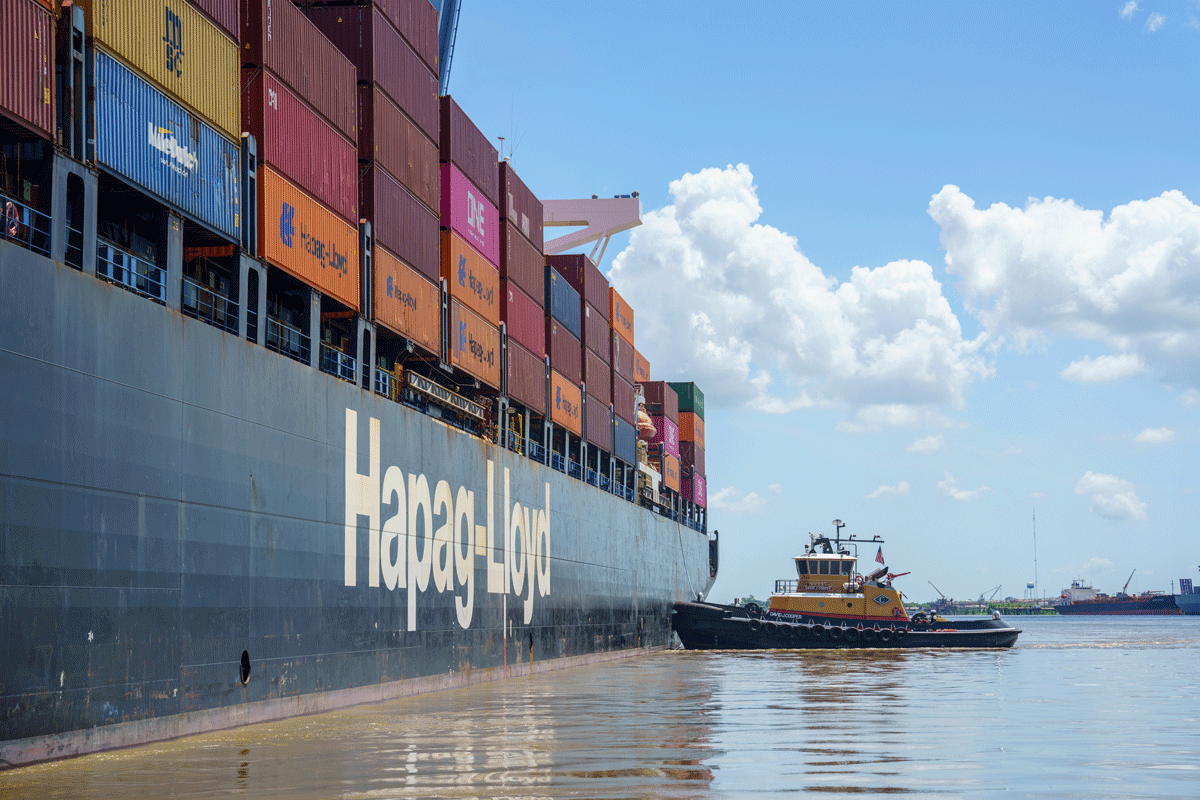
The Mardi Gras, the flagship vessel of the Crescent Towing fleet in New Orleans, pushes a large cargo ship on the Mississippi River. Photo by Zack Smith
Tugs: The “Push-Pull” Maneuver
The Mardi Gras is the flagship vessel of the Crescent Towing fleet in New Orleans, a “tractor tug” that can pull a ship with up to seventy tons of force. Watching Captain Roy Helmstetter at the helm of the Mardi Gras, I can barely tell that he is steering the ship. He gently manipulates two controllers, each assigned to an azimuth thruster, or “Z-drive.” These propulsion units can rotate 360 degrees, independent of the other. Captain Helmstetter radios back to dispatch for details on his next assignment: The Palena. This Liberian-flagged vessel is 997 feet long and stacked with multi-colored shipping containers eight rows above its deck. All seventy tons of towing force will be needed for the job at the Nashville Avenue Wharf today.
It is a typical assignment for a tugboat at the Port of New Orleans. Cargo ships come up the Mississippi from the Gulf and dock with their bows facing upriver. After unloading and reloading, they need to reverse course. But the cargo ships are too big and unwieldy to do it themselves. Indeed, the Palena will need the assistance of two tugs today. Captain Helmstetter will coordinate with his counterpart on the other workhorse tractor tug in Crescent Towing’s fleet, the David J. Cooper.
Captain Helmstetter begins his work by tying off his tug to a bollard near the bow on the deck of the Palena. His partner tug will do the same at the stern. Then, while facing the vessel, both tugs will put their engines into reverse and pull the ship away from the dock while keeping it parallel to the shore. Glancing downriver, Captain Helmstetter keeps tabs on the other tug to stay even with it. Combined, the two tugs are making the most of their 10,860 horsepower.
For tug crews, arriving for work at Crescent Towing means saying goodbye to dry land for the next week.
The second part of the job is a “push-pull” maneuver that will spin the Palena 180 degrees. At the stern of the Palena, the David J. Cooper tug winches in its stern line, slowly but powerfully moving forward to nudge into the cargo ship’s hull. From two hundred yards away I can feel the rumble of its engine in my chest. Pushing at the stern creates a fulcrum: a point where the ship can pivot. Meanwhile, the Mardi Gras continues to pull at the bow. The Palena’s bow swings into the current like a door on a hinge.
Now the river can finish the job. As the Palena turns perpendicular to the dock, the Mississippi’s powerful current begins pushing its bow downriver. As it completes its turn, the cargo ship’s propellers can generate enough force for it to navigate on its own.
Captain Helmstetter retrieves his lines back to the Mardi Gras, the David J. Cooper does the same, and both are off to their next job.
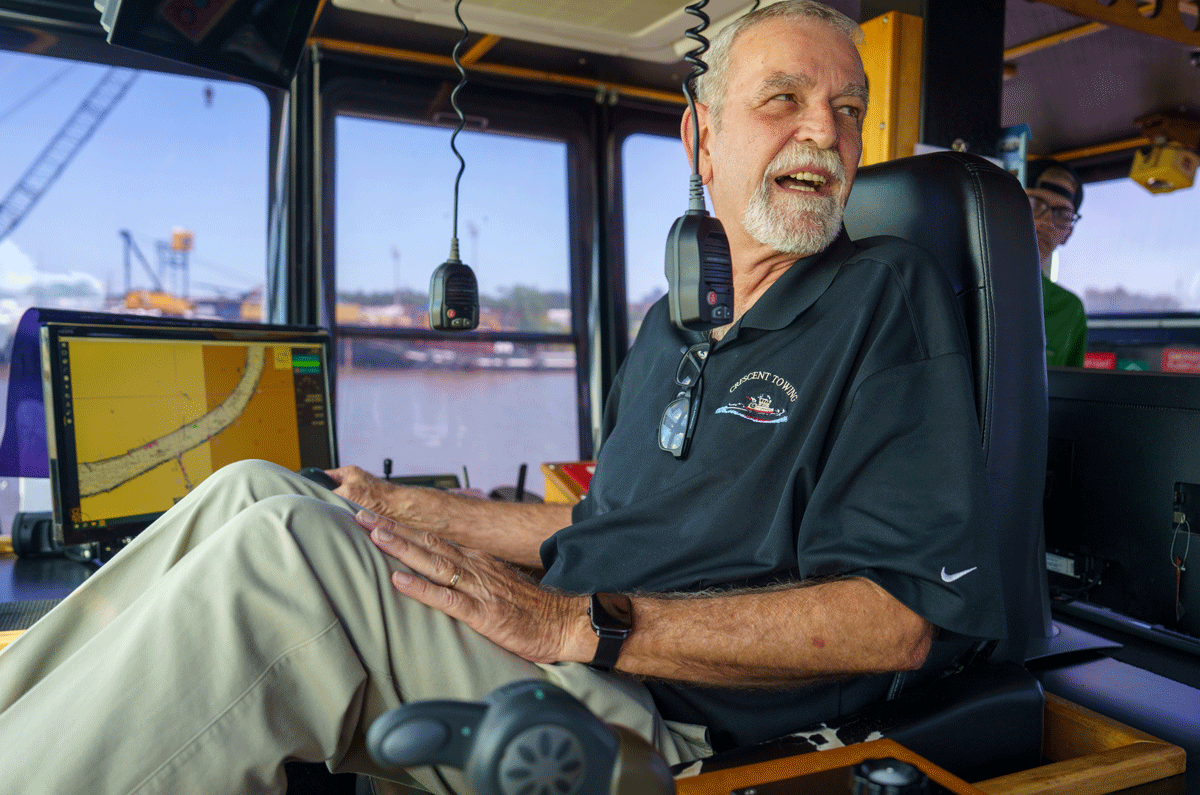
Captain Roy Helmstetter at the helm of the Mardi Gras. Photo by Zack Smith
Lines: Tripping the Pelican Hook
Andrew Wahlen is trying to show me how to trip a bow line attached to an anchored buoy on the Mississippi about thirty miles upriver from New Orleans. He is standing at the helm of his twenty-five-foot aluminum workboat, with twin 150-horsepower outboard engines rumbling behind him. He tightly circles the buoy until he is facing it, ten feet away. His workmate, Jose Hasbun, stands near the bow awaiting his order. I’m doing my best to hold on and stay upright.
In most ports around the world, mooring operators work dockside. They receive lines from incoming ships to tie them off one by one to concrete and metal structures connected by walkways to the shore. When ships depart, they untie the lines again, one by one.
Wahlen works for Cooper Mooring, which specializes in “mixed mooring” services, and he spends most of his time on his workboat. His job is to tie and untie lines to dock fixtures that can’t be accessed by land.
Mixed mooring is crucial to shipping on the Mississippi. The river bends, limiting the number of long and straight stretches suitable for traditional docks. To make the most of every inch, many cargo facilities augment their dock structures by positioning concrete pilings and anchored buoys both upstream and downstream of their shoreline platforms. These additional fixed objects, both fore and aft, allow a six-hundred-foot ship to tie off to a three-hundred-foot structure via its bow and stern lines, respectively. In some cases, “docks” on the Mississippi have no shoreline structure at all. Ships can tie off to buoys anchored midstream while they load and unload cargo to and from barges or even other ships, tethered to their own buoys.
From two hundred yards away I can feel the rumble of its engine in my chest.
Wahlen points to a hollow steel cork, six feet in diameter, bobbing in the river. That is his target. Welded to it is a two-foot “pelican hook,” so-called because it resembles the bird’s curving beak and neck.
To reach the hook, Wahlen nudges the throttle so that his workboat’s speed and direction upriver precisely matches the river’s current. His bow holds steady a foot away from the buoy. We appear to be parked against it, but his outboards are working behind him.
The hook has a mechanism that, when pulled, can release the line attached to it. But the force required is more than can be done by hand.
Wahlen’s mate grabs a line attached to the hook’s spring mechanism. He ties this line off to a cleat on the workboat, then Wahlen reduces his engine’s speed and lets the current push him downstream. With enough distance, the pelican hook pops open. His mate tosses the trip line back toward the buoy, and Wahlen motors on to the next one.
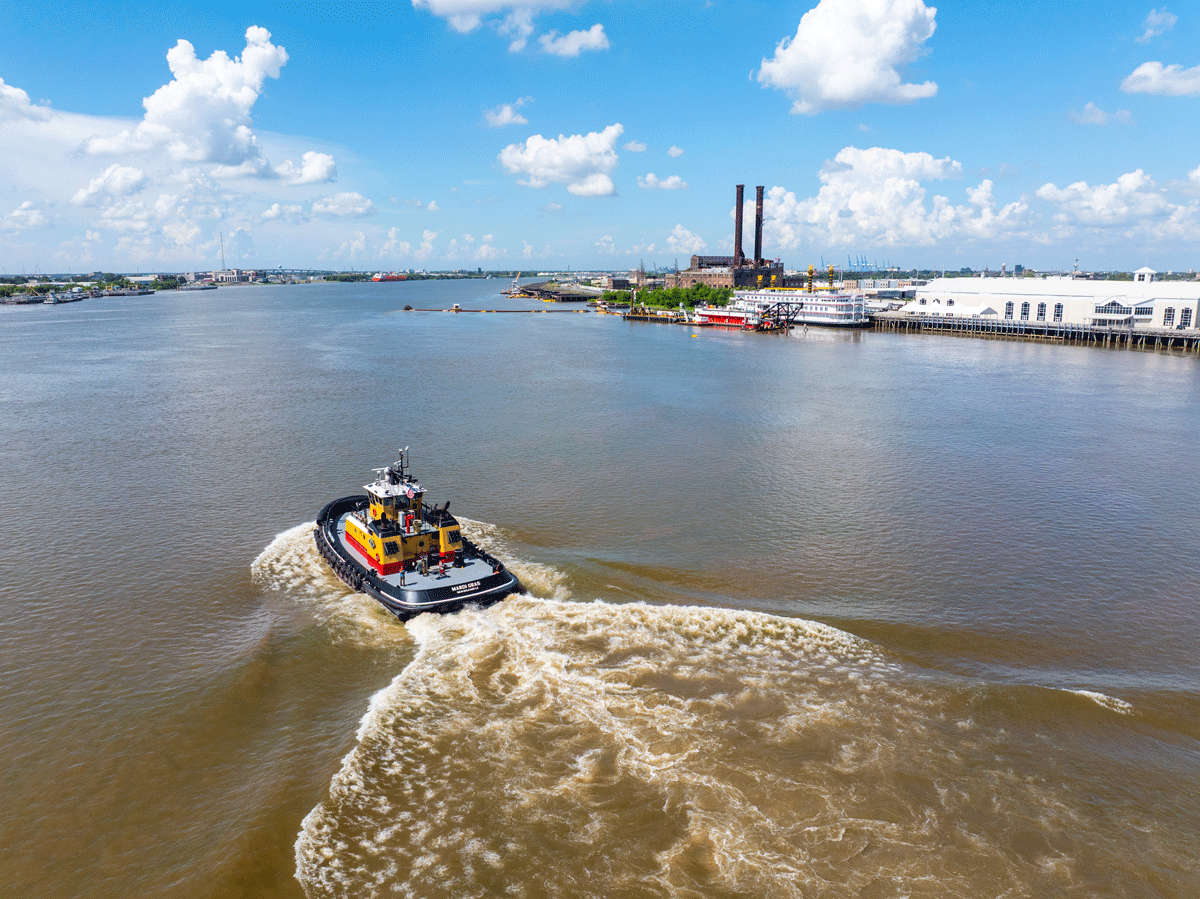
The Mardi Gras, the flagship vessel of the Crescent Towing fleet in New Orleans, cruises along the Mississippi River. Photo by Zack Smith
Prepping for a Seven-Day Tour
For tug crews, arriving for work at Crescent Towing means saying goodbye to dry land for the next week. Once his shift starts, Captain Helmstetterwill stay on the Mardi Gras for seven days straight. Unless there is a medical emergency, the crew doesn’t leave the boat. Although docking and disembarking may be tempting, even if just for a few minutes, it is too risky. If a nearby vessel needs emergency navigational assistance, it needs it right away.
Stocking up for a weeklong shift requires considerable planning. The crew of the Mardi Gras will need enough provisions to feed four hungry adults for a week. An entire wall of Crescent Towing’s supply room is lined with fridges and freezers filled with dairy, meats, veggies, drinks, and snacks. Making the tug their home also means preparing for everyday chores like washing and cleaning, so household supplies like dish detergent and garbage bags need to be restocked before the shift.
There is no cook assigned to the crew, only a captain, a mate, an engineer, and a deckhand. Captain Helmstetter has been on the job for nearly fifty years; he knows his way around a galley. His longtime engineer and mate both know how to cook as well. But deckhands come and go—usually young men who start their careers with a hearty appetite but little knowledge of food preparation. Frozen pizzas can get old after a while, so everyone needs to learn how to prepare a real meal eventually—and hygienically. Fog and storms are obvious risk factors of the job; it turns out cross-contamination from mishandled poultry is likewise no laughing matter.
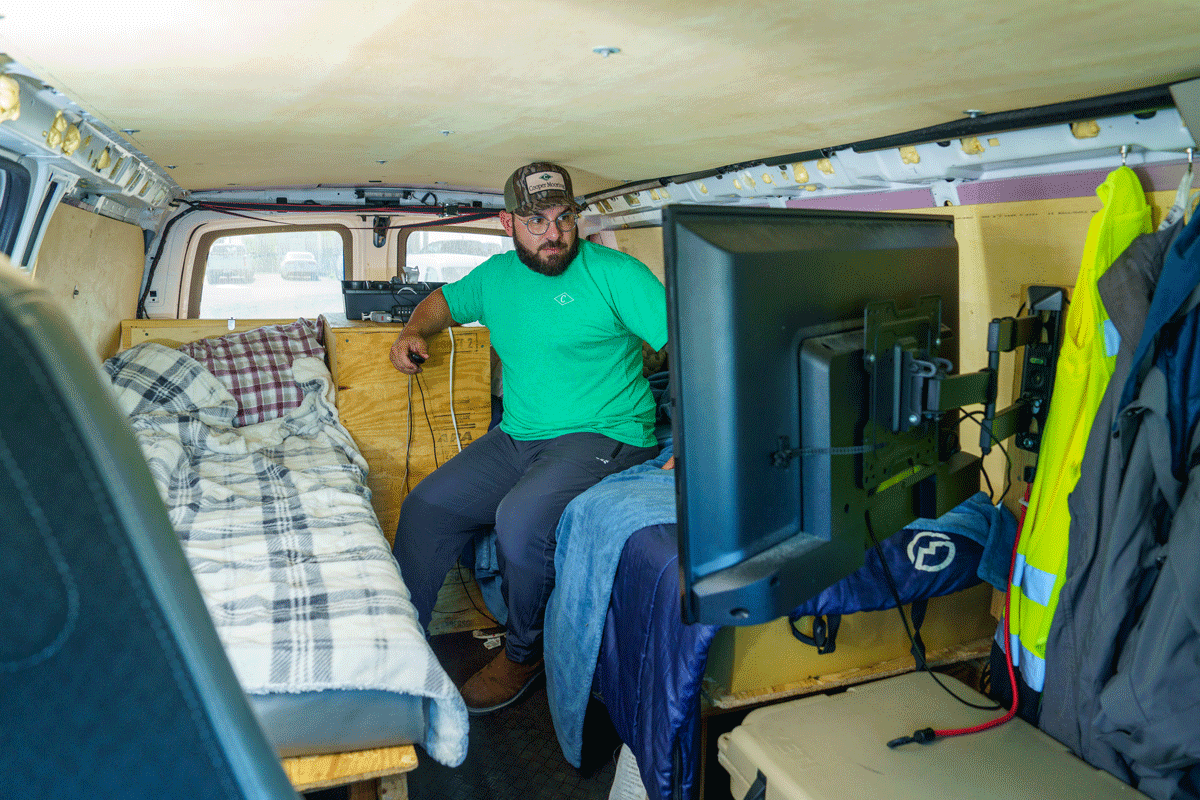
Jose Hasbun, an operator for Cooper Mooring and Andrew Wahlen’s mate, lives out of a van during 48-hour stretches on the job. Photo by Zack Smith
Living in a Van Down by the River
Wahlen works forty-eight hours on, seventy-two hours off. This suits him just fine. He gets some guaranteed overtime hours, but not so many as to exhaust him. And having three days off allows him to really wind down, rest, and recuperate before his next shift. If anything, by the end of his final “off” day, he’s antsy to get back into his work routine.
Anyone who watched Saturday Night Live in the early ’90s will remember Chris Farley’s sketch about a motivational speaker trying to scare teenagers straight. To caution them from making the same mistakes he’s made, he bellows, “I live in a van down by the river!”
Wahlen has heard—and used—the catchphrase many times. It has been a running joke among Cooper Mooring crews for the past thirty years. Cooper Mooring has twenty workboats staged at locations within Louisiana from Davant to Darrow along a 120-mile stretch of river. To access them, Wahlen and his workmate travel via van. Between jobs, the van is their home, where they will eat, sleep, text, scroll, watch movies, and play video games.
It turns out that, at Cooper Mooring, the phrase “grab a line” is actually a bit of ironic slang. It means “get some rest now, you might not later.”
The first time I encountered one of these vans, it took me a minute to process what I saw inside. It was a marvel of ingenuity. Van modification varies from crew to crew. Some go all out and remove the bench seating, replacing it with 2×4 frames and plywood bed platforms. What rough lumber lacks in finish, it gains in hyper-practicality. The space below and between the beds can be tailored to fit the unique size and shape of gear used in this line of work—toolboxes, hard hats, personal flotation devices. Hooks can be fastened anywhere to hang gloves and jumpsuits that need to dry after rainy jobs. And snaking under and around the seats is a web of electrical cables, drawing from the van’s battery to power the crew’s television, gaming console, phone chargers, and fans.
Masters of Their Crafts
Though Wahlen and Captain Helmstetter have found ingenious ways to make living on the job more comfortable, sleeping with “one ear open” for a call from dispatch is not easy. But these multi-day shifts come with huge benefits, one of which is the unburdening of the five-day-a-week commute. On a traditional work schedule, people who worked on the river had to live near the river. Back then, a two-hour round trip, say from the North Shore of Lake Pontchartrain to Algiers and back, was seen as a lengthy commute. The transition to multi-day shifts now offer tug and line workers an opportunity once reserved only for professionals who could do their work remotely or on a hybrid remote/in-person schedules: freedom to live farther from the work site. Today’s tug and line workers have the flexibility to opt into longer commutes that would have been inefficient five times a week but seem reasonable just once a week or once every other week. And on the river, be it executing a push-pull maneuver or wrangling a bow line from an anchored buoy, each is the on-site expert of his task, given the freedom to work unsupervised and the independence to exercise creative problem-solving. The workers are granted on-the-job autonomy that many white-collar employees rarely get to experience.
Photo by Zack Smith
“Grab a Line”
Mastering the art of tugs or lines is only part of the job. Captain Helmstetter and Wahlen have both seen their share of very talented and skilled operators wash out during training or shortly thereafter. They lacked another essential skill: being able to make the river your home for days at a time.
I first saw this skill in action when I was in a van, asking Wahlen questions about a recent job on the river. A radio call came in from dispatch. The order: “Grab a line.” I expected Wahlen to jump into action and drive us back to the boat launch. Instead, he let out a deep breath, tilted his seat back, and closed his eyes.
It turns out that, at Cooper Mooring, the phrase “grab a line” is actually a bit of ironic slang. It means “get some rest now, you might not later.”
Being able to quickly wind down and relax is a skill that not all can master. Even fewer can do so in close proximity to other full-grown adults in tight spaces.
But for those who can sleep on demand, the job has a lot of upsides.
Ken Kolb, PhD, was born and raised in New Orleans. He is currently conducting research for his next book about shipping on the Mississippi River and the Port of New Orleans.