Magazine
Turners’ Hall’s Original Publishers
Long before 64 Parishes’ offices were there, Steeg Printing and Publishing printed the Jewish Ledger from Turners’ Hall
Published: September 1, 2026
Last Updated: September 1, 2026
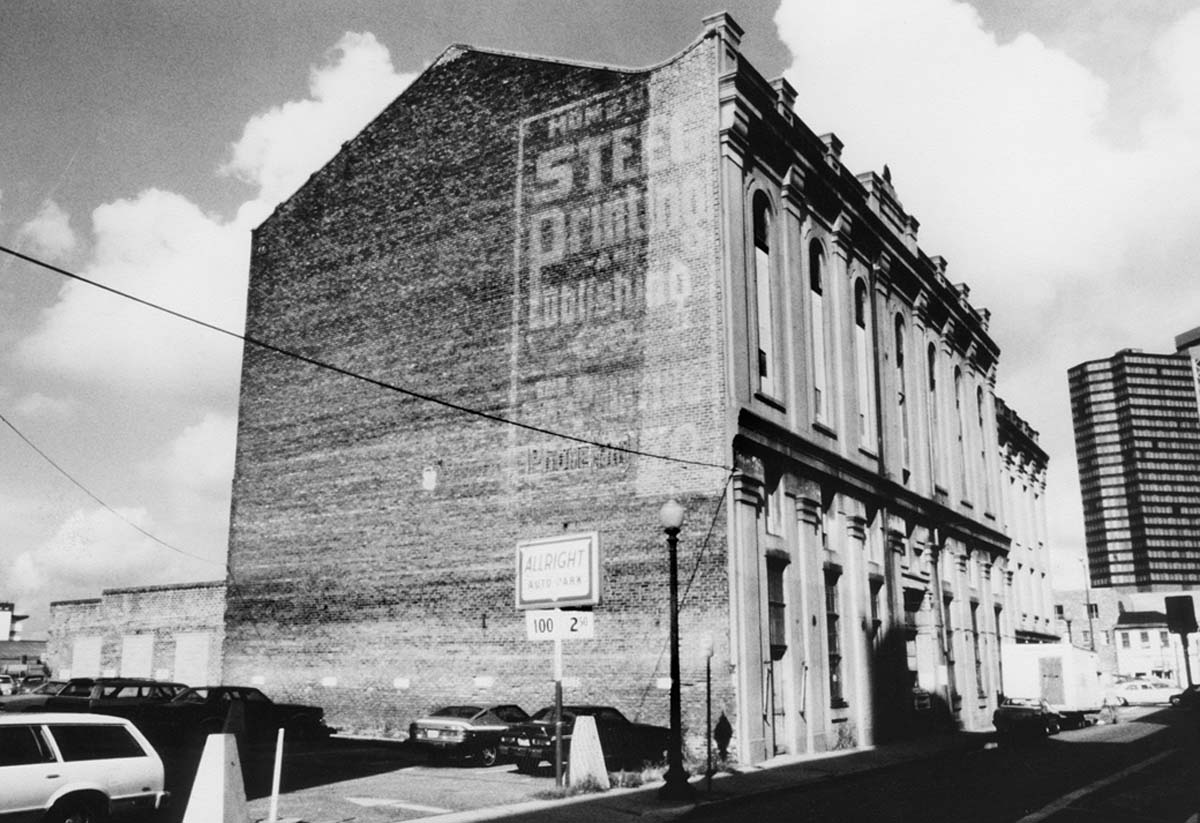
Photo by Allen Karchmer, courtesy of Louisiana Cultural Vistas
During the mid-twentieth century, when Turners' Hall was a used furniture warehouse and appliance store, stenciled lettering for Steeg Printing and Publishing was visible on the side of the building.
We couldn’t find the boxes. I had made contact with the heir to the family history of Steeg Printing and Publishing, a former tenant of Turners’ Hall, which now houses the Louisiana Endowment for the Humanities. Robert Steeg, a local attorney, was happy to talk to me about the history of his family’s long-closed business. In exchange he hoped to retrieve some boxes of old papers related to the business that he had, at some point, been told were somewhere in Turners’ Hall. No joy: sometime during the years of floods, renovations, and “what-is-all-this” dumpster-filling clearouts, the box had apparently been lost. Steeg would have to content himself with the mementos he already had—and I had to build an article about a once-prominent local business out of family stories and the limited trail of internet sources existing for a company that was sold in 1940.
Aaron Steeg arrived in New Orleans from Germany’s Rhineland as a teenager in 1868; he married a local young woman named Klara Weil and worked for her father before purchasing Merchant’s Printing Company in 1902, which would become Steeg Printing and Publishing. After Aaron’s death in 1926, his son Moise took over the business. When Moise died suddenly in 1940, his son Moise Jr., an attorney, sold the press to a relative, who renamed and later closed it. Moise Jr., the father of my box-hunting contact Robert, became a well-known philanthropist and activist in New Orleans with a professorship at Tulane Law named after him; he also wrote a highly regarded book about Tiffany glass.
None of the Steegs who ran the printing press in Turner’s Hall could have foreseen that, a century later, a magazine housed in the same building would be trying to publish the history of their family business.
During its operation in New Orleans, Steeg Printing and Publishing printed Mardi Gras programs, posters, the phone book (quite the contract in those pre-website days), and periodicals, most notably the Jewish Ledger and the Masonic magazine Square and Compasses. (Aaron Steeg was also founder of the former, and editor and publisher of the latter.) The publicly available records on the printing house are sparse. The death of a young worker in a complicated accident involving an electric printing press led to a long and occasionally cited legal battle with the boy’s parents; a more prosaic case saw Steeg Publishing and Printing sue a client who never paid. Archives in Florida and Israel and at the Museum of the Southern Jewish Experience in New Orleans have digitized editions of the Jewish Ledger, trumpeting Steeg as the publisher but offering little context beyond that. A Creole genealogy website tells the brief but engaging story of Adolph Moret, a man of color who began work at Steeg in the mid-1910s and spent a number of years there before setting up his own company, Moret Printing, which initially operated out of his backyard but lasted until Hurricane Katrina. And that is very nearly that.
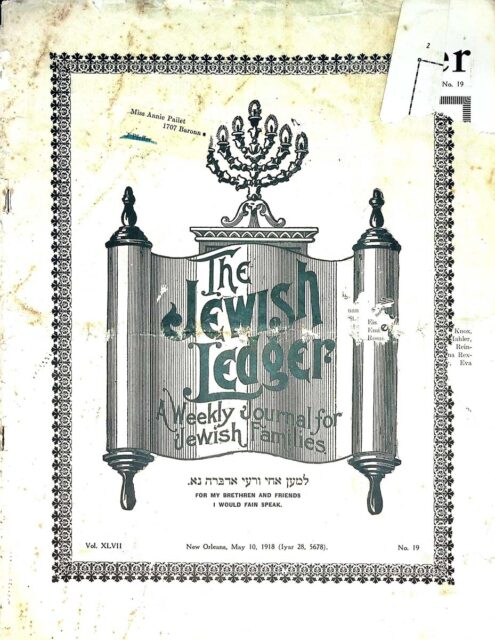
Cover of the May 10, 1918 edition of The Jewish Ledger, published by Steeg Printing and Publishing. Courtesy of The Museum of the Southern Jewish Experience
But details that didn’t make the internet’s patchy records have been passed down through the Steeg family. Strictly speaking, these stories are hearsay—Robert Steeg had not yet been born in 1940, and so never met his press-operating grandfather and never set foot inside Steeg Printing and Publishing—but they give us glimpses of how the business operated in the city’s ecosystem. Steeg remembers his father describing how he’d deliver pushcart-loads of the Jewish Ledger to businesses along what was then Dryades Street and is now Oretha Castle Haley. Then a bustling commercial district with a number of Jewish-owned businesses, particularly department stores like Kaufman’s and Handelman’s, Dryades Street was a manageable walk from Turners’ Hall for an energetic boy. Black shoppers barred from Canal Street made up a substantial part of the Dryades corridor’s business. While it would be too rosy to describe the shopping district as “integrated” —these same shoppers would boycott businesses along this corridor in 1960 for refusing to hire Black workers in managerial or customer-facing roles—the stores and customers on Dryades Street did better reflect the diversity of the city’s population. (And as the home of Leidenheimer’s Bakery, it probably also smelled good.)
A responsible corporate citizen before the concept was commonplace, Steeg Printing and Publishing hired people of color, like Moret, and strove to keep its employees on the rolls during the Depression. This represented a significant challenge, as New Orleans, the leading city in an agriculture-heavy state and a major port, was hit early and hard by the effects of the collapse. The shape that emerges is of an business run along ethical lines, enmeshed in the various cultures of the city: run by immigrants and their descendants, employing Black people, and printing work of interest to the city’s Jewish and Masonic communities—as well as the great unifier, Mardi Gras.
You never know what questions your descendants will have. None of the Steegs who ran the printing press in Turner’s Hall could have foreseen that, a century later, a magazine housed in the same building would be trying to publish the history of their family business. Our chief defense against oblivion (and a kindness we can do future journalists) is to keep telling our stories—and to keep some primary sources in waterproof, clearly labeled boxes.
Chris Turner-Neal, the former managing editor of 64 Parishes, now lives in Buenos Aires, Argentina.