Magazine
Uplifting New Orleans
Using mule-powered screws and hydraulic lifts, Abry Brothers have been raising and moving buildings since 1840
Published: June 1, 2026
Last Updated: September 1, 2026
HNOC and NOMA, courtesy of Abry Brothers, INC
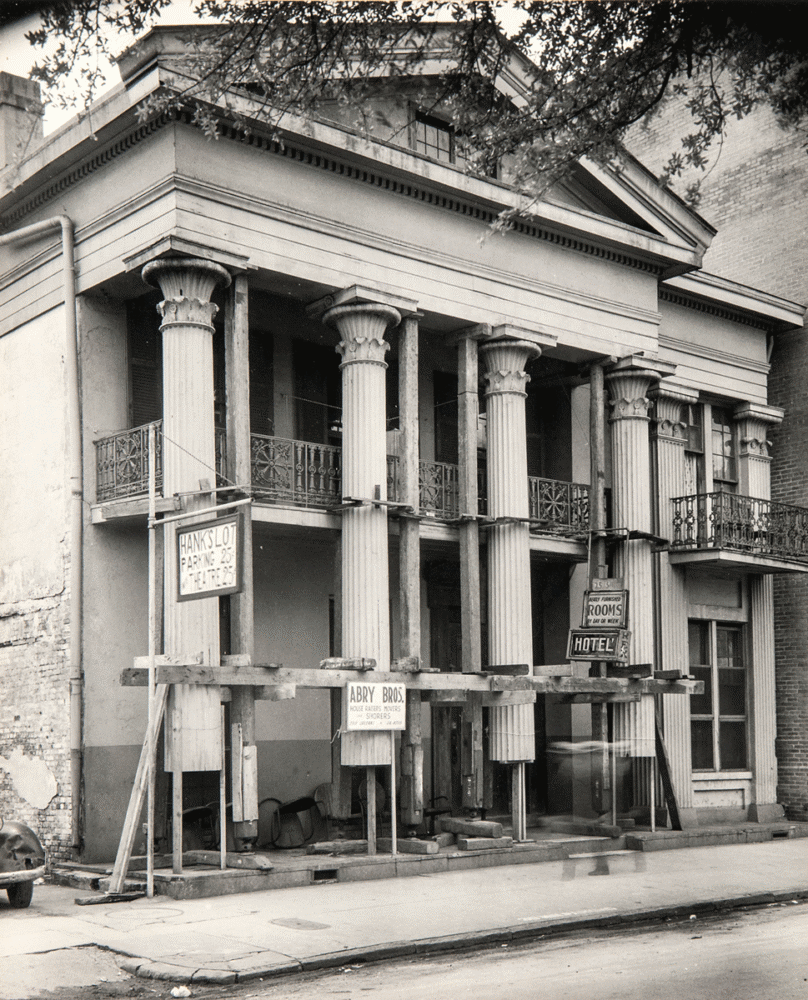
Suspension (#2) by Clarence John Laughlin. Gelatin silver print of a building that was once in the 200 block of N. Rampart Street in New Orleans, 1946.
Greg Abry’s fate was sealed by a summons to jury duty—not his own, but his mother’s.
Louise Abry learned she would need to check in each morning for two summer weeks at the courthouse. What would she do with her school-age son, Greg? Her husband, Herman, had a ready answer: he would bring the boy to work—and the boy was eager.
Days at his father’s side required no suit and tie, only clothes fit for clambering over beams and heavy equipment. Herman ran Abry Brothers, and during those long weeks, eleven-year-old Greg Abry began to learn the arduous, tricky, sometimes seemingly miraculous job of raising, moving, leveling, and shoring buildings.
“When I was younger than that, I would ride around with my dad to look at jobs,” Greg said. “He would even let me drive the truck pulling a house they were moving—very slowly.”
Greg never stopped spending school breaks digging beneath houses and working around construction gear. He joined a long line of Abrys in the business, starting with his great-great-great-grandfather, John G. Abry. In 1832, the elder Abry moved to New Orleans from Frankfurt, Germany, bringing with him experience in moving houses. By 1840, he had opened shop in a city where termites, clay-rich soil, high water tables, and frequent flooding conspire to damage homes—and demand taller footings.
“We never run out of work,” Greg said.
Today, his twin sons make Abry Brothers a seventh-generation enterprise. Thomas, the chief operating officer, holds a degree from Louisiana State University in construction management. Patrick, the chief administrative officer, is an LSU-trained engineer. They acknowledge that the work can be dirty and dangerous. The reward is knowing they are saving structures in the city they call home—structures whose craftsmanship and materials often can’t be replicated today.
Recently, the trio tried to assess just how many buildings in the greater New Orleans area the Abrys have improved, secured, and sometimes outright saved. Thomas punched numbers into a calculator. Patrick noted that some buildings had been worked on twice. After an approving nod from Greg, they settled on an estimate: more than ten thousand structures.
A few projects capture the scope and complexity of that work. In 1917, Abry Brothers moved St. Boniface Church, topped with a 119-foot steeple, nearly half a mile. (The wooden structure burned in 1945.) In 1941, the company lifted a thirty-five-unit brick apartment building to repair its failing foundation; residents continued living there during the process.
Over the decades, the firm has shored up a former cotton warehouse on Tchoupitoulas now home to a Rouses, the Sazerac House, and the City Park Carousel while structural improvements were made. When Turners’ Hall, an 1868 palazzo-style masonry building in the Central Business District, threatened to buckle one late night in December 2024, Abry Brothers arrived at daybreak with steel beams to secure its façade. Work is ongoing on the one-time German social hall and home to the Louisiana Endowment for the Humanities since 2000.
The New Orleans Museum of Art holds Abry history on its walls, too, but not because of work the company has done. The museum owns an image by the pioneering Louisiana surrealist photographer Clarence John Laughlin. In the 1946 photograph, titled Suspension (#2), a neoclassical building’s four columns appear lopped off at their bases, hovering midair; one holds a sign with the words “Abry Bros.” The work was later purchased with a donation from the Abry family.
Shoring and raising techniques have evolved. Once, mules walked in circles to turn screws that lifted houses on wooden beams. Later, air jacks were adapted for house-raising—thanks, Greg said, to “some early, ingenious Abry” who noticed powerful jacks used to compress cotton before shipping and turned them on their sides to harness the same force. Today, computerized systems add precision to hydraulic lifts. A combination of physical labor and modern technology has always been required to lift buildings weighing 350 tons or more, but the sense of wonder remains.
In a video on the company’s website that shows the raising of Tulane University’s Alumni House above flood level, white dormers and brick walls rise slowly skyward in one smooth movement. The scene recalls the dramatic house lift-off in the animated Disney film Up, powered by a mass of helium balloons floating above the roof. To elevate the Alumni House, massive steel beams and synchronized hydraulic pumps did the heavy lifting. Crews added concrete blocks atop the existing foundation walls and filled the empty cells with steel and concrete—materials designed to last another two hundred years.
Once the beams were removed and the house rested securely at its new height, liquid flowed. It wasn’t flood waters, though. Each team member popped open a bottle of Champagne.
Kerri Westenberg, a New Orleans writer, has been an editor at numerous magazines, including National Geographic, Bon Appetit, and Cooking Light. She wrote the award-winning article “Warning: This Article May be Banned” for 64 Parishes.