Amazing Stories, Visionary Art
HNOC’s Daniel Galouye Papers
Published: August 29, 2025
Last Updated: December 1, 2025
Courtesy of the Historic New Orleans Collection
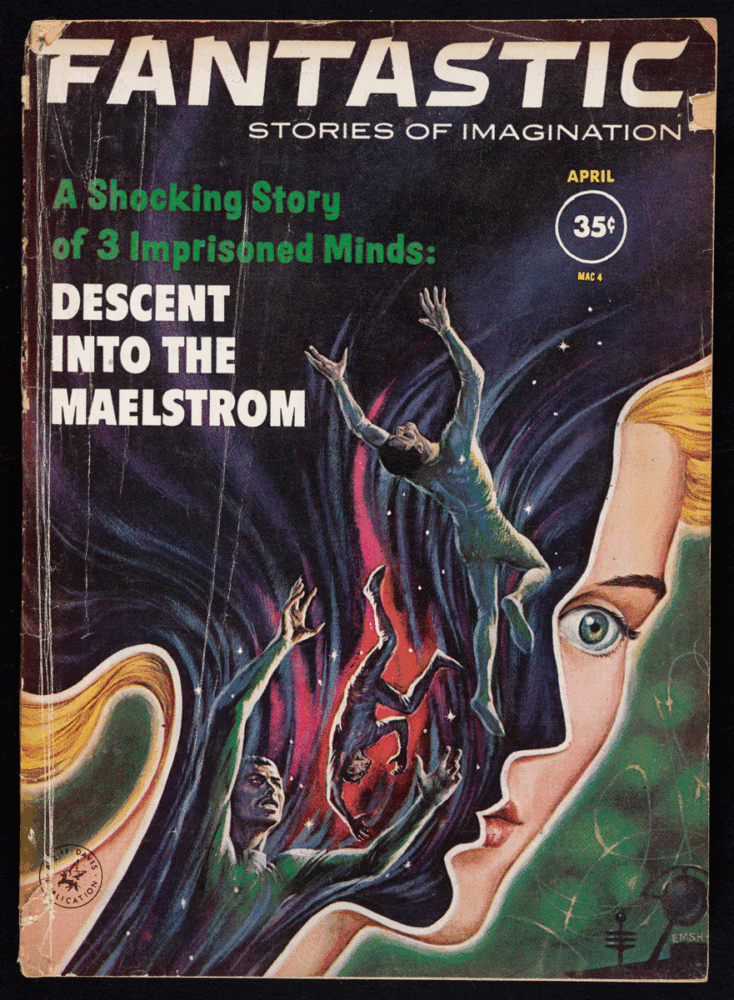
Cover of April 1961 Fantastic Stories of Imagination featuring Galouye’s “Descent into the Maelstrom.”
Long before Black Mirror and Severance, science fiction magazines were a potent way to channel modern anxieties into entertainment media. One New Orleans writer became a leading world builder of weirdness. Join us—if you dare—for a deep dive into the archival holdings of the Historic New Orleans Collection.
In the early 1950s, science fiction was a popular but still largely fringe genre. Film, books, and short stories published in dedicated magazines were discussed and traded among fans through mailing lists and small conventions. Among the most popular was Worldcon, which debuted in 1939 and was hosted by the World Science Fiction Society. The 1951 gathering, dubbed Nolacon I, was held at the St. Charles Hotel in New Orleans.
Conventions were an opportunity for fans to screen new films—and Nolacon I didn’t disappoint, offering a midnight preview of Robert Wise’s The Day the Earth Stood Still, recognized today as a classic and selected by the Library of Congress for preservation in the National Film Registry. Convention attendees could mingle with sci-fi heavy hitters like writer Robert Bloch and editor John W. Campbell. Also on the agenda, at Nolacon and other conventions, were auctions of original work by the talented artists whose visions graced the covers of the era’s science fiction and fantasy magazines.
Over one hundred specimens of these magazines, with their fun and evocative cover art, are available to the public as part of HNOC’s Daniel F. Galouye collection, spanning the years 1952 to 1970. A prolific author of science fiction, Galouye is best remembered today for his novels, including the Hugo Award–nominated Dark Universe (1961)—but his writing career began much earlier. Born in New Orleans in 1920, Galouye worked as a journalist before and after serving as a Navy pilot in World War II. An injury suffered during the war eventually led to his early retirement from the States-Item in 1967.
Galouye’s first piece of short fiction, “Rebirth,” was published in the March 1952 issue of Imagination. He continued to publish in Imagination and other magazines for nearly two decades, sometimes under the pen name Louis G. Daniels. After Dark Universe, Galouye published four more novels. His work showed an interest in the ways that consciousness and perception can be altered or unreliable. In a 1968 article published in the States-Item, Galouye discussed how the genre should try “to stimulate the sluggish imagination of a public primarily concerned with the immediate necessities of life and to extend the horizon of speculation on future developments.”
A pioneer of cyberpunk, Galouye’s influence extended beyond the page. His 1964 novel Simulacron-3 was the basis of the Saturn Award–nominated 1999 film The Thirteenth Floor, and his work precipitated concepts of virtual and simulated realities recognizable in films like The Matrix.
The illustrations accompanying Galouye’s stories helped realize his visions of worlds populated by futuristic technology, influencing what would become a highly recognizable aesthetic. Robots, rockets, and flying saucers were frequent subjects, as were humans interacting with extraterrestrials in prosaic settings, as on the cover of the April 1959 issue of Galaxy, which features a human astronaut playing a game of poker with one robot and five extraterrestrials.
The September 1960 cover of Worlds of If shows an alien commenting on a painting while the human artist looks on. The cover of the July 1964 issue of Amazing Stories: Fact and Science Fiction, which features a story by Galouye titled “Reign of the Telepuppets,” shows an astronaut on a planet with a red surface, surveying the work of three vaguely anthropomorphic robots. This imagined tech is a near analog to today’s Mars rover.
The cover logline for Galouye’s “Descent into the Maelstrom,” featured in the April 1961 issue of Fantastic: Stories of Imagination, declares it “a shocking story of three imprisoned minds.” The imprisoned minds are shown as three free-floating bodies in space within the silhouette of a face, which is superimposed over another face. “Mindmate,” featured in the July 1964 issue of Amazing Stories: Fact and Science Fiction, is illustrated by a man’s head doubled by a smaller version, which is topped by what the reader might assume is a mind-manipulating device.
By the end of the 1960s, sci-fi magazines were in decline, displaced by comic books. Galouye continued to publish into next decade, including a 1973 novel The Infinite Man, which combined material from his 1950s magazine pieces. He died in 1976, at just fifty-six years old, but his legacy lives on in the way science fiction has influenced our vision of the future.
Learn more at hnoc.org.