Magazine
American Populist
American Populist: Huey Long of Louisiana is the 2026 Book of the Year
Published: June 1, 2026
Last Updated: September 1, 2026
LSU Press, 2025
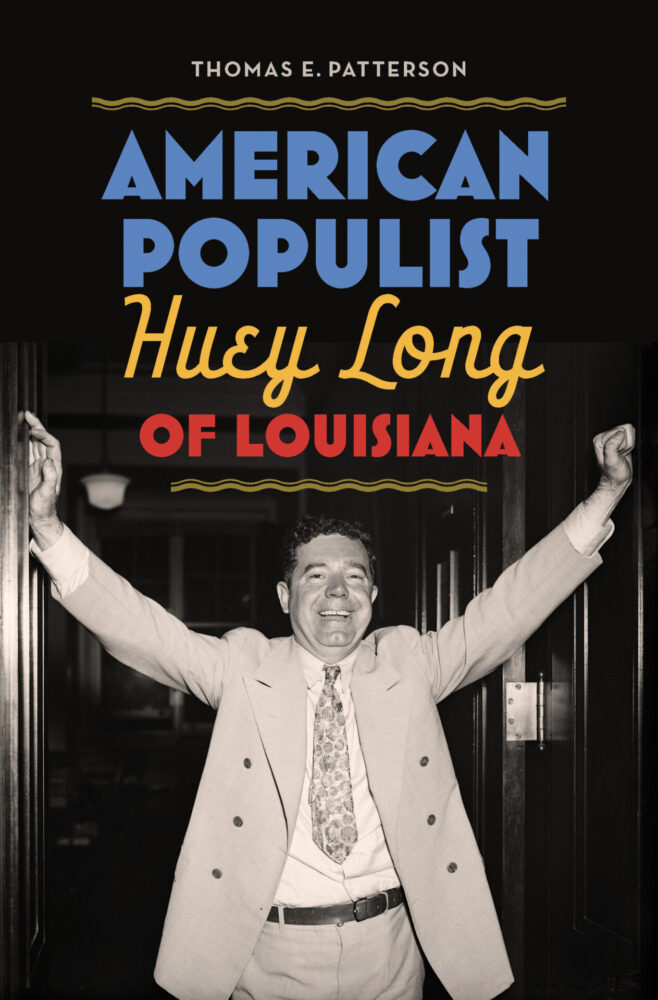
American Populist: Huey Long of Louisiana by Thomas E. Patterson is the LEH’s 2026 Book of the Year. Published by the Louisiana State University Press, American Populist reframes the present-day caricature of Long, deconstructs existing narratives and introduces new scholarship to the subject of the Kingfish. The following is an excerpt from the book’s introduction.
Plantation owners and a corrupt New Orleans machine ruled Louisiana. Immediately upon his election, however, Huey astounded the state by regulating railroads, utilities, and oil companies for the first time. On behalf of independent oil drillers, he took on Standard Oil Company. He forced a phone company to write refund checks to its customers throughout the state after he argued the case in the U.S. Supreme Court, winning compliments from one of the justices along with the case. These efforts made him popular, and Huey won the governorship of Louisiana on his second try in 1928.
Huey’s accomplishments as governor are legendary. His legislation gave free schoolbooks and bus rides to secondary school students. He sponsored education classes that taught 125,000 illiterate adults to read. School enrollment accordingly increased by 20 percent, and adult illiteracy decreased by 10 percent. His free-schoolbooks law artfully provided them to Catholics in private schools without violating the First Amendment. He shifted the tax burden from the poor to the wealthy. He took Louisiana out of the mud, building roads, bridges, an airport, a state capitol, and a governor’s mansion. Even opponents admitted to the high quality of his building projects. Huey radically improved Louisiana State University (LSU), beginning with the creation of a large marching band, an improved football team, and a new medical school, doubling the supply of doctors. He expanded the free Charity Hospital in New Orleans, and its death rate was reduced. LSU’s accreditation rating went from C to A. Enrollment exploded. New buildings, courses, and first-rate faculty accompanied the expansion. Tuition was cheap, and many students obtained state jobs. LSU attracted applicants from all over the South during the Great Depression.
Elected U.S. senator, Huey advocated the redistribution of wealth by means of high taxes upon the wealthy. This was one of Franklin Delano Roosevelt’s promises in his 1932 campaign, during the third year of the Great Depression. Believing that Roosevelt was progressive, Huey helped him win the presidency. Huey strengthened the early New Deal Banking Act so that it rescued state as well as federal banks and insured bank deposits. With these changes, it was the most successful of the early New Deal programs. Yet Huey and Roosevelt could not get along.
Huey’s revolutionary program of taxing the wealthy to provide services to everyone else, his ruthless control of patronage from the state government down to local school boards, his humiliation of the old aristocrats, and his continued electoral success provoked violent reactions.
In February 1934, Huey started a movement called the Share Our Wealth Society. Anyone could organize one. The societies sought a more equitable distribution of wealth by taxing the rich and guaranteeing everyone else a minimum income, a home, college and vocational education, and an old-age pension. He advocated shortening the hours of work, increasing the money supply, a unique farm program, and generous veteran benefits, too. Share Our Wealth’s platform was set forth in a thirty-two-page pamphlet. The mission of the societies was to develop a voting majority for his economic proposals and elect Huey president. Their growth was stunning. There were an estimated nine million members in September 1935. This threatened Roosevelt so much that he endorsed or sponsored legislation in the so-called Second New Deal of 1935—Social Security, progressive taxation, the Labor Act, and aid to college students, among them—to “steal his thunder.”
Roosevelt did not rely on stolen thunder alone to fight Huey. He abused the IRS and the FBI to investigate or prosecute him and his allies, and he expanded and politicized governmental relief expenditures in Louisiana to defeat him. William Ivy Hair calls this the “dark side” of Roosevelt’s presidency.
In response, in a series of special legislative sessions that passed laws with frightening speed, Huey cannibalized every governmental job in the state, including local governments and school boards. This increased his patronage without raising the total tax load of the state. It was done while he was a U.S. senator and lacked any official role in Louisiana’s government. If that were not unusual enough, he dominated Louisiana legislative sessions in person, explaining the legislation and instructing his followers how to vote. Many thus thought that he was an incipient fascist, the first potential dictator of the United States.
Louisiana at the time had a history of violence. Huey’s revolutionary program of taxing the wealthy to provide services to everyone else, his ruthless control of patronage from the state government down to local school boards, his humiliation of the old aristocrats, and his continued electoral success provoked violent reactions. In one congressional election, armed gangs opposed to Huey hijacked state trucks and burned the ballots they carried. An organization of armed men who had formed to overthrow Huey was routed by tear gas fired by the National Guard. Advocacy of armed revolt against the “dictator” Long appeared in newspapers. Huey was threatened publicly with whipping, hanging, and kidnapping. The mayor of Shreveport said he would swing the rope. The lieutenant governor said he would pardon the kidnappers.
Conspiracies to assassinate him were common. Thirty years later, one of the plotters reminisced that Huey was a “dictator just like the Kennedys.” We “would all have killed him, he said with relish.” The bodyguards Huey surrounded himself with added to the sense of drama and danger.
On September 8, 1935, a brilliant young doctor shot Huey in the Louisiana State Capitol. Huey’s bodyguards riddled the assassin with bullets. The circumstances provoked conspiracy theories that are still asserted today. Two days later, Huey died age forty-two.
Copyright © 2025 by Louisiana State University Press. Used by permission of the publisher. lsupress.org.
Thomas E. Patterson is Bradlee Professor of Government and the Press at Harvard University’s John F. Kennedy School of Government. Previously, Patterson taught for over two decades at Syracuse University’s Maxwell School of Citizenship.