Magazine
Asylum on Flowery Hill
The history of the East Louisiana State Hospital in Jackson
Published: March 1, 2026
Last Updated: June 1, 2026
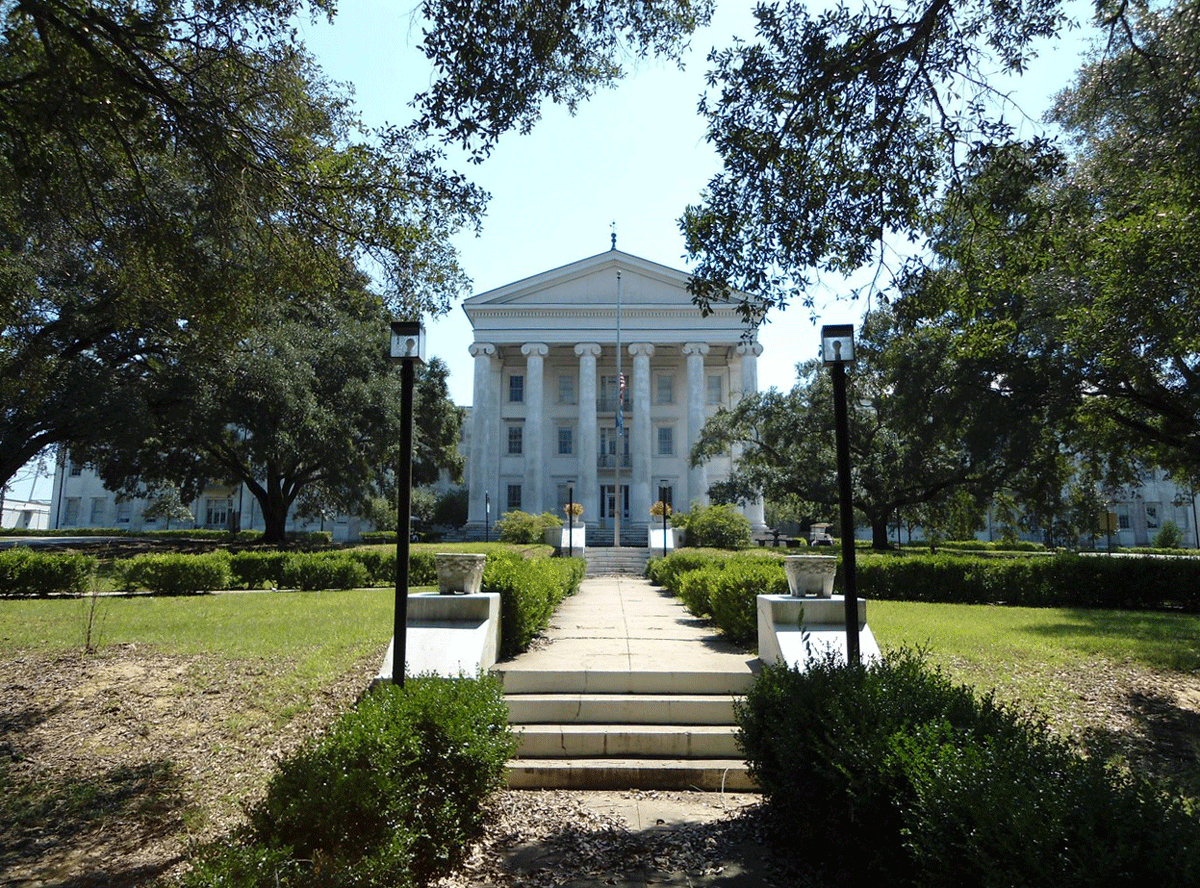
Photo by Z28scrambler, courtesy of Wikimedia commons
Charged with designing a hospital in 1847 that would not look like a prison, architect Charles Gibbons likely produced this Greek Revival design for the state's first facility for mentally ill patients.
In 1847, the state legislature passed a law directing the establishment of the “Insane Asylum of Louisiana” in Jackson, Louisiana, and laying out how it should be governed along with processes for patients’ committal. A site outside town with the optimistic name of “Flowery Hill” was chosen and obtained for the project based on its relative isolation and perceived healthful aspects—which in those malarial and yellow-feverish days could simply mean it wasn’t covered in standing water full of mosquito larvae. The architect, recorded only as “Mr. Gibbens” but likely Charles Gibbons, famous for other work in the Felicianas, was given the brief to make something pretty that wouldn’t look like a hospital or a prison. He succeeded: the Greek Revival structure he fabricated is described in the site’s successful application to the National Register of Historic Places as an “outstanding example” of the style even though it was “stretched to its limits” to accommodate the requirements of an inpatient facility.
Renamed East Louisiana State Hospital, the facility still operates on the same site today, though those laid to rest in the attached cemetery now outnumber current patients. The history of the facility mirrors that of mental health treatment across the United States and indeed much of the world, with recurring questions regarding both the definition of “insanity” and how the mentally ill should be treated.
Though the hospital was intended to be ready for incoming patients in December 1847, construction delays due to bad weather meant that patients couldn’t arrive until late 1848; even then some parts of the facility remained under construction, and it was never fully completed to the original plans. In the first decade of the 1900s, a sister asylum was built in Rapides Parish under the name “Louisiana Hospital for Insane of the State of Louisiana” (sic, in the official record). The original intent was to segregate both facilities, but chronic underfunding and crowding meant that both at times could not separate patients by color.
[T]he Greek Revival structure . . . is described in the site’s successful application to the National Register of Historic Places as an “outstanding example” of the style even though it was “stretched to its limits” to accommodate the requirements of an inpatient facility.
Who were “the insane?” In Louisiana as in other jurisdictions, the definition varied over time and overlapped with criminal law and disability in addition to mental illness. 1855 legislation allowed those arrested for a crime who were in the grip of “insanity or mental derangement,” along with those acquitted or whom the grand jury wouldn’t indict for such reasons, to be sent to the state mental hospital or a similar parish-level institution “until he be restored to his right mind.” Notably, there’s no definition in this establishing text how such insanity or derangement is to be defined, nor who should make this assessment. Per the 1910 “Act to provide proper proceedings relative to the insane,” any “respectable citizen” could inform the local judge that a “lunatic or insane person ought to be sent to . . . one of the State hospitals”; the judge would then hold a hearing along with two physicians unrelated to the prospective lunatic. (A carve-out allowed the city courts of New Orleans to continue what they were doing, a separate process based on affidavits.) Subsequent legislation makes clear that people with developmental disabilities were being housed with the “insane,” criminal or not, and that they were to be transferred to the new “State Colony and Training School.”
If the definition of the “insane” has historically been unclear, so has their progress once admitted to the East Louisiana State Hospital, though interested parties have intermittently investigated. In 1963, the residents were joined by photographer Richard Avedon, who stayed in the facility for a week, photographing the residents. Avedon, then at Harper’s Bazaar, was noted for his portraiture, photographing people “in the wild” on the street and as they went about their lives, instead of in formal studio settings. Avedon’s sister had been institutionalized after a schizophrenia diagnosis and ultimately died by suicide; his probable curiosity about how she had lived likely explains the project.
In 1980 the New Orleans Times-Picayune had a reporter get a job as an orderly, leading to a series called “Century of Shame”; subsequent promises of reform seem not to have materialized. In 2019, nola.com sent reporters openly, as part of a broader series on Louisiana’s mental health care system. They interviewed stakeholders, including then-CEO Steve Lea, but were not able to visit any areas of the facility housing patients. The resulting article criticized the perceived “competition” between those in the facility because of involvement with the criminal justice system and those otherwise needing mental health care, indicating a tension between the hospital’s roles as a care facility and as a quasi-correctional institution. A plan to shutter the ailing building never came to fruition, and so while some of the outbuildings have been abandoned to the elements, graffiti, and thrill seekers bent on investigating the “abandoned asylum,” the original structure still houses some of the Louisianans who most need help.
Chris Turner-Neal, a former managing editor of 64 Parishes, now lives in Buenos Aries.