Magazine
Back in “the Fun Shop”
Two magicians made a Halloween store Shreveport’s secret Gay Pride headquarters
Published: June 1, 2026
Last Updated: September 1, 2026
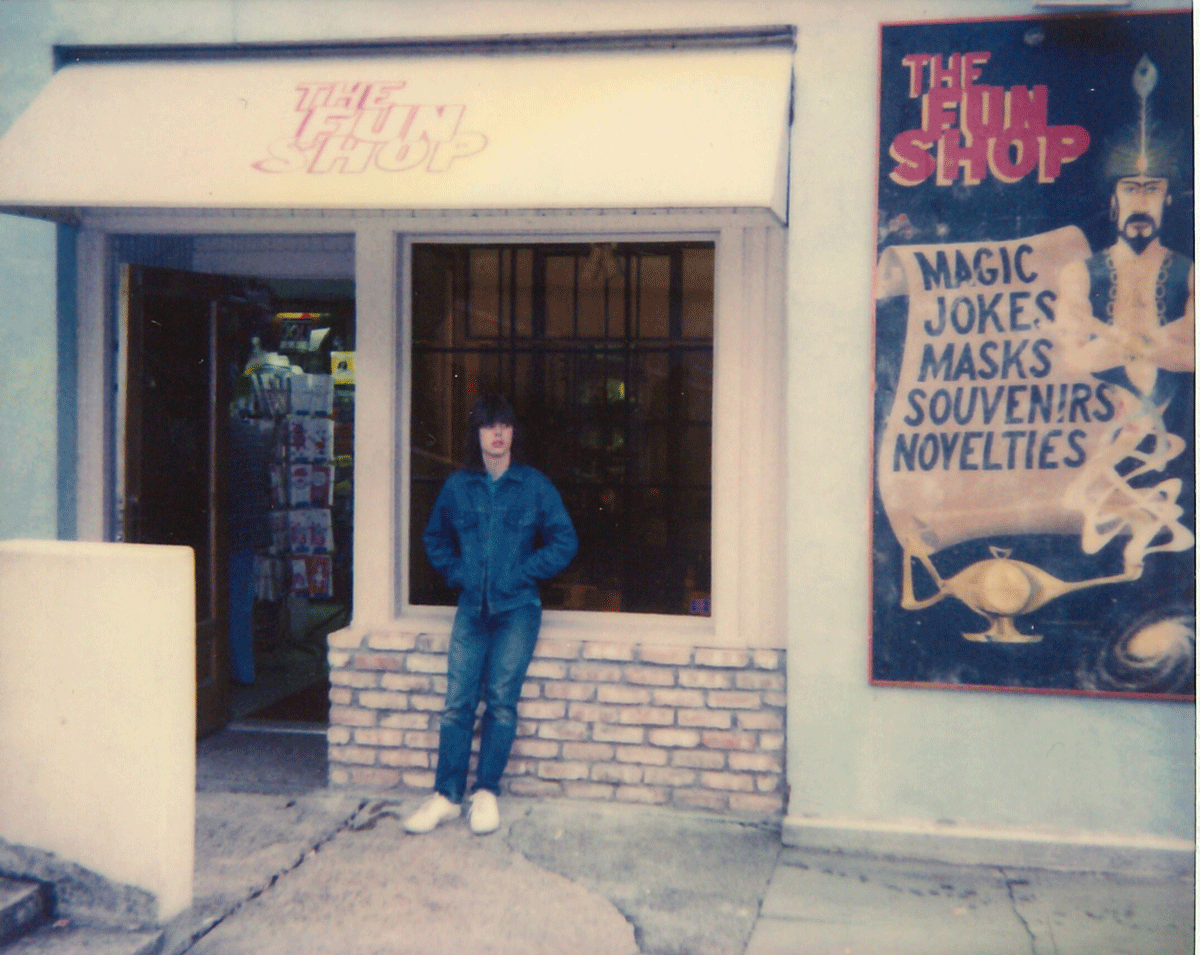
Courtesy of Bill Lindsey
Young man stands in front of the Fun Shop in Shreve Square, circa late 1970s.
In Reagan-era Shreveport, a Halloween novelty shop on the southeastern corner of Shreve Square maintained a backroom, cordoned off with a black curtain and a sign that read “Adults Only.” Such intrepid language stimulated whisper campaigns in high school hallways and church lobbies that proved irresistible to the curious and brave. “When someone turned eighteen, like on their birthday, they would say, ‘We gotta go by the Fun Shop,’” recalled former store manager William “Bill” Lindsey in a telephone interview on January 9, 2026.
Station wagons blasting New Wave beats would pull up to the shop. The visitors would enter in silence. “They’d come in nervous, I mean nervous like a mouse in a house of cats,” remembered Lindsey. Traipsing past the Halloween masks and magic tricks near the window displays, they would present their IDs to staff and lift, at last, the curtains to reveal a universe of wonders withheld. “They’d go back and end up laughing and giggling,” Lindsey said. “Because it was pretty racy, in the early eighties, to see adult novelties and XXX-rated video boxes right there in front of you. It’s like that shock thing: Here’s the adult world”—which, at the Fun Shop, meant frank depictions of sexuality in a clean and brightly lit room monitored by a store employee.
The Fun Shop, at 103 Texas Avenue under the Texas Street Bridge, was co-owned by two “unmarried” men in this Baptist stronghold of northern Louisiana—“The Buckle of the Bible Belt.” Yet religious sentiment did not deter Shreveport’s mainstream media outlets from promoting the Fun Shop during Halloween seasons. For example, in a 1979 story in The Shreveport Times entitled, “It’s always Halloween at the Fun Shop,” owner Joe Hutson exclaimed, “We had three different styles of ‘Coneheads’ masks, and we are completely sold out of them.” The prior year, in a Shreveport Journal article entitled, “Super Masks for Super Spooks,” co-owners Joe Hutson and Johnny Benson boasted, “We have as much fun as being at a party!” In a region of dwindling economic prospects due to declining oil revenues, the Fun Shop promised patrons creativity and amusement with no strings. “Everybody, of all walks, was coming through that door,” insisted Bill Lindsey, who declined to name names. “All cultures and all artists and all kinds.”
In this community, “Sundays were for church,” explained gay Shreveport historian and documentarian David Hylan in a recent telephone interview. “Mondays, you go to visitation. Wednesdays, you go to a prayer meeting. It was all around that religious life.” According to the 2011 study “The Bible Belt in a Changing South” by geographer Stanley Brunn, more than 25 percent of the religious adherents in Shreveport’s 200,000-strong population ascribed to a form of scriptural interpretation called Biblical literalism, which defined homosexuality as an “abomination” throughout the late twentieth century. But many of these residents nevertheless lived tolerantly with the local “odd shop” devoted to earthly delights.
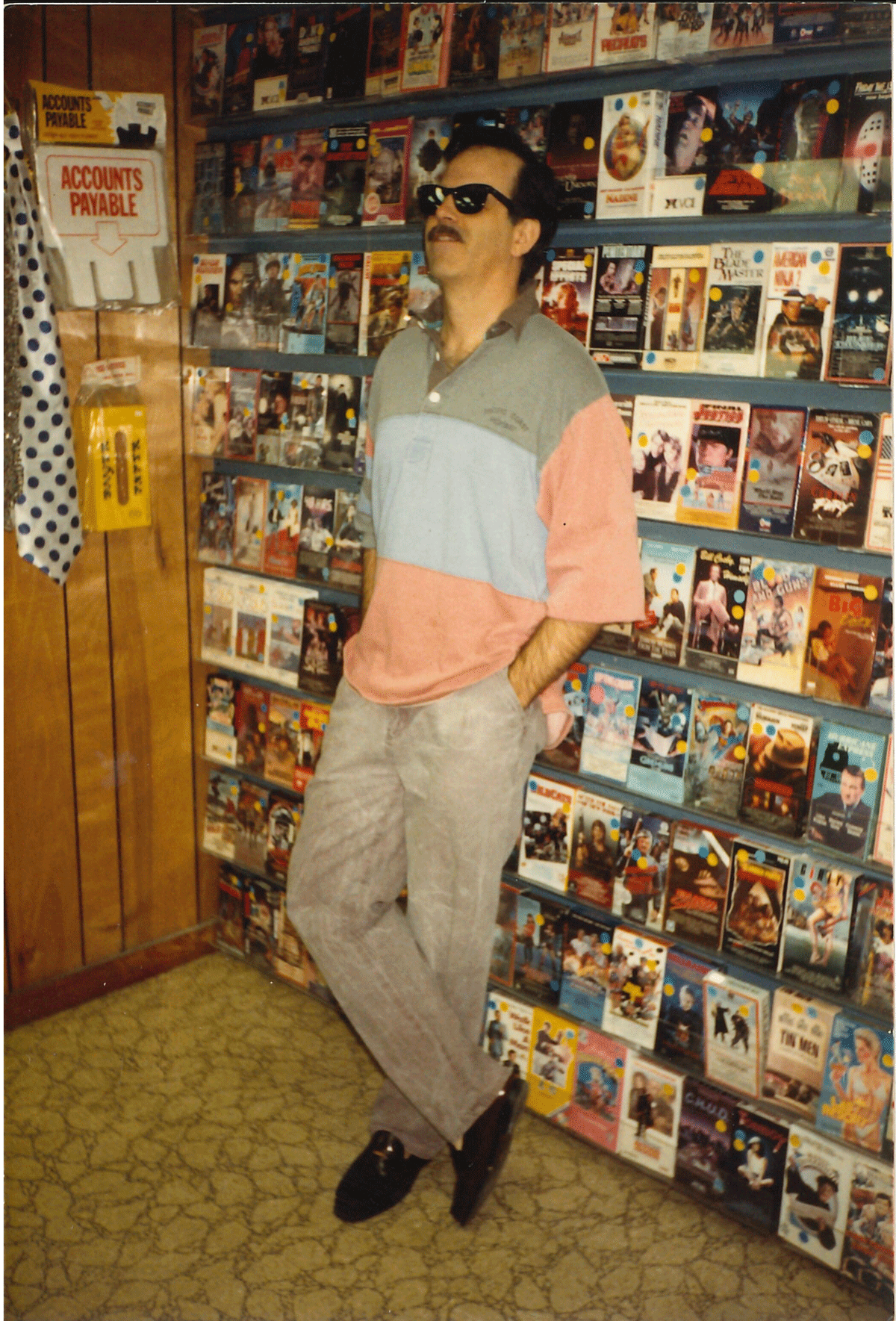
Fun Shop Owner Joe Hutson leans against a display of VHS tapes in the Fun Shop. Courtesy of Bill Lindsey
Fun Shop co-owners Garland “Joe” Hutson and John Wayne “Johnny” Benson met at Northwestern State University in Natchitoches. In 1972, Hutson was a bespectacled grad student in the Psychology Department, while Benson was a dreamy undergraduate who’d just declared as a Speech Education major. Physically, Hutson stood out on campus as all-American handsome, with brown-green eyes and a Spartacus chin. He wore tastefully open polyester shirts (top buttons undone), which advertised his ample chest hair. Four years younger than Hutson, by contrast, Benson sported a shoulder-length mane he slowly grew to his waist, which rendered him an artsy beauty. The student body celebrated Benson as a gifted magician. Hailing from Springhill, Louisiana, near the Arkansas border, he’d been that entrepreneurial kid on the playground who performed magic tricks for spare pocket change. At parties, he could guess a card drawn at random from a deck or make a stuffed rabbit disappear up his sleeves.
Being gay in the Bible Belt was akin to a magic act—now you see it, now you don’t. Pre-AIDS, gay life in Natchitoches operated in the furtive mold similar to Shreveport, where “several of the more prominent civic and business leaders in the community are generally known to be gay—although married,” as wrote a gay Natchitoches resident named Damien to a gay New Orleans activist named Alan Robinson in the early 1980s.
It’s unknown if Benson or Hutson made the first move, or how carefully. But the two men not only clicked romantically at college—they also discovered that they shared niche interests in magic and costuming. Within the year, they’d slipped away from their studies to explore the regional mecca of Houston, Texas. By January 1974, according to Caddo Parish records, they transplanted back to Hutson’s hometown of Shreveport and took out a lease at “Building No. 103 Shreve Square.” To solidify their union, they drew up a legal “Partnership Agreement” wherein each contributed five thousand dollars as start-up capital for “a retail novelty shop.” In an era absent other legal mechanisms for same-sex couples, the Fun Shop represented a marriage of interests, which allowed them to co-own a vehicle and share bank accounts without arousing suspicions.
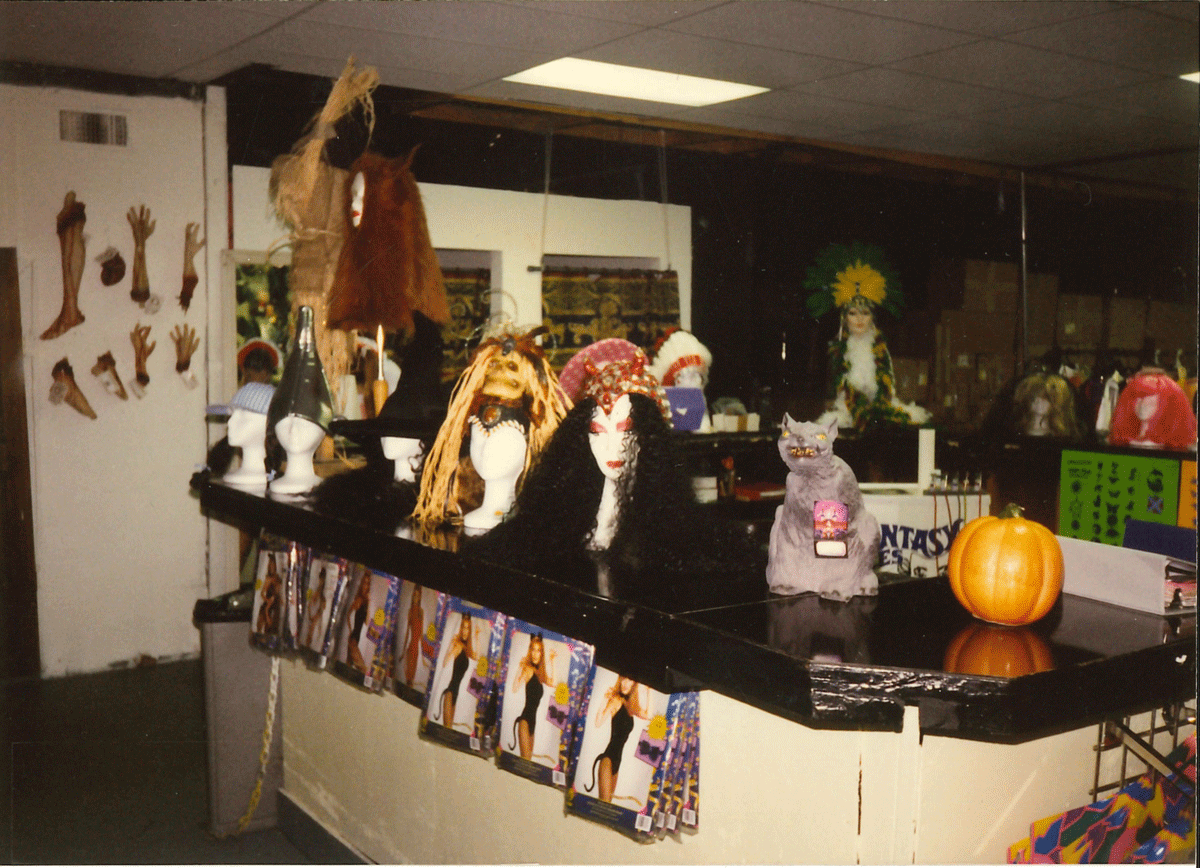
Halloween costumes and masks were among the ephemera sold at the Fun Shop. Courtesy of Bill Lindsey
It was in 1975 that Johnny Benson’s magical talents ascended to local fame. The Shreveport Journal profiled his birthday party illusionist act as part of introducing the Fun Shop to readers. “Lots of people come in here and say I’m weird,” Benson told the Journal after pulling a thirty-five-foot roll of rainbow crepe paper from his mouth. “I tell people I’m the weirdest thing in here.” Shreveport was then considered a smallish city with a zany downtown scene, and so the Fun Shop’s stock of freak teeth and Jello molds in the shape of human anatomy were received as a form of entertainment.
“The face of the Fun Shop was Joe Hutson, and Joe was from here,” explained Bill Lindsey. Hutson was known around town for his signature mustachioed smile, a winsome grin seemed to say, behind the eyes, that he was up to something amusing. Within Hutson’s rolodex dwelt the numbers of major businessmen and politicos of the city. “[Joe] knew how to talk to people,” Lindsey said.
By estimations of several former employees, the percentage of retail revenue earned through the Fun Shop’s front of house versus the back “adults only” section remained a steady 60 percent to 40 percent over the course of the shop’s history, lasting from the 1970s to the turn of the millennium. Those who frequented the store for yearly Halloween costume inspiration professed to be unaware that the back room existed, much less that it contained an “Erotic” emporium trumpeted in national gay travel guides such as the Damron Address Book.
“I would stop in when I was a teenager who was kind of a geek about magic tricks and novelties and was greeted with good humor and the kind of acceptance that suggested that the owner knew me a little better than I had yet to know myself,” recalled Mark S. King, a Shreveport native and gay journalist, reached for comment via email. “I loved being there, even if I couldn’t put it precisely as to why.”
In 1983, Hutson and Benson took a leap as gay business owners: They got political. Overnight, the twosome became the most “out” residents in Shreveport when they co-founded a Gay Pride Committee (GPC), the first organization in city history to embrace the post-Stonewall model of visible, vocal gay citizenship. Almost instantly, the Fun Shop transformed into a GPC planning center. Writing letters, taking meetings, and forming alliances with a range of Gulf Coast gay organizations such as New Orleans’s Louisiana Lesbian and Gay Political Action Caucus (LAGPAC) and Houston Pride, Hutson and Benson brainstormed what a gay parade might look like through Shreveport’s downtown.
Being gay in the Bible Belt was akin to a magic act—now you see it, now you don’t.
“You seem to be making a lot of progress,” wrote LAGPAC President Alan Robinson to the Fun Shop in a letter dated April 29, 1983. “Impressive.” Gay activist Larry Bagneris, who founded Houston Pride and organized that city’s first Pride parade in 1979, advised the GPC to make safety a priority by starting their efforts modestly and attenuating the local community to the then radical notion of visible homosexuality. “I don’t want to take any credit due to Joe Hutson and John Benson,” insisted Bagneris when reached in July 2025. “We were talking long-distance on the phone. They were working it on the ground.”
Hutson and Benson heeded Bagneris’ advice by tabling a Pride parade for a future year. Instead, on Saturday, June 18, 1983, the GPC kicked off the inaugural Gay Pride Week in Shreveport by hosting a drag pageant at a popular gay disco called Monte’s My Way Lounge that crowned a “Mr. & Miss Shreveport Gay Pride Pageant.” LAGPAC President Alan Robinson traveled in from New Orleans to bear witness to this pioneering event. More than 170 people attended the pageant, according to a report Robinson delivered to LAGPAC. Local media outlets did not cover the week’s events.
The following afternoon, June 19, more than a hundred people gathered on a sunny Sunday in a Shreveport park for a Gay Pride Picnic. “About 20% were women,” Robinson estimated in his LAGPAC report. “Several women and men brought their children.” Hutson and Benson booked a private tour bus for later in the week to take Shreveport revelers to meet Larry Bagneris at Houston Pride, where singer Tina Turner was slated to perform. Lastly, Hutson and Benson volunteered to appear as Shreveport’s go-to contacts on a nascent list drawn up by Alan Robinson for a statewide AIDS Lobby Network.
Many forget that the plague struck Louisiana first in the Bible Belt. Of the state’s first six confirmed cases, according to a Shreveport Journal article “AIDS: Who is at risk?” published on June 28, 1983, the earliest two arose in Shreveport—both female, both perishing of an unknown malady attacking the immune system. When it became possible to test for AIDS in 1983, a CDC official went through the state’s backlog and placed those official deaths from AIDS in 1979 and 1982, respectively. Later, according to a New Orleans Times-Picayune article published on August 12, 1985, a Shreveport doctor came forward with a patient who died in 1975 of AIDS-related indicators, and the CDC agreed, which moved the timeline of disease spread back another leap. By July 1984, Louisiana would rank sixteenth in the nation for states reporting AIDS cases, according to CDC figures, with more than half of those patients already dead. The fatality rate stunned policymakers, many of whom nonetheless kept quiet about the emergency.
In 2013, the City of Shreveport passed a Fairness Ordinance to prohibit discrimination on the basis of sexual orientation and gender identity, which made their Bible Belt municipality the second city in Louisiana to offer LGBT+ protections.
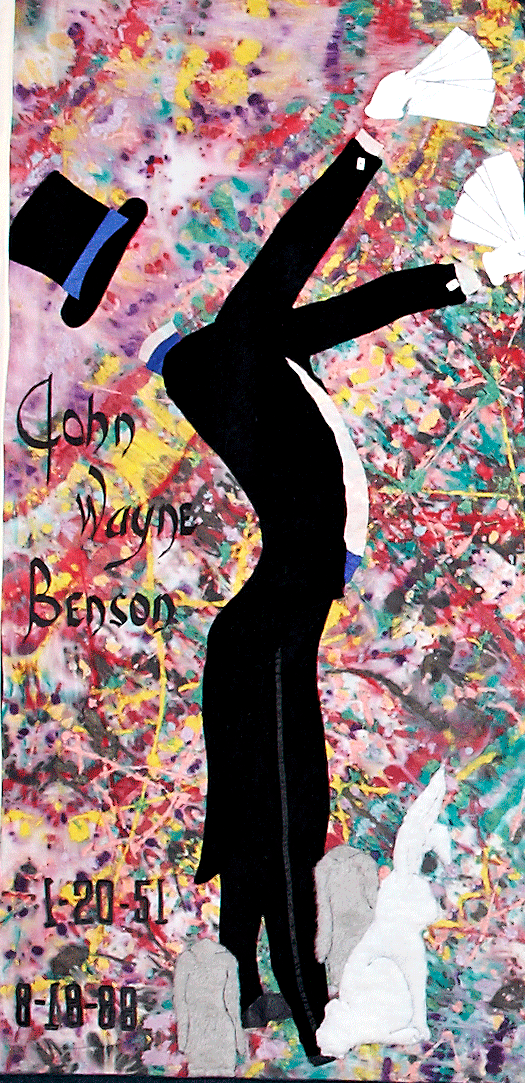
John Wayne Benson’s section of the AIDS Quilt, contributed in 2014 by The Philadelphia Center as part of World AIDS Day observances in Shreveport.
At first, according to longtime gay Shreveport activist Dr. Robert “Bobby” Darrow, fear of the incurable disease spreading from casual contact such as a handshake ran so rampant that the only doctor in town who’d treat AIDS patients was a family clinician named Dr. Marcus Spurlock. Sidelining their Pride activism, Hutson and Benson joined twenty concerned citizens to form an AIDS organization called GLAD in August 1985. Officially, the acronym GLAD stood for “Greater Louisiana Alliance for Dignity.” But, for those in the loop, it meant “Greater Louisiana AIDS Defense,” a name they’d delay acknowledging publicly until 1989. As its first order of business, GLAD voted to start an AIDS information hotline operated by trained volunteers.
News of this four-hour-a-night hotline, however, didn’t circulate for months as GLAD tussled with how to be civic advocates without outing its leadership. For example, David Dement, the son of restauranteur and future mayor of Bossier City (sister city to Shreveport) George Dement, obscured his involvement with GLAD beyond his inclusion as an officer for the nonprofit in paperwork filed with the Louisiana Secretary of State. Constrained by his family’s political name, Dement bided his time and eventually went public in the 1990s as a board member for other AIDS nonprofits, as validated by close friend and fellow activist Bobby Darrow. Dement died at the age of fifty-two “after a long and valiant battle with illness,” a common euphemism for AIDS in Shreveport Times death notices.
Self-employed through the Fun Shop and co-owning his residence at 337 Rear Topeka Street with Johnny Benson, Joe Hutson represented the rare gay citizen who could step forward in 1985 as a spokesperson without fear of employment or housing repercussions. “It’s a hard thing to have a terminal disease,” Hutson explained to The Shreveport Times on behalf of GLAD in a story that October. “But to not have anyone to talk to who understands it makes it worse.” As he spoke these words, Hutson did not explicitly reveal his own situation. For several years, Benson had struggled with alcoholism, and his unaccounted-for nights during relapses likely involved encounters with outside partners. In late 1985, Benson tested positive for HTLV-III/LAV (then the clinical name for HIV). A subsequent test confirmed that Hutson also had the disease.
The pioneering Fun Shop owners fell into illness. Benson got sicker faster. Hutson threw himself into his GLAD activism as his partner weakened—first unable to shuffle a deck of cards and then unable stand, much less make it to the Fun Shop. Housebound, Benson grimly assessed his future and made a move. In April 1986, he took out a $25,000 life insurance policy with Financial Security Life Insurance Co. In applying for this policy, Benson was not specifically asked to disclose his AIDS diagnosis, and he did not volunteer it. He pre-paid several years of premiums and named Hutson as the sole beneficiary.
Now board chairman of GLAD, Hutson organized a free AIDS seminar at the Louisiana State University Medical Center auditorium in July 1986. Shuttling Benson between doctor’s appointments while managing GLAD consumed Hutson’s time, and he needed help running the Halloween store. To ring the register and curate window displays, Hutson hired Bill Lindsey, a longhaired gay wild child he’d met at Monty’s My Way. “Johnny was sick at this time and pretty much not in the business,” recalled Lindsey. “I only got to meet Johnny one time later through a benefit for him, and he couldn’t stay very long.”
By November 1986, Johnny Benson was in and out of the hospital. Visitation rights, with Hutson on the record as a “business partner,” often came into question. “They were not going to let Joe in that hospital room,” said Lindsey. “Just because you’re his boyfriend, y’all been together for a decade, they don’t recognize that.” Consulting an attorney friend named John A. Richie, Hutson and Benson learned of an unconventional arrangement to resolve the matter. And so, on November 24, 1986, 39-year-old Garland Joseph Hutson legally adopted 35-year-old John Wayne “Johnny” Benson as his son and heir.
This “Act of Adoption” gave Benson “all the rights of an adopted child,” including hospital visitations from an adoptive parent. According to Shreveport AIDS historian David Hylan in a recent interview, seeking lawful loopholes was a common tactic for couples facing AIDS and desperate to be at a dying partner’s bedside. On December 2, 1986, just a few days after Hutson’s adoption of Benson, the Financial Security Insurance Co. wrote to rescind Benson’s life insurance policy due to his AIDS status. It’s unknown how they discovered this information. Enclosed with the letter, in which company vice president Bob D. Clynch accused Benson of falsifying health history, was a check for $494.50 to reflect the full return of his premiums, which Benson did not deposit on the advice of his attorney.
Then Shreveport police raided the Fun Shop on March 31, 1988. This incident represented the first police incursion in the business’s then fourteen-year run. “One cop had this little attitude problem, and so he confiscated everything,” recalled Fun Shop employee Bill Lindsey, who was present after the raid. Authorities charged Hutson with the crime of selling items “designed or marketed as useful primarily for the stimulation of human genital organs” using a three-year-old state law that made their trade a felony with a penalty of up to three years’ imprisonment. Out of lockup on a $5,000 bond, Hutson faced the possibility of being incarcerated during Benson’s final days.
Irate, Benson expended precious energy forming a state lobbying group called the Private Acts Legal Defense Fund to rescind the “obscene devices” law. “I am planting a seed hoping people will become aware of what government is doing to regulate our bodies,” Benson told The Shreveport Journal. Moved by his partner, Hutson pursued a civil rights case. “Joe went to court and fought [it],” Lindsey said, describing how a judge sympathetic to the Fun Shop embarrassed the parish prosecutor by dismissing charges in the courtroom and setting a legal precedent—“and that’s why you were allowed to buy adult materials in the City of Shreveport.”
Thirty-seven-year-old John Wayne “Johnny” Benson passed away “of a lengthy illness” on Thursday, August 18, 1988, as read his Shreveport Times obituary. His surviving partner and “cherished companion,” Joe Hutson, scheduled visitation and services at a local funeral home for the following Saturday and Sunday. “I did go to the wake because we were invited to go, friends from the store,” recalled Bill Lindsey. “Family members were there and everything. We kind of just stayed in the background, and when Joe would walk by, we’d give him a hug.”
Gradually, Hutson returned to the rhythm of managing the store, and Lindsey emerged as more than a friend. (“The first I saw Joe, I was like, ‘This man’s gonna be my husband,’” Lindsey said.) Lindsey moved into Hutson’s residence at 337 Rear Topeka Street, and the two embraced a loving domesticity that made the most of the present. “Joe was basically a grown-up kid,” validated a Fun Shop employee of the era named Darren Pope in a recent telephone interview. “He still had that vibe, that energy.”
In June 1989, Hutson sued the Financial Security Life Insurance Co. for the company’s refusal to pay benefits on Benson’s life insurance policy. This civil lawsuit contended that the company’s 1986 cancellation had been invalid and that the still-in-effect policy had become no longer contestable after two active years, which elapsed in mid-1988. On June 26, 1989, Caddo Parish Judge Marvin Gahagan awarded Joe Hutson the full $25,000 as the named beneficiary of one John Wayne Benson. It was Johnny Benson’s last and, perhaps, best magic trick: a disappearing, reappearing insurance policy that supported his surviving partner with loving security.
After fighting AIDS, fomenting Pride in the city he loved through four US presidential administrations, and navigating one forced relocation of the Fun Shop by city developers with a differing vision for Shreve Square, fifty-five-year-old Garland Joseph “Joe” Hutson took his last bow on Wednesday, December 11, 2002. Within a week of his death, the Fun Shop building was sold to cover outstanding debts, and the final footprint of a trailblazing gay couple vanished with a flourish of signatures. Abracadabra. In 2013, the City of Shreveport passed a Fairness Ordinance to prohibit discrimination on the basis of sexual orientation and gender identity, which made their Bible Belt municipality the second city in Louisiana to offer LGBT+ protections. When Bill Lindsey read the news, he thought of Joe Hutson smiling.
On December 1, 2014, a local AIDS clinic called The Philadelphia Center (founded in 1990 by a successor organization to GLAD called ACT UP Shreveport) donated a newly sewn patch to the AIDS Memorial Quilt, a global community arts project ongoing since 1987. The patch depicts a tuxedoed magician, his face invisible, his arms extended skyward, cards flared in his hands and rabbits nestling near the words “John Wayne Benson.” Miles away in Springhill, near the Arkansas border, lies the man’s gravestone with a fading quote: “THE LAST SHALL BE FIRST AND THE FIRST LAST.” Presto.
Robert W. Fieseler is a National Lesbian and Gay Journalists Association “Journalist of the Year” and the acclaimed nonfiction author of Tinderbox—winner of the Edgar Award and the Louisiana Literary Award, shortlisted for the Saroyan International Prize for Writing. His second book, American Scare: Florida’s Hidden Cold War on Black and Queer Lives, was released in 2025. He lives with his husband in New Orleans.

This story is funded by a grant from the Greater New Orleans Foundation’s LGBTQ Fund