Magazine
Back of Town
Excerpt from Eugène and Eulalie: A Family Saga of Love, Race, and Property in Nineteenth-Century New Orleans
Published: September 1, 2026
Last Updated: September 1, 2026
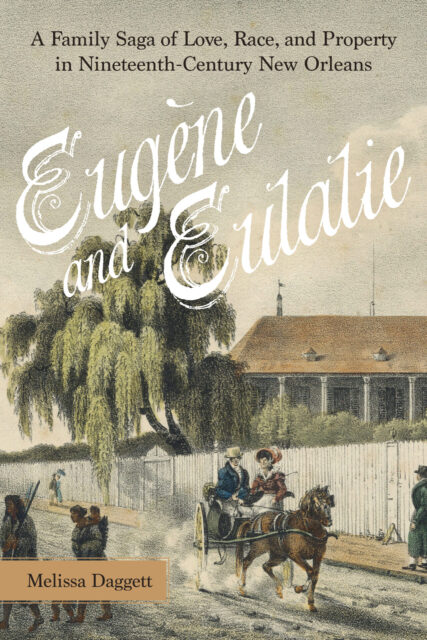 Melissa Daggett’s Eugène and Eulalie is an epic story of love, race, prosperity, and legal maneuvering. It chronicles for the first time in a comprehensive way the largely forgotten lives of Eulalie Mandeville, a free woman of color, and her white partner, Eugène Macarty. Mandeville and Macarty, both descendants of elite colonial families, began an interracial relationship in the 1790s that endured for more than half a century and produced five children. It also led to Mandeville’s phenomenal rise to the pinnacle of wealth and success within the unique tripartite racial structure of nineteenth-century New Orleans.
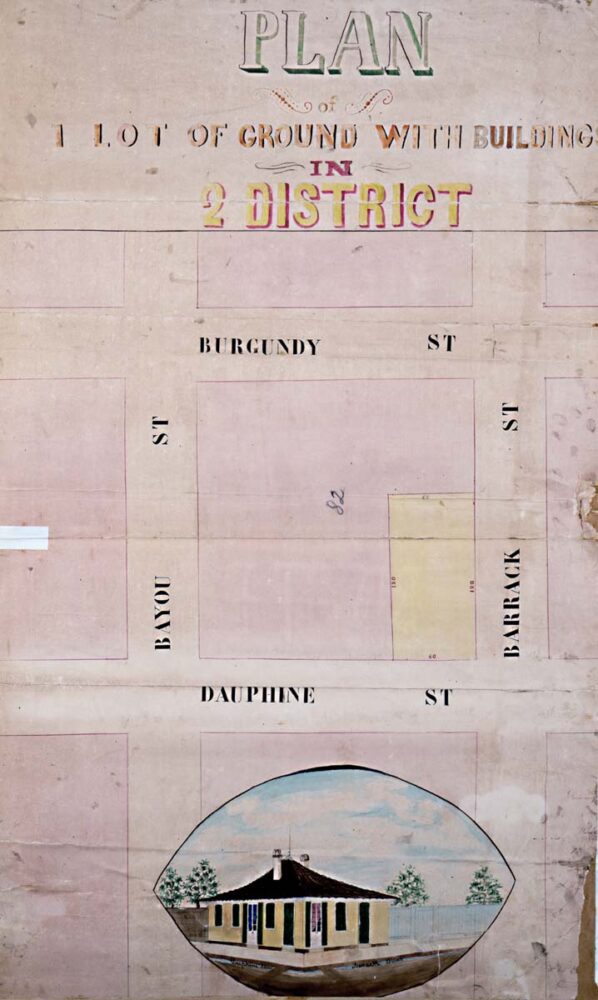
Creole cottages were the most common house type in New Orleans during the early 1800s. Eulalie Mandeville’s Creole cottage at the corner of Dauphine and Barracks streets featured a canted tile roof above nogged (sometimes called briquette-entre-poteaux, or brick-between-post) walls and a double chimney. For the exterior colors, Eulalie chose yellow ochre paint with Paris green shutters and doors and off-white woodwork, a popular color combination of the era. The spacious yard was enclosed by a high white plank-and-picket fence along the street boundary. Presumably, Eulalie’s children played under the fruit trees and the family enjoyed a parterre garden planted with herbs for cooking and medicinal purposes.
Eugène Macarty had purchased the cottage from the Samuel D. Earle estate for $2,400. The Creole cottage had a separate kitchen and three rooms for servants. According to an advertisement in the Courrier de la Louisiane, the house was in good condition and had recently undergone a complete repair, with the two front rooms “neatly papered.” Detached kitchens were very common as it was a way to lessen heat in the house and prevent kitchen fires from spreading to the main building.
The front door opened to a central hallway with two rooms on each side. The four rooms were of equal size, and each room contained a fireplace. At the end of the central hallway were two smaller rooms, called cabinets. One of the rooms was open and had a side door fronting Barracks Street and housed a narrow, curved staircase leading to attic storage. There were no dormers in the roof, which indicated no additional living spaces.
Two years after Eugène Macarty purchased the house, he sold it to Eulalie for three thousand dollars. On Friday, June 29, 1810, he appeared before notary Estevan de Quiñones to notarize the sale. Macarty may have sold the house to put his home in Eulalie’s name in case of his death. The newly enacted civil code of the Territory of Orleans (1808) prevented such a donation of that value from a white man to his Black partner, so the act of sale more than likely was a pro forma act to circumvent the law that limited inter vivos donations.
By 1820, Dauphine Street was the third most populated street in the city, with 1,147 residents. The street was a microcosm of the city’s ethnic divisions. Whites, free people of color, and enslaved people lived on Dauphine Street. According to Richard Campanella, more enslaved and free African Americans—694 in 1820—lived on Dauphine than on any other street. As the parallel French Quarter streets increased distance from the river, the percentage of white residents steadily decreased: “Levee Street, closest to the river, was 60.4 percent white; next, Chartres Street was 56.9 percent . . . and Dauphine was 39.5 percent.” In 1820, as was the case a century earlier, white residents wanted proximity to commercial areas, the government, and churches, all of which were located closer to the river. The “back of town” neighborhood was lower topographically, more prone to flooding, and deemed by the city denizens a less desirable area. Dauphine Street was in the middle stratum of the French Quarter streets running parallel to the river.
A similar linear population pattern emerges when considering the free people of color. The closer to the river, the smaller the percentage of free people of color on the street, as recorded in the 1820 U.S. Census. Campanella states that the middle position was occupied by Dauphine Street, with 29.3 percent of les gens de couleur libres, while the lowest percentages were found on Chartres Street (5.8 percent) and Levee Street (5.6 percent). There was a linear hierarchy of wealth that stretched from the river to Rampart Street, the original northern boundary of New Orleans. Chartres and Levee Streets were the streets highest in real estate value and had the highest percentage of whites and the lowest percentage of free people of color.
Extrapolating population information from the 1820 U.S. Census, the percentage of enslaved people living on Dauphine Street was an astounding 31.2 percent. Some of these individuals may have been enslaved relatives of their masters. Most enslaved people enumerated on the census had been bought and sold at the numerous slave pens that dotted the streets of New Orleans, or else they were children of slaves who followed the same slave status as their mother. The high percentage indicates that urban slavery was alive and well on Dauphine Street during the first half of the nineteenth century. Urban slaves were used as house servants; some were hired out on daily, weekly, or monthly schedules to earn cash for the enslaver; and others were used as de facto workers. The use of female slaves as street vendors for their master or mistress was a system that Eulalie Mandeville skillfully employed to build her successful textile empire.
EXCERPT FROM:
Eugène and Eulalie: A Family Saga of Love, Race, and Property in Nineteenth-Century New Orleans
by Melissa Daggett
Hardcover, $39.95; 256 pp.
Louisiana State University Press
April 2026