The “Pink Menace”
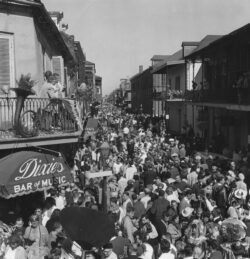
Excerpt from Café Lafitte in Exile: Queer New Orleans and the Story of America’s Oldest Gay Bar
Published: June 1, 2026
Last Updated: September 1, 2026
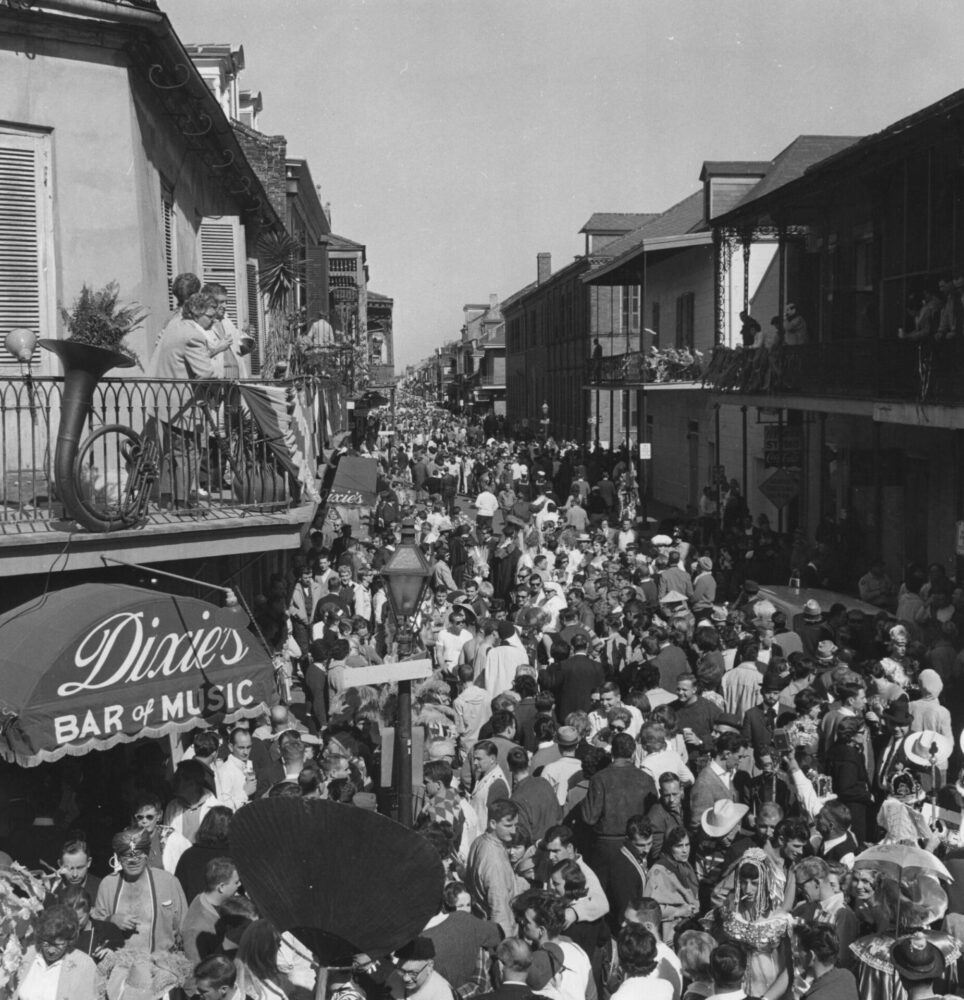
HNOC, the Richard R. Dixon / Cole Coleman Collection, gift of Mr. & Mrs. Richard R. Dixon
Outside Dixie’s Bar of Music on Mardi Gras, 1950s.
Café Lafitte in Exile tells the story of queer New Orleans through the lens of its most legendary gay bar. The bar has held a central place in New Orleans’s queer scene for many years, with a profuse mythology entwining its history. Drawing on oral histories and newspaper accounts, as well as personal recollections, the authors paint a vivid portrait of Café Lafitte and the queer community that sustains it. It’s a history of joy, a chronicle of struggle, and a reclamation of the history of southern queerness.
 For much of the mid-twentieth century, gay life in New Orleans was centered in the Quarter in a few bars and in the homes of a few artists, writers, and photographers. In 1939, jazz musician “Miss Dixie” Fasnacht opened Dixie’s Bar of Music in the Central Business District and in 1949 moved the bar to the Quarter. According to historian Roberts Batson, she may have been the model for a character in Gore Vidal’s The City and the Pillar (1948). Although she retired in 1964, Miss Dixie, who died in 2011 at the age of 101, remains a legend, especially for her support of her patrons, who were frequently harassed by police during periodic “cleanup” campaigns. Hoyle Byrd remembers the first time he went to Ms. Dixie’s at the tender age of sixteen: “I was nervous, and Dixie must have seen it because she made me feel welcome and had me sit by the register, which was near the staircase, next to her sister who was the cashier. She told me if the place was raided, I could go upstairs and hide. She was the sweetest lady.”
For a brief time, there was also the Starlet Lounge and Tony Bacino’s Bar. In addition to the bars in the Quarter, the famous Club My-O-My (featuring “female impersonators”), which flourished during the 1940s and 1950s, was located on the lakefront, and across town, on St. Claude, there was the Golden Feather, a bar that catered to African American gay men. There were also a few lesbian bars on Tchoupitoulas near the Irish Channel, but these were short-lived. In the Quarter, Alice Brady opened Mascarade in 1952, the first of several lesbian bars she owned. Outside the bars, gay life manifested itself in private cocktail parties (one thinks of Dorian Greene’s Peace Party soiree in John Kennedy Toole’s A Confederacy of Dunces) and homes such as Lyle Saxon’s literary salon on Royal Street and the home of famed lesbian photographer Francis Benjamin Johnston on Bourbon Street.
There were also unwritten rules and an understood protocol governing gay life in the 1950s and 1960s. More often than not, bartenders served as the arbiters and enforcers of this code of conduct. Sex workers, called “hustlers,” for example, were relegated to a few bars in the upper Quarter, most notably Wanda’s on Iberville and Mom’s Society Page (where several bartenders were former priests) in Exchange Place Alley and had to operate under the watchful eyes of the bartenders. The same was true for johns. Rarely did hustler and john negotiate directly; rather, the bartender brokered such transactions, acting as advisor and referee to both parties.
Surreptitious codes were necessary for postwar queer America, especially in New Orleans, which was much more homophobic than recent generations can possibly imagine. Despite New Orleans’s penchant for tolerance and its laissez-faire attitude, gays in New Orleans have historically faced a considerable amount of homophobia, especially from police. . . . The vice squad would, on occasion, either raid bars or send undercover cops (almost always young and good-looking ones) into the bars to make arrests. This practice continued well into the 1970s. Albert Carey remembers meeting a good-looking young man at the bar who was an undercover police officer: “When he excused himself to go to the bathroom, the bartender told me to be careful because he was a vice cop.” Bartenders customarily slapped a wooden board on the bar to warn patrons they were getting too touchy-feely. Arrests were often accompanied by a police beating and pressure to name other “perverts.” Anyone unfortunate enough to be arrested for “crimes against nature” or “committing a lewd act” often had their name and picture published in the Times Picayune. This could result in arrest, family alienation, loss of a job, eviction, and in some cases, commitment to a mental asylum. This type of harassment began to subside in the 1980s.
In 1955, police superintendent Provosty A. Dayries publicly proclaimed that homosexuals were the city’s “Number One vice problem,” adding, “They are the ones we want to get rid of most.” Widespread ignorance and familiar stereotypes of gay people were prevalent, especially the notion that homosexuals were predatory and looking to recruit teenagers and children. . . .
Contributing to the homophobia of the time were deliberate actions by government authorities. In 1958, the city adopted a more pragmatic approach in its crusade to save the city from the “pink menace.” In that year, the city council established a Committee on the Problem of Sex Deviates. An initial report of the committee proposed a “climate of hostility” be adopted toward homosexuals (as if the climate were not hostile enough). The committee’s chairman was Jacob Morrison, a prominent citizen and cofounder of the Vieux Carré Property Owners and Associates. Morrison had been a thorn in the side of the gay community for years. He had, a few years earlier, led a successful effort to have the liquor license of the Starlet Lounge (at the corner of Chartres and St. Phillip) revoked, and Morrison then turned his attention to Tony Bacino’s bar. In the summer of 1958, the manager and staff of Tony Bacino’s were arrested six times. They were charged with violating this remarkable city ordinance: “No person of lewd, immoral, or dissolute character, sexual pervert . . . shall be employed” in bars and restaurants. Amazingly, this ordinance was not repealed until 1993. . . .
Public attitudes of the 1950s changed little in the 1960s. Because gays were forced to live in the closet, cracking the closet door open for a few hours at a gay bar was a particularly intense experience, both relieving but also awkward, not to mention dangerous, which added a titillating element to cruising.
EXCERPT FROM: Café Lafitte in Exile: Queer New Orleans and the Story of America’s Oldest Gay Bar
by Frank Perez and Jeffrey Palmquist
Hardcover, $32.95; 208 pp.
Louisiana State University Press
March 2026