Magazine
Born from a Duel
A history of the Bowie & other knives in Louisiana
Published: March 1, 2026
Last Updated: June 1, 2026
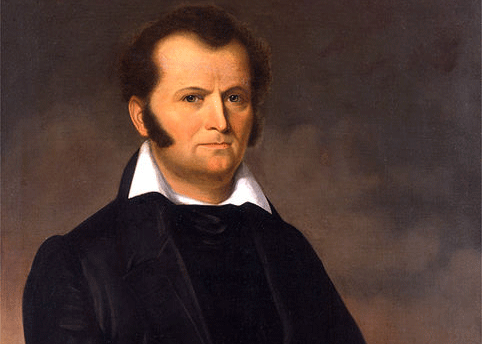
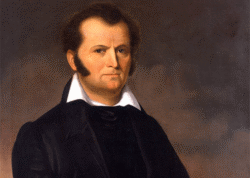
Courtesy of Texas Sate Capitol
Portrait of Jim Bowie. Healy, George Peter Alexander (artist)
Around 1662, shipments of couteaux boucherons—European kitchen knives that were typically made in sizes small, medium, and large—made their way across the Atlantic Ocean to France’s North American colonies. In 1682, French explorer Robert Cavelier, sieur de La Salle, began his journey down the Mississippi River from the Illinois Country. Jesuit missionaries, an assortment of tradesmen, and military and government officials, including an Italian-born French military officer named Henri de Tonti, loaded their canoes with supplies to join La Salle. Gifts were offered to the Native people they encountered to establish relations that supported the expansion of colonial territory and the discovery of new trade routes. This gift-giving policy was vital in securing safe passage down the Mississippi River near Indigenous villages, particularly in the late 1600s, when French-Canadian explorers had not yet established forts or trading posts in the Lower Mississippi River Valley. Most of the exchanges took place along the banks of the Mississippi River, where initial meetings were often tense. In one of those exchanges, Tonti gifted a knife to the Natchez Chief in Louisiana, sparking a long and storied history in Louisiana about the couteau boucheron.
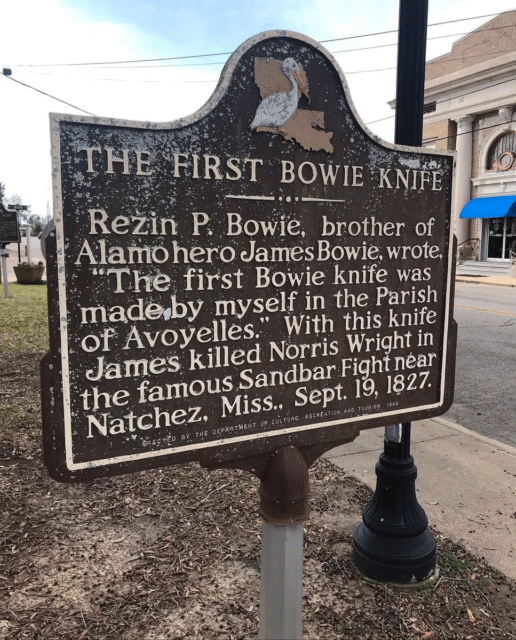
The first Bowie Knife Historical Marker in Avoyelles Parish, Louisiana. Courtesy of Stephen Bateman
Arguably the most important item exchanged between the French and the Indigenous people was the knife. However, the couteau boucheron may not have been the first knife the Natives had received as a gift. Nearly 150 years prior to the French-Canadian exploration, Spanish explorer Hernando De Soto traveled through the Lower Mississippi River Valley. When La Salle, Tonti, and their men arrived, there were sightings of Spanish swords inside the Native huts, suggesting that De Soto had offered metal tools to them during his exploration.
Still, according to French documents, the couteau boucheron was the most gifted and utilized knife in the seventeenth century throughout North America, New France, and the Lower Mississippi River Valley. The Indigenous populations of the lower Mississippi River Valley did not have prior access to fixed metal blades, and the knife was in many instances a more practical and durable tool in comparison to tools made of stone or bone. The couteau boucheron served many roles: it was an instrument of diplomacy, it served as a field knife to dress wild game, and it was a weapon carried into battle.
In 1763, with the British victory in the French and Indian War, France ceded Louisiana to Spain, and the British competed with Spain for control of trade and economic policies with the various Native tribes. The couteau boucheron proved to be so highly valued amongst the tribes that the British continued to import these knives throughout North America.
In 1802, when James Bowie was a young boy, the Bowie family moved from Kentucky to Louisiana, near the Bayou Teche area. Later, James and his brother Rezin settled on a large piece of property along Bayou Boeuf in Avoyelles Parish. Men of the era often engaged in duels to maintain their honor and test their courage, particularly during their formative years. James Bowie was no exception. In August 1817, James Bowie purchased a jackknife—a popular Spanish pocketknife imported and sold in general stores throughout Louisiana—for fifty cents at the Bennett General Store in Avoyelles Parish. This purchase changed the course of American history.
Eyewitnesses who remembered Bowie’s “big butcher knife” began to spread the word of his prowess with the lethal blade, capturing public attention and starting the legend of Bowie’s reputation as the South’s most formidable knife fighter.
For years James Bowie carried that small jackknife, a very impractical knife for a duel. After a few duels and close calls, Rezin recommended James carry a more suitable weapon for such encounters and took it upon himself to design a knife much larger for his brother James. He commissioned a local blacksmith, Jesse Clift, to render this design; Clift forged the large hunting knife from an old file, a common material used during those days to make a knife. A historical marker outside of the courthouse in Marksville, Louisiana, commemorates the first Bowie knife made by Rezin Bowie Jr. (Although the names of the maker and designer of the first Bowie knife are a subject of dispute, most historians and descendants of James Bowie who have access to family documents name Rezin as the originator of the knife. One source for this assertion is J. R. Edmonson’s Alamo Story: From Early History to Current Conflicts, published in 2000.)
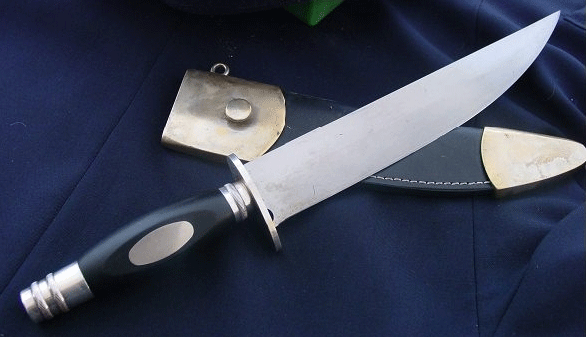
A copy of the knife on display at the Alamo, which James Bowie gave to a Captain Fowler of the United States Mounted Rifles, who carried it until his death in the 1840s. Photo by Mike Cumpston, courtesy of Wikimedia Commons
According to historian Harold L. Peterson in American Knives: The First History and Collector’s Guide (1958), the original design was described as having a blade slightly over nine inches long, one-and-a-half inches wide, single edged, with no curve. In September 1827, James Bowie killed a man with a knife on a sandbar in the middle of the Mississippi River, between Vidalia, Louisiana, and Natchez, Mississippi. Eyewitnesses who remembered Bowie’s “big butcher knife” began to spread the word of his prowess with the lethal blade, capturing public attention and starting the legend of Bowie’s reputation as the South’s most formidable knife fighter. Soon, men asked blacksmiths and cutlers to make them a “Bowie knife.”
The Bowie knife carried by James Bowie to the Alamo in San Antonio was made by Daniel Searles, a gunsmith and knifemaker out of Baton Rouge. In 1836, after James Bowie’s death at the Alamo, the Bowie knife became the most sought-after knife in the United States of America, the height of its popularity lasting from 1840–1865.
In the mid 1800s New Orleans was not just a major city—it was four times larger than the next largest city in the south. In addition to being a crucial port city where goods were shipped up and down the river as well as internationally, the Crescent City was also a manufacturing powerhouse and arguably the epicenter of knife-making in the South. Waves of immigrants had settled in New Orleans during the early eighteenth century, many of whom were skilled cutlers, surgical instrument makers, and craftsmen bringing their expertise with them from their native countries. With the outbreak of the American Civil War, the immigrant knife makers in New Orleans quickly turned to making edged tools, including Bowie knives, for the Confederate military.
In April 1862, Union troops came up the Mississippi River and captured the city of New Orleans. The capture of New Orleans caused many local knife makers in the city to cease operations; some packed up all their equipment and headed to other southern states. When news got out that Union troops were advancing, some knife makers hid unfinished knives in the walls and floorboards of their shops, only to be found years later during renovation efforts. Currently, several Bowie knives from local nineteenth-century cutlers line the cases of the Louisiana Civil War Museum in New Orleans. Knife collectors and makers still hold the Bowie knife in high regard today; it remains one of the most sought-after knives throughout the world.
The knife in Louisiana was far more than a blade; it was a symbol of technological exchange, a diplomatic tool, and a practical item for survival. Its impact on the course of history is evident through its presence in archaeological digs, including a 1940s excavation of the Bayou Goula site in Iberville, Louisiana, in which several types of iron knives from the 1600s were identified, including a couteau boucheron. As a knife maker in the twenty-first century, I have gained immense appreciation not only for the historical narrative of the knife in Louisiana but also the methods in which the knives were made. Over the years I have forged historically accurate knives from the seventeenth, eighteenth, and nineteenth centuries, including a batch of couteaux boucherons with sinker cypress handles and 1085 high carbon steel. Sourcing local material like cypress pulled out of a Barataria bayou, and forging a knife that first appeared in Louisiana hundreds of years ago, reminds me that the knife remains a living piece of history in our state.
Stephen Bateman is a historical researcher with the Jenny Craig Institute for the Study of War and Democracy at The National World War II Museum and a knife maker. He owns and operates Down The River Forge. He can be reached at downtheriverforge.com, Instagram @downtheriverforge or at [email protected].