Magazine
Carnival at Carville
Johnny Harmon’s photographs document Mardi Gras & daily life at the Gillis Long Hansen’s Disease Center
Published: March 1, 2026
Last Updated: June 1, 2026
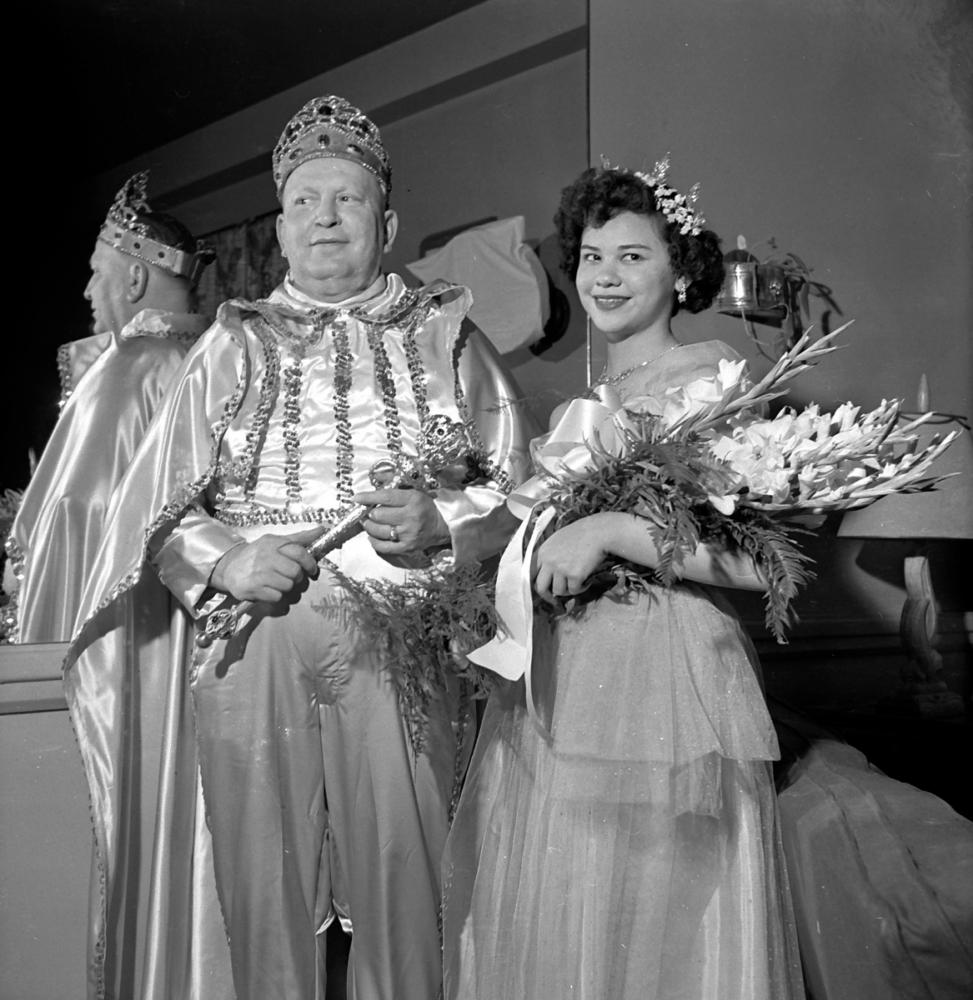
Photo by Johnny P. Harmon
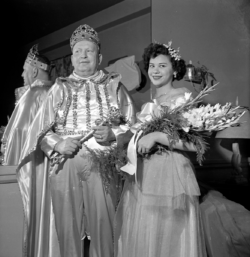
Carville Mardi Gras royalty were attired in costumes that rivaled any New Orleans ball.
From 1894 to 1999, people of all ages diagnosed with leprosy, now called Hansen’s disease, were quarantined seventy miles upriver from New Orleans in Carville, Louisiana. The United States Public Health Hospital (later the Gillis Long Hansen’s Disease Center) in Carville had previously been a sugar plantation; located on three hundred acres of land on a bend in the Mississippi River, it was the only hospital in the nation that focused on care and research for those with Hansen’s disease. Isolated behind barbed wire, incarcerated for life, separated from family, denied their civil rights, and counseled to change their names, the residents created their own community in Carville. By 1932, they had produced their own Mardi Gras. They masked, paraded, and danced through the halls of the hospital that had become their home.
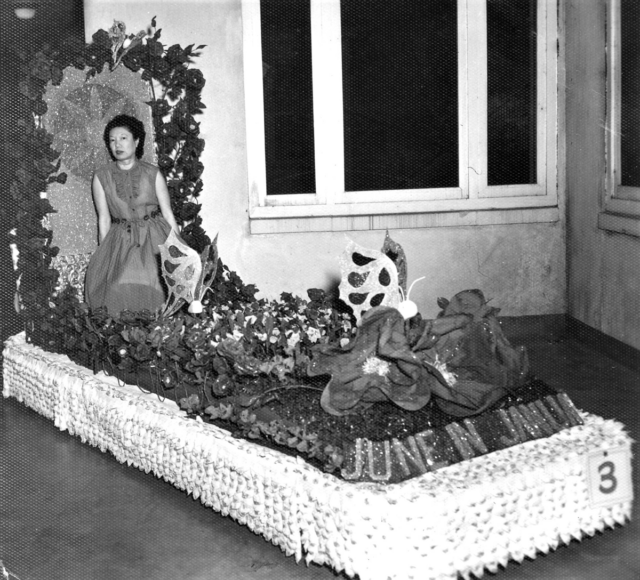
Chinese patient Grace Choy was a longtime resident of Carville. Over twenty countries sent patients to Carville for treatment.
Masks and costumes let wearers play out fantasies and act without inhibitions. For patients in mandatory quarantine, marginalized for their disease, Mardi Gras offered a chance to feel normal, and free. Folklorist Marcia Gaudet in her book Carville: Remembering Leprosy in America illustrates this with accounts from patients. Patient Julia Elwood was unscarred by Hansen’s disease but still felt the stigma; dressed as a clown on Mardi Gras, she could forget her fears and dance. Johnny Harmon bragged about his day costuming as Mae West. Pirates,can-can girls, monks, and devils paraded along the walkways.
A massive reconstruction project of the site before World War II led to a longer and more elaborate celebration. Covered walkways now connected all the buildings on the hospital campus; the revelers routed the parade through these walkways, which finally opened onto a second-floor grand ballroom, where the celebration continued. That year’s king, queen, and court were presented, and dancing began. By the late 1950s, outsiders began to celebrate Mardi Gras with the residents; orchestras invited from the area provided the musical accompaniment for the event’s grand finale.
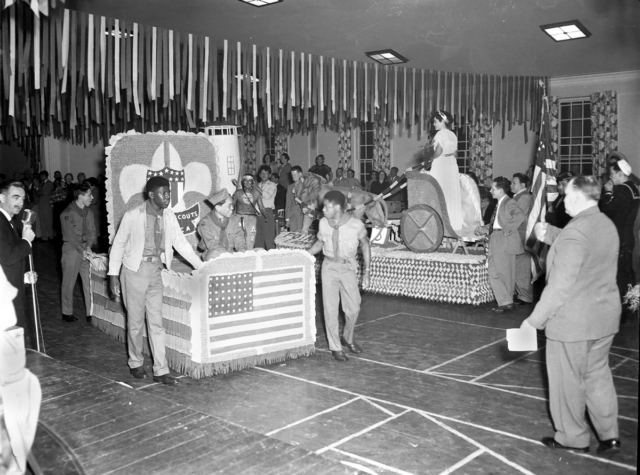
Boy Scout Troop 66, Carville’s integrated troop in the Jim Crow south, celebrates the Order of the Arrow, a prestigious honor that very few scouts attain.
The population of the hospital totaled between three hundred to four hundred patients at any given time. The patients formed groups and for their Mardi Gras celebration, they built themed floats that displayed creativity, ingenuity, and skill in using the materials on hand. The Mexican Social Club, the American Legion and Auxiliary Posts, the Patients Federation, the Boy Scouts, Lions Club, and the Legion of Mary were all clubs within the hospital community and they paraded annually.
Club themes varied. One year, the Lions Club designed a lion pulling royalty on a chariot. A patient named Billy described a float built to resemble a pirate ship, released its “buried treasure”—a roomful of cats carefully pirated away prior to the parade. Current events and politics also offered topical material for floats. The March-April 1958 issue of The Star, a patient-produced international journal, pictured a rocket ship float, celebrating the achievements of the space race. A 1994 float featured a tombstone declaring “R.I.P. BoP,” an ironic reflection of the patients’ feelings toward a failed government program. The Bureau of Prisons had briefly housed prisoners at Carville; the quarantined patients resented the program, and Mardi Gras was the perfect time to express their displeasure.
By the late 1950s, outsiders began to celebrate Mardi Gras with the residents; orchestras invited from the area provided the musical accompaniment for the event’s grand finale.
Those not on floats decorated their bicycles, scooters, and wheelchairs. José Ramirez, a young patient from Texas, recalled his first Mardi Gras in Carville in the late 1960s:
My introduction to the unique life of Louisiana was to participate in . . . a Mardi Gras parade in the beautiful Recreation Center’s Hall. . . . One of the other patients came to my room with a wheelchair and told me, “We are going for a ride.” My chauffeur was much older than I and had participated in many parades in years past and wanted to introduce me to one of the more positive experiences. The gentleman placed some green and gold ribbons on my chest and wheelchair as he rushed down the long, elevated hallways. He told me to just wave as he placed me behind some colorful bicycles. I was simply speechless as we paraded into the hall as patients and staff cheered. I was given colorful beads to throw into the crowd, not knowing the significance of such. It was a joyous moment for me that allowed me to take a trip away from home sickness, sadness, and physical pain. I learned a great deal that day about the powerful spirit of my peers.
Though originally the Carville celebration was a private gala created by and for those who had been outcast, in later years it garnered a high profile and drew participants and attendees from the surrounding communities. From the 1970s through the mid-1990s, the parade was led by Father Frank Coco, a Jesuit priest, clarinetist, and member of the famed Pete Fountain Half Fast Marching Band in New Orleans. (To accommodate his participation, the celebration was moved to the Friday preceding Mardi Gras.)
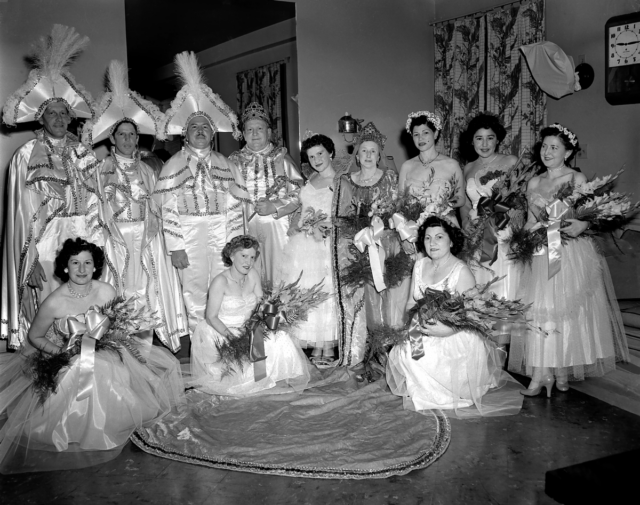
Royalty at a Carville Mardi Gras were as lavishly attired as the krewes in New Orleans (ca. 1955).
Royal positions for the Mardi Gras celebration were a significant honor, privilege, and responsibility. My friend Mary Broussard had been a long-time patient at Carville, and she once reigned in court with her husband. In 1999, she was again chosen as queen, shortly before the hospital closed. She and I had been planning a visit to her family in San Antonio. She told me she would only make the trip to San Antonio if she were back in Carville in time for the fitting for her gown.
Doubloons became an integral part of the festivities in the 1990s, following the example of New Orleans Mardi Gras. Carville minted their own doubloons featuring the infirmary on one side and an armadillo, their symbol of hope for a cure, on the other. This hope was answered; with successful treatments, the need for isolation diminished. The population of Carville residents aged, but the show continued.
By the 1990s it became clear to the federal government that maintaining the hospital was financially impossible, but patients who had been involuntarily quarantined did not want to leave this home they had known for most of their lives. They rallied for continued care and for the continuation of Carville. United States Representative Richard Baker from Louisiana’s 6th congressional district negotiated a settlement for the residents. The facility was returned to the state of Louisiana and the National Guard. Three options were offered to the residents: patients could leave with medical care and a guaranteed annual stipend for life; patients who were self-sufficient could remain at Carville as long as they could maintain their own care; and those who needed more medical care and attention would be moved to the Summit, a hospital and nursing facility in Baton Rouge. At Summit, the tradition of masking and revelry continued. Today all the patients from Carville are deceased, but those affected by Hansen’s disease continue to hope for an end to the disease and the stigma which has dogged it for centuries.
Claire Manes is a retired educator and the descendant of five deceased resident patients at Carville, Louisiana. Her passion for her family story has inspired her research and her book Out of the Shadows of Leprosy: The Carville Letters and Stories of the Landry Family
Johnny P. Harmon was a photographer and a patient of the Carville Leprosarium, who captured images of the Carville residents, documenting their daily life.