Magazine
From City Park Stadium to the Arena, via Venus and Mars
The Beatles and Paul McCartney in New Orleans
Published: March 1, 2026
Last Updated: August 21, 2026
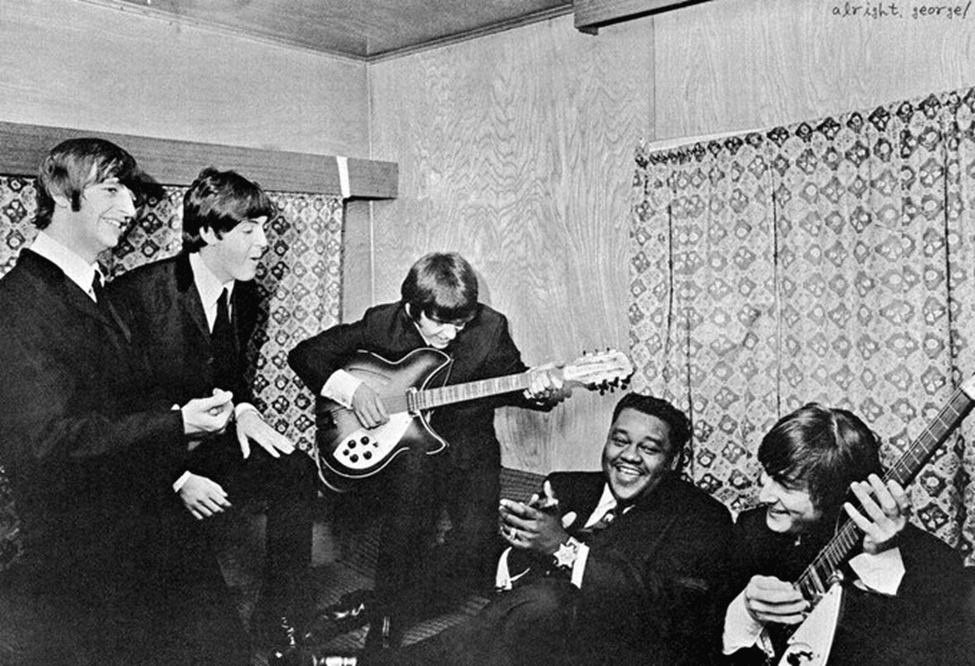
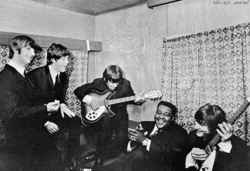
Fats Domino with the Beatles in their trailer before their concert in New Orleans City Park in September 1964.
In September 1964, the musical and cultural phenomenon known as “the British Invasion” stormed New Orleans when its top brass, the Beatles, played at City Park Stadium. Sixty-one years later, the popularity and relevance of this band from Liverpool remain undiminished, as demonstrated in October 2025 at a Crescent City concert by founding member Paul McCartney. The multi-instrumentalist and singer, who was one of the Beatles’ principal songwriters along with John Lennon, performed with unflagging, vibrant energy and consummate expertise for almost three hours at the Smoothie King Center, in his fourth concert there since 2002. McCartney’s palpable delight and enthusiasm were matched by the capacity audience who sang along, word for word, on all but some lesser-known songs.
At eighty-three, McCartney’s voice is somewhat weathered. He missed some notes, most noticeably when accompanying himself, alone, on acoustic guitar, mandolin, or piano. McCartney seemed to unabashedly embrace this sign of aging, however, making no attempt to hide it with easily available pitch-correction technology. Instead, his unselfconscious, forthright approach—contrasting with the cold, slick, auto-tuned perfection heard at some large-venue shows—exuded genial informality. This cheerful mood was further heightened by the great rapport between McCartney and his four-piece band. Despite an elaborate light show, loud fireworks, and special-effects footage shown on huge screens—for an audience of more than thirteen thousand—at heart the concert had the feel of five old friends playing purely for fun and the love of music. On one level such ebullient camaraderie was part of a well-rehearsed act, but even so it came across as genuine. McCartney played thirty-five songs from his solo career, his post-Beatles band Wings, and the Beatles’ repertoire, including “Hey Jude,” “Get Back,” “Golden Slumbers,” “Maybe I’m Amazed,” and “Being For The Benefit of Mister Kite!” The Beatles’ first single, “Love Me Do,” from 1962, “I’ve Just Seen A Face,” and “Help!” were the only numbers McCartney performed from the band’s early years.
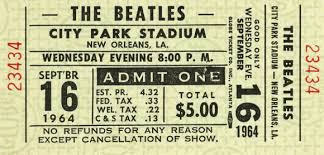 There was no overlap with the set list from the City Park concert, an event that started the Beatles’ and then McCartney’s decades-long homage to New Orleans music. As one of the opening acts on their 1964 tour of North America, the band chose hometown hero Clarence “Frogman” Henry. They recorded three songs written by New Orleans R&B artist Larry Williams—“Slow Down,” “Bad Boy,” and “Dizzy Miss Lizzy”—thus gifting Williams with a windfall of songwriting royalties. At City Park the band played “Long Tall Sally,” originally recorded in 1956 by Little Richard at the studio of the acclaimed New Orleans audio engineer Cosimo Matassa; Richard was accompanied by A-list session musicians including members of Fats Domino’s band.
The Beatles idolized Domino and insisted on meeting him while they were in town in ’64. Their 1968 song “Lady Madonna” paid tribute to Domino’s percussive piano style. Domino soon recorded it too, along with covers of the Beatles’ “Lovely Rita” and “Everybody’s Got Something To Hide Except Me and My Monkey,” sung with a thick New Orleans accent. John Lennon recorded Domino’s “Ain’t That A Shame” on a 1975 solo album, and in 2007 McCartney and Allen Toussaint recorded Domino’s “I Want To Walk You Home” for the compilation album Goin’ Home: A Tribute to Fats Domino.
[McCartney’s] unselfconscious, forthright approach—contrasting with the cold, slick, auto-tuned perfection heard at some large-venue shows—exuded genial informality.
In 1975 McCartney came to New Orleans with his post-Beatles band, Wings, to record the album Venus and Mars at Allen Toussaint’s recently opened Sea-Saint Studio in Gentilly. McCartney might well have sequestered himself to work undisturbed. But, in a 2003 interview with this writer, Toussaint recalled, “When Paul was here he tried to connect with lots of people in the music community. He stayed for quite a while and he made his rounds. Paul was extremely generous. He pulled out all the stops and rolled the red carpet out for everyone . . . people like Professor Longhair, Earl King, Benny Spellman, and Ernie K-Doe would come to the studio quite a bit. And McCartney welcomed them; it’s not like they were hangers-on.” Although Toussaint was a renowned producer himself, he did not play that role on this project. According to journalist Pete Paphides’s liner notes for the CD reissue Wings Deluxe, Toussaint observed, “I saw [McCartney] producing and I saw a part of what makes him so great. I saw him going towards the magic. He knew exactly where that was.”
For the most part McCartney did not hire New Orleans musicians to play on Venus and Mars. Writing for nola.com in 2015, journalist John Wirt cited McCartney in 1975 telling an unidentified interviewer, “I don’t like to come to a place and use too much of the local talent, because you get people saying, ‘Oh, they’re taking our style.’” There were exceptions, however, including Toussaint, bassist George Porter Jr. of the Meters, singer Benny Spellman of “Fortune Teller” fame, and percussionist Kenneth “Afro” Williams of the popular funk and soul group Chocolate Milk. In an interview with this writer, Williams recalled getting a phone call from Toussaint, telling him to come to Sea-Saint to play on a session. “I asked Allen whose session it was, and he just said, ‘Be here at 4:00 p.m.’ I walked in, and there was Paul McCartney! I felt starstruck, but he was a regular guy, very friendly and nice. He made me feel comfortable right away.”
While in town McCartney and his wife costumed up and dove into Mardi Gras, resulting in “My Carnival,” a song inspired by the Afro-Caribbean piano rhythms of Professor Longhair, then the elder statesman of New Orleans R&B. When work on recording Venus and Mars was completed, McCartney hosted a party on board the riverboat Voyageur for New Orleans R&B musicians including Robert Parker (“Barefootin’”), Earl King (“Trick Bag”), Lee Dorsey (“Ya Ya”), “Frogman” Henry (“Ain’t Got No Home”), Allen Toussaint, the Meters, and Ernie K-Doe (“Mother-in-Law”). McCartney and K-Doe sang a duet version of the Beatles’ “I Want To Hold Your Hand;” circa 2000 this writer heard K-Doe refer to him as “Paul MacArthur—you know, that boy with the Beatles. I taught him how to play!” Months later when Venus and Mars was released, McCartney threw another party on another boat, in California, flying in a who’s who of New Orleans R&B musicians to mingle with mega-celebrities. Professor Longhair’s performance was recorded, and in 1978 it appeared as the album Live on the Queen Mary. In November 2025 McCartney re-released it as a deluxe LP. Paul McCartney’s ongoing connection with New Orleans music remains as strong as ever.
Ben Sandmel is a New Orleans-based drummer, folklorist, and the author of Ernie K-Doe: The R&B Emperor of New Orleans. He produced and played drums on the Grammy-nominated album Deep Water by the historic Cajun-country band The Hackberry Ramblers. In 2018 the LEH honored Sandmel with an award for his Lifetime Contributions to the Humanities. In September 2021, Sandmel graduated from Tulane University with a master’s degree in musicology.
Listen Up is funded in part by a grant from the New Orleans Jazz & Heritage Foundation.