Winter 2025
From the Ashes
Excerpt from New Orleans: A Concise History of an Exceptional City
Published: December 1, 2025
Last Updated: March 1, 2026

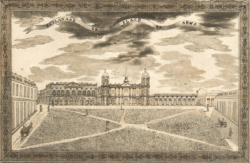
Inset from J. L. Roqueta de Wosieri’s map of New Orleans, 1803, HNOC
This map inset shows the barren Plaza de Armas featuring the impressive new Spanish-style Casa Capitular (Cabildo), St. Louis Cathedral, and the Capuchin Presbytère designed by Gilberto Guillemard after the Good Friday Fire of 1788.
 All told, more than 850 buildings were destroyed in the Good Friday Fire of 1788 that destroyed most of the upper Vieux Carré ravaging the residential area between Dauphine and Chartres, and Conti to St. Philip Streets. The conflagration destroyed the St. Louis Church, the Cabildo, the corps de garde (military barracks), armory, and the jail on the Plaza de Armas. Remarkably, the fire spared the large West Indies–style Government House (destroyed by fire in 1828), the royal tobacco warehouse and powder magazine (on present-day Canal St.), and the old Ursuline Convent in the lower part of the city. The fire also damaged Madame John’s Legacy, at the time the residence of the Beluche family. The home was reconstructed in the original style and therefore exemplifies French colonial (West Indies) residential design, even though the structure was rebuilt during the Spanish period.
The 1788 Fire greatly devastated the colonial city, and the rebuilding process represents one of the great examples of the city’s resilience in its three hundred-plus years of history. The fire required the rebuilding of the original town, today’s French Quarter. New buildings were constructed in a style reflecting Spanish architectural design—incorporating private interior courtyards, tile roofs, exterior wrought-iron balconies and galleries (verandas), and facades abutting the sidewalk. The use of patio courtyards, tile roofs, and balconies reflected the strong Moorish Arab influence on the architecture of southern Spain. And even though the Vieux Carré is named the French Quarter today, the neighborhood’s buildings dating to the rebuilding in the 1790s characterize an Andalusian village.
But in fact, these courtyards, balconies, and tile roofs are present throughout much of the Mediterranean world, including southern France and Italy. The use of colombage (bricks between posts) was common to many parts of northern Europe and to pre-Spanish New Orleans. Additionally, the use of stucco to protect the exterior bricks and posts appears to be evident as early as the rebuilding of the old Ursuline Convent in 1753. Today, this exterior coating and iron balconies seem reminiscent of a quaint European style and certainly distinguish New Orleans from the English-colonial brick Georgian architecture of the Atlantic Coast, as exemplified in old Williamsburg, Virginia, and Boston’s Beacon Hill.
. . . . Notary Don Andrés Almonester y Rojas, perhaps the wealthiest Spanish resident in the city, financed the rebuilding of the Casa Capitular (Cabildo), which was completed in 1795. He hired a French architect and surveyor and a Spanish military officer, Gilberto Guillemard, to design the building, which remains one of the grandest from the Spanish era in the Vieux Carré. Like earlier French engineers Pauger and Broutin, the French-born architect Guillemard trained at the Académie royale d’architecture (Royal Academy of Architecture).
While in the service of Spain, Guillemard was stationed in Havana, where he gained a familiarity with Spanish and Mediterranean design. In redesigning the new Cabildo, he drew on the surviving arched walls from the corps de garde along St. Peter Street to extend a prominent portales arcade across the front at ground level, creating a distinctly Mediterranean or Latin American architectural design motif.
Originally, the Guillemard-designed building contained two levels with a shallow-sloped roof, and the second-floor façade featured a large, arcaded gallery with a fine view of the Plaza de Armas and the Mississippi River. The pediment contained the sculpted seal of Spanish Louisiana, later removed by American officials and replaced with an American military motif designed by Italian artisan Pietro Cardelli. On the second level, the interior grand Sala Capitular (Capital Room), with its elaborately carved fireplace mantle, hosted official meetings of the Cabildo (town council) or Catholic superiors.
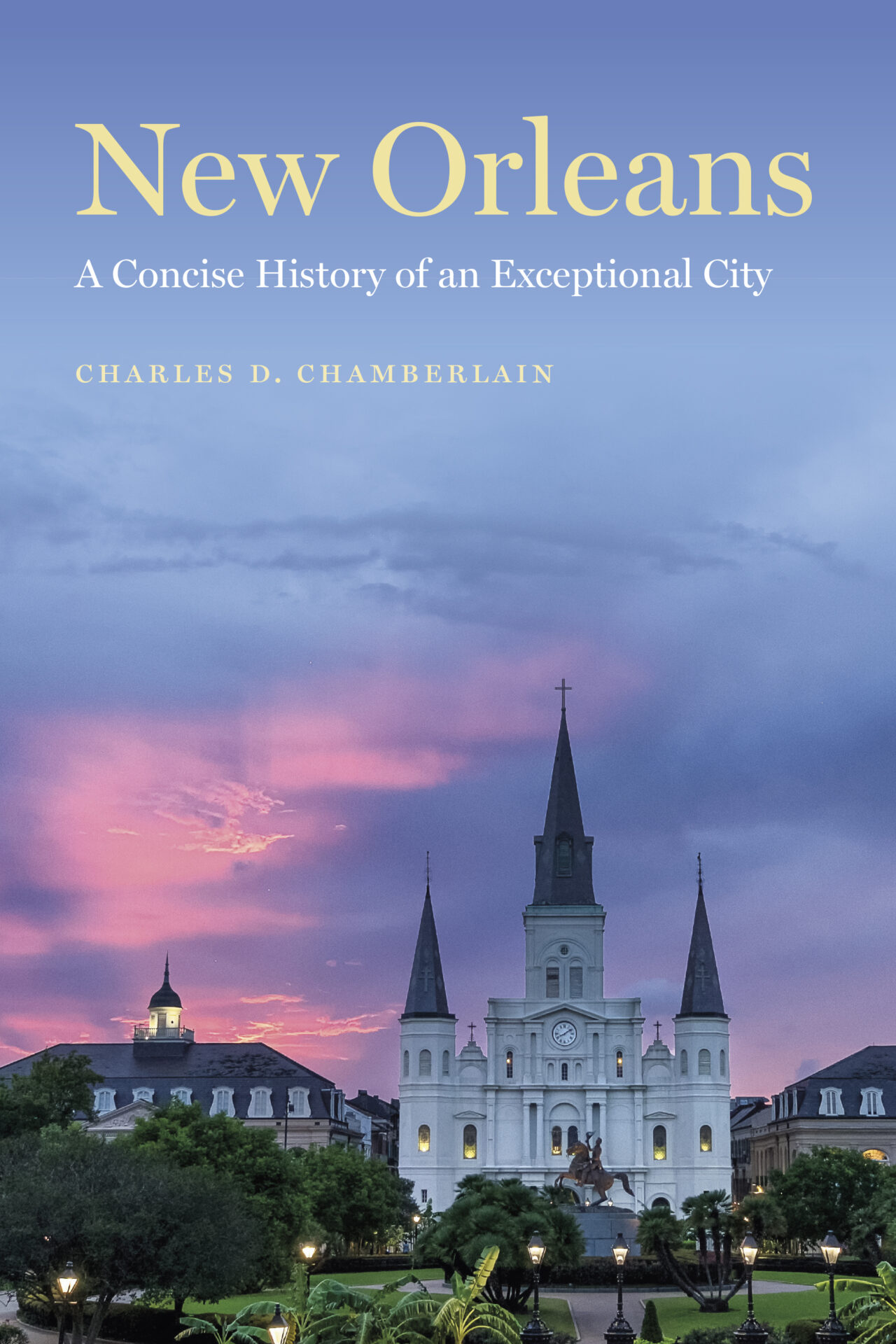
Guillemard also designed the new St. Louis parish building, which the Catholic Church upgraded to a cathedral on its completion in 1794. The tall, two-level church was both larger and grander than the original one designed in 1720 by Adrien Pauger. As depicted in the detailed inset illustration of city surveyor Jacques Tanesse’s 1817 map, the Spanish-era two-story church façade featured three arched entrances flanked on the ends by tall domed bell towers, with a smaller spire in the center (fig. 6). The design is very similar to that of the cathedral in Cadiz, Spain, which maintained a strong trade relationship with Latin America and New Orleans. The building is also similar in appearance to the cathedrals in Santiago de Cuba and Havana, where Guillemard studied. In the early American period, esteemed English architect Benjamin Latrobe designed a tall center tower with a bell, which was completed in 1819.
The French architect designed the Presbytère, completed in 1815, in the same design as the Cabildo. The three buildings were renovated to their present three levels in the years before 1850. Guillemard’s overall symmetrical and well-balanced architectural ensemble is a distinctive landmark distinguishing New Orleans architecturally from other American cities.
EXCERPT FROM: New Orleans: A Concise History of an Exceptional City by Charles D. Chamberlain
Paperback, $34.95; 368 pp.
Louisiana State University Press
August 2025