Magazine
“Gone to Texas”
Greenwood as Louisiana’s gateway to the West
Published: March 1, 2026
Last Updated: June 1, 2026
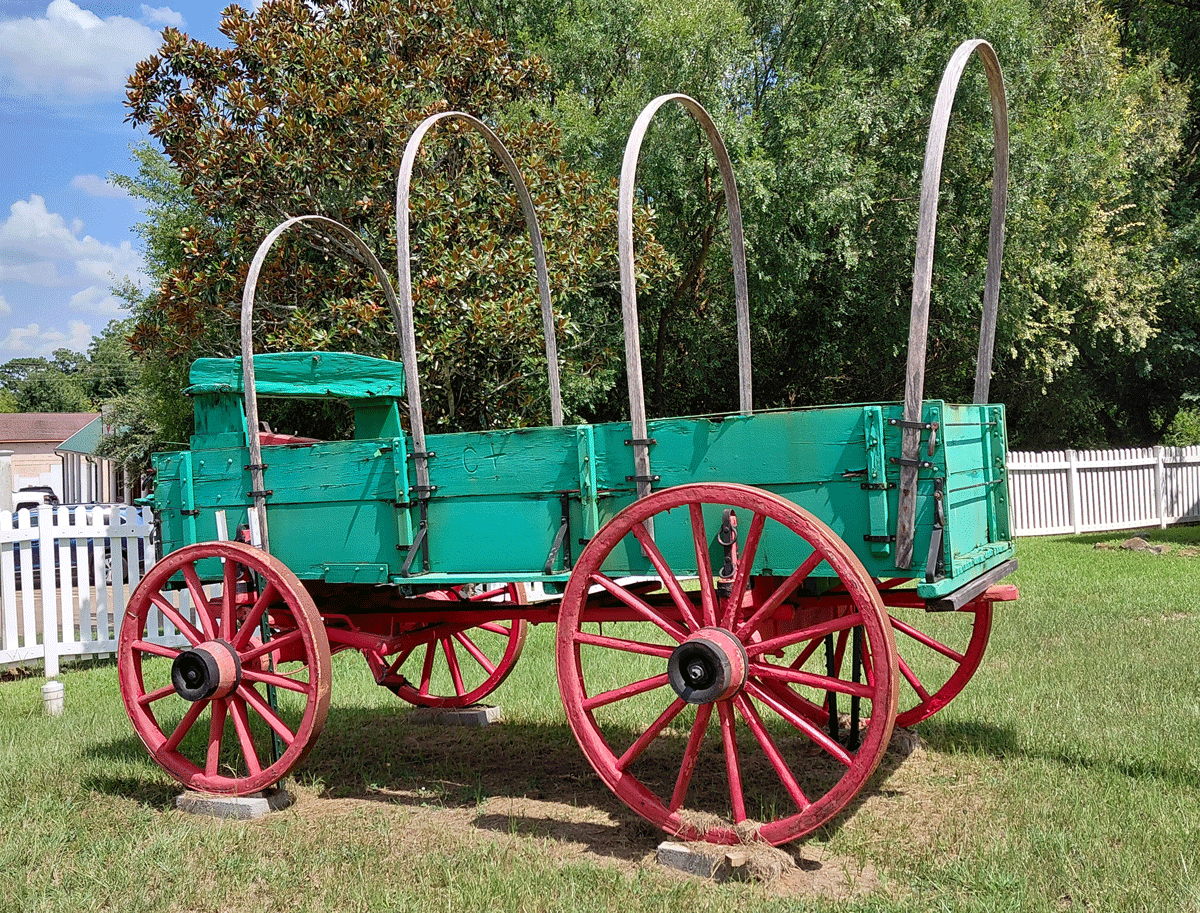
Photo by Richard Campanella
Pioneer wagon on display in Greenwood.
If “pioneers,” “stagecoaches,” and “western frontier” are not terms typically found in the Louisiana lexicon, perhaps it is because the southern half of the state dominates our historiography. Three out of every four residents live below the thirty-first parallel, where a more fluvial and coastal geography set the stage for words like “colonials,” “pirogues,” and “plantations” to dominate the historical discourse—not to mention “slavery,” “steamboats,” and “ports.”
Of course, parts of northern Louisiana had their share of those historical elements, yet the region as a whole stood apart in many regards, particularly from the perspective of westward-migrating Americans. It offered everything the soggy coastal plain did not. It had solid terrain through which Native people blazed latitudinal pathways, crossing a sequence of longitudinal rivers. It remained largely unsettled by Europeans, being relatively inaccessible from the sea. It had eastern ingresses along the Mississippi River, convenient to Americans coming down from the north, and western egresses into Texas along the Sabine River. By the early 1800s, crude backcountry roads became to northern Louisiana what rivers and bayous had long been to southern Louisiana: the premier arteries for human mobility.
Westward migrants had a number of options to cross northern Louisiana. Many took the Harrisonburg Road from Natchez to Natchitoches and Nacogdoches and proceeded on the Camino Real (Royal Road, today’s Old Spanish Trail) to San Antonio and ultimately Mexico City. Other travelers took the latter half of that route, called the Natchitoches–San Antonio Road, which passed through Many, Louisiana—home today to a Spanish Mission-style Catholic church and a homage to the Alamo on its aptly named San Antonio Avenue.
By the early 1800s, crude backcountry roads became to northern Louisiana what rivers and bayous had long been to southern Louisiana: the premier arteries for human mobility.
Still other travelers forked off at Harrisonburg toward Alexandria and onward to Texas on Nolan’s Trace, blazed by smuggler Philip Nolan to drive Spanish-bred horses from San Antonio back to Natchez. So many migrants came this way that folks in Harrisonburg called their busy thoroughfare “the Texas Road.”
Instead of using Natchez as a jumping-off point into Louisiana, some pioneers ferried from Rodney across the Mississippi River to Waterproof, Louisiana, at times at a pace of fifty covered wagons per day. Where to cross the Sabine River into Texas? Many used the ferry that gave rise to Logansport, which to this day is Louisiana’s largest community on the Sabine. Its pioneer heritage explains the Conestoga wagon monument at the town entrance.
By the 1830s–1840s, the most popular trans-Louisiana passage was to float down the Mississippi to Lake Providence and trek overland on the public Stagecoach Road heading west. The segment from Monroe to Shreveport, which cost fifteen dollars for a thirty-hour ride in a careening carriage or wagon, helped spawn a number of lasting communities, among them Forksville, Vienna, Arcadia, Mt. Lebanon (which still has an Old Stagecoach Road and a number of circa-1840s stopovers), Minden, Bellevue, Fillmore, and Red Chute. Stagecoach Road got nicknamed the Wire Road when telegraph lines were strung along it in 1857. A spur later built through Bossier City became known as the Shed Road—part sheltered turnpike, part boardwalk, and part covered bridge.
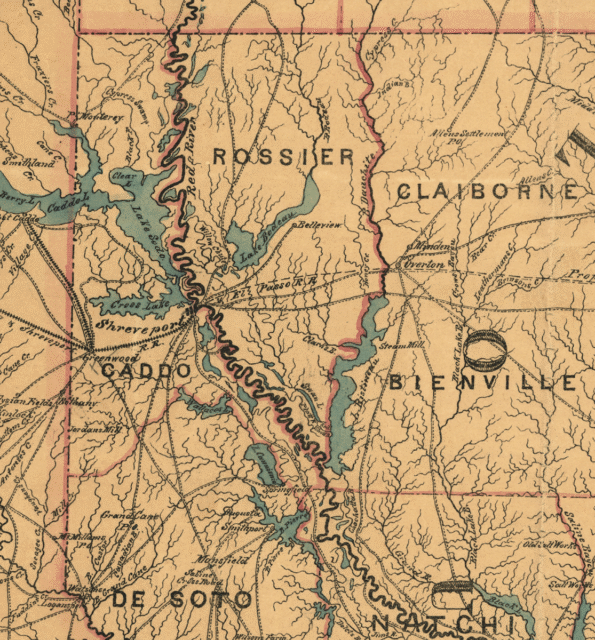
All paths lead to Greenwood (left, west of Shreveport), as detailed in this 1864 map by Helmuth Holtz.
The main Louisiana jumping-off point to the Texas frontier was not riverine Shreveport, as one might expect, but landlocked Greenwood, fifteen miles to the west. Today a bedroom community of 3200 people, Greenwood became the Louisiana equivalent of what St. Louis, Kansas City, and Omaha would become for the nation. A number of interrelated factors explain why.
In 1821, Mexico gained its independence from Spain and assumed control of what is now Texas. With trepidation, Tejanos (Texans of Mexican/Spanish descent) allowed Anglo-Americans to settle for the sake of economic development. They soon came to regret it, because enmity developed between the Texians (English-speaking newcomers) and their Spanish-speaking hosts. Fighting during 1835–1836 succeeded in launching the independent Republic of Texas, which eagerly sought Anglo-Americans to migrate from the United States. Thousands heeded the call, many by way of northern Louisiana.
These same years also brought Indian removal policies to the region, in which federal authorities forced the Caddo tribe, through cunning and cross-cultural confusion, to relinquish their land in Arkansas and Louisiana and move to the Brazos River in Texas.
The displacement enabled all the more traffic to flow overland across northern Louisiana—pioneers heading west, and cotton heading east, to ship down the Ouachita or Mississippi to New Orleans. All the while, workers graded treads, built bridges, and opened ferries, and prehistoric networks of interlaced trails cohered into established roads.
The main east–west road in extreme northwestern Louisiana followed a slight ridge as it neared the US/Texas border, where it intersected another artery. An overnight stopover formed at the crossroads, which gave rise to stores and houses. A post office followed, bringing still more traffic, since the Republic of Texas had no postal service and its citizens had to come to Louisiana to send and receive letters (marked “Hold for Texas”). Other travelers came to settle, “from Georgia, Alabama, South Carolina, and especially Tennessee,” wrote geographer John Whitling Hall in a 1979 local history, “and they bore names like Simpson, Whitworth, Cates, Warnock, Ford, Tucker, Page, Jones, MacReady, Metcalf, Harper, Lister, Hoss, and Eubanks.” Upon arriving at the crossroads community, they might have seen the initials “G.T.T.” marked on doors or signs—“Gone to Texas.”
In 1839, William Littlejohn and nine other investors purchased land around the crossroads. Two years later, they founded the Greenwood Town Company, named for investor Samuel Greenwood, and began to sell lots for residential development. They tried donating land for a courthouse in the hope of securing designation of Greenwood as the seat of recently created Caddo Parish (1838). The State Legislature demurred on that matter, but did authorize, in 1844, the construction of an improved twenty-foot-wide toll turnpike from Shreveport to Greenwood.
According to Keumsoo Hong, author of the dissertation “The Evolution of the Red River Valley Settlement System, 1714-1860” (Louisiana State University, 1999), the proscribed rates for travel on the Greenwood Turnpike were 8 to 10 cents per mile for a loaded cart or wagon; 4 to 5 cents for empty carts or wagon; 3 cents for a man on horseback; 2 cents per head of cattle, horse, or mule; and 1 cent per every hog, sheep, or person.
By the 1840s, a judge in Greenwood had workers complete the first brick home in Caddo Parish, while neighbors constructed log cabins and wooden cottages. All were built in the American way, with center halls and side-wall chimneys, quite different from the Creole and Acadian vernacular houses of southern Louisiana. Soon, Greenwood became a “rival town” that was a “more promising place than Shreveport,” according to the Biographical and Historical Memoirs of Northwest Louisiana (1890), with a steady stream of families from South Carolina, Georgia, Alabama, Tennessee, and elsewhere, most bound for Texas.
By the 1850s, Greenwood boasted a saddlery, tanning yard, wagon-makers, plow-makers, blacksmiths, tinsmiths, machine shops, foundries, and brickyards, along with “seven stores, a Mason lodge, two two-story schools, a Methodist church, five doctors, three saloons, and a hotel” with fifteen rooms and a ballroom, according to historian Clare D’Artois Leeper in her 2012 book Louisiana Place Names. Now with Texas having joined the Union, cargo-bearing wagonloads outnumbered those carrying migrants; the geographer John Whitling Hall estimated that “an average of 100 ox wagons rumbled through town, eight to ten oxen to a team, bringing cotton from as far west as Dallas, and hauling freight back on the return trip.”
Later in the 1850s, the opening of the Vicksburg, Shreveport, and Texas Railroad augmented that flow, even as it drew traffic away from the overland road. An 1864 wartime map by Helmuth Holtz depicts Greenwood as a regional hub with six roads and three railroad tracks, commensurate to Shreveport. The momentum persisted enough after the Civil War for Greenwood to gain municipal incorporation as a town in 1876.
But by then, Greenwood had steadily lost its geographical advantages. Migrants bound for Texas could now take trains rolling swiftly and comfortably straight past old stagecoach posts like Greenwood. Those same railcars brought cotton back—to Shreveport, from which it could float down the Red River to New Orleans. In 1896, the Town of Greenwood let its incorporated status lapse, though in the early 1900s it regained some momentum as a rail junction for the lumber-bearing Missouri, Kansas & Texas and Texas & Pacific Railroads. Greenwood came back in the century ahead, when modern highways once again made the old crossroads into an interstate community. It re-incorporated as a town and is now a stable and pleasant suburb to its former rival, Shreveport.
Yet one still gets the sense in modern Greenwood that something different happened here. The town’s welcome sign reads “Home of the Pioneer Club,” while a placard at a downtown park shows a line of horse-drawn stagecoaches. Across the street is an actual nineteenth-century covered wagon, on display outside the circa-1840 Dunn Home, which has all the traits (center hall, side chimneys, gable roof, front porch) of rural Anglo-American architecture. Every September, Greenwood holds a Pioneer Heritage Festival, featuring frontier-style pancake breakfasts and oxen rides. Another distinction: Greenwood’s Main Street is not the principal artery through town (that would be Greenwood Road, a.k.a. US Route 79/80) but rather a curiously quiet two-block-long residential street that is only one lane wide. Could this be the last vestige of that twenty-foot-wide turnpike of 1844, Louisiana’s western gateway?
In fact, Greenwood is still a major gateway to Texas—which is just 4.5 miles to the west, on the modern “stagecoach road” known as Interstate 20.
Richard Campanella, a geographer with the Tulane School of Architecture and Built Environment, is the author of Crossroads, Cutoffs, and Confluences: Origins of Louisiana Cities, Towns, and Villages; Draining New Orleans; Bienville’s Dilemma; and other books. He may be reached through richcampanella.com, [email protected], or @nolacampanella on X.