Magazine
Music in the Court of Calanthe
Shreveport’s Calanthean Temple was a nexus of live music and Black society at the turn of the twentieth century
Published: June 1, 2026
Last Updated: September 1, 2026
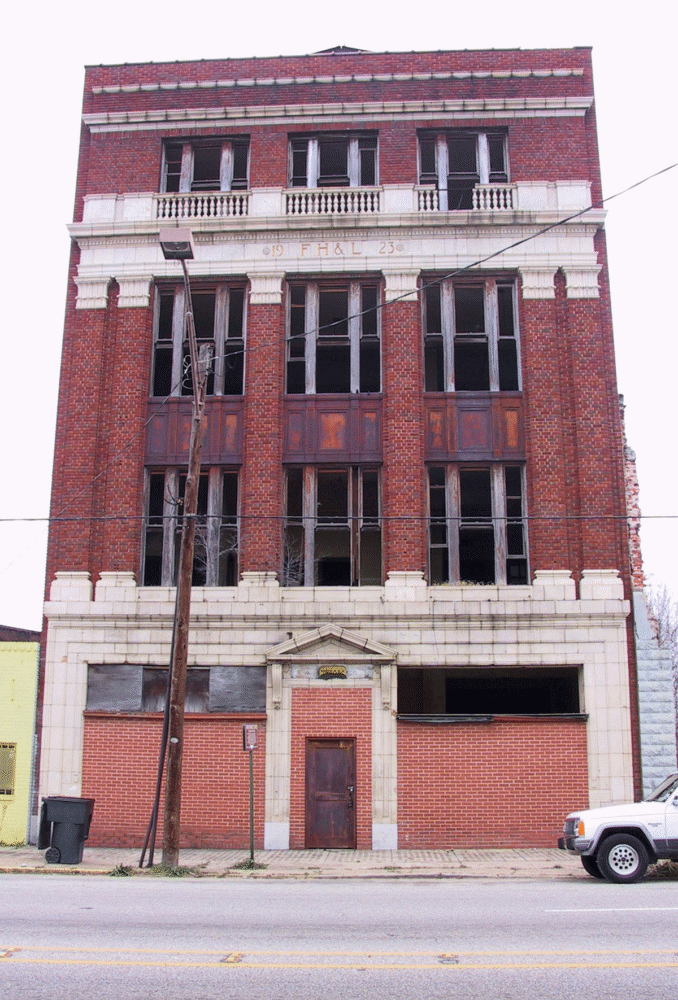
Photo by Dayna Bowker Lee for the Louisiana Folklife Program
The Calanthean Temple in downtown Shreveport was the largest structure in the United States built by African Americans at the time of its completion in 1923. The fraternal Order of Calanthe hosted concerts there by artists like Duke Ellington and Louis Armstrong from the building’s rooftop garden.
Mention the music heritage of Shreveport, Louisiana, and the likeliest thing to come to most people’s minds will understandably be the Louisiana Hayride, the star-studded variety show that boasted Elvis Presley as the jewel in its tiara over the years that it broadcast country and rockabilly performances to a national radio and television audience between 1948 and 1960. Fewer—and very few indeed from outside of Shreveport—would name the Calanthean Temple. Founded by the fraternal Order of Calanthe, the venue’s heyday was waning in the early fifties just as the Hayride’s star was on the rise. But during its time in what the Shreveport Times once called “the center of Black society in turn-of-the-century Shreveport,” its rooftop stage boasted just as much star power and arguably created just as many thrilling memories.
Some fraternal orders, such as the Freemasons, claim to trace their origins back to the Middle Ages. The hundreds of years fuzzed by the mists of time allow for insinuations of arcane mysticism, cult rituals, religious mysteries, and sub rosa political influence and conspiracy that goes all the way to the top. This is where we get delightful fictions—or are they?—like The Da Vinci Code or the idea that certain twenty-first-century pop stars and politicians are in fact reptile aliens pulling the strings of global statecraft. (The historical Illuminati were a real fraternal order founded in eighteenth-century Bavaria; they seem not to have been reptilian shapeshifters.) But most fraternal orders are—as far as we know—more pedestrian societies founded for benevolent purposes: mutual aid, networking, charity works, socializing. There was a particular boom in American fraternal orders in the late nineteenth and early twentieth centuries as new immigrant groups found their footing, establishing clubs like the Knights of Hibernia, for Irish Catholics.
“That’s where everyone went. It was jumping. I was fresh from the country. It was heaven to me.”
These organizations were important nexuses of support to those who shared certain aspects of identity, like vocation or country of origin; they could also be exclusionary on the basis of race and gender. Over time, Black men’s organizations and women’s auxiliaries also proliferated. Sixteen years after an all-white, all-male Knights of Pythias debuted in Washington, DC, an unaffiliated Black men’s organization was chartered in 1880 in Missouri and named the Knights of Pythias of North America, South America, Europe, Asia, Africa, and Australia. The Grand Court Order of Calanthe, founded in 1883 in the unincorporated Louisiana community of Whitehall, was its women’s auxiliary. Like Carnival krewes, these orders often borrowed their names from ancient history and mythology; in the Greek legend of Damon and Pythias, Calanthe is the wife of Pythias.
This era of fraternal orders had a lasting impact on architecture, with Elks and Masons and Knights erecting robust brick and stone temples in downtowns across America for their meetings and celebrations. (As The Historic New Orleans Collection noted in its 2023–24 exhibit A Mystic Brotherhood, these buildings, like the Etoile Polaire No. 1 Lodge on North Rampart Street and the Shriners’ Jerusalem Temple on St. Charles Avenue, can be found throughout New Orleans, and are often used for concerts, weddings, and Mardi Gras balls.) The Calanthean women, whose ceremonial attire includes white wool fezzes studded with rhinestones, began planning the imposing Calanthean Temple in Shreveport in 1915 under the leadership of society maven Cora Murdock Allen.
Cora Allen was a prominent figure in Shreveport in the early twentieth century. She’d founded the city’s first Black women’s club in 1908 and went on to become a president of the National Association of Colored Women for Louisiana, a delegate to the International Council of Women’s 1930 conference in Vienna, and the Grand Worthy Counsellor of the Order of Calanthe. She identified the need for her club to have a headquarters, but perhaps even more so the need for business and social space for Black Shreveporters who couldn’t rent office space or go to restaurants and nightclubs designated whites-only under Jim Crow law.
According to a report in the Black weekly newspaper the New York Age, in 1922 the Shreveport Calantheans formally committed $100,000—the equivalent of nearly $2 million today—to the project. When the four-story building opened at 1007–1009 Texas Avenue in the historically Black neighborhood of St. Paul’s Bottom in 1923, it accommodated doctors, dentists, lawyers, realtors, employment agencies, Black-owned oil company offices, and the first location of the Freeman & Harris Café, the oldest continually operating Black-owned restaurant in the United States.
And of course, there was the rooftop garden. Like the Dew Drop Inn in New Orleans, but by all accounts much swankier, it hosted concerts by major touring Black entertainers that Black audiences could attend, as well as late-night jam sessions and dances that took place after the stars had finished their gigs at segregated venues. Jelly Roll Morton, Ray Charles, Louis Jordan, Cab Calloway, Duke Ellington, and Louis Armstrong (himself a Knight of Pythias) performed there. “It swayed with everyone—Charleston flappers to the zoot-suited jitterbuggers—before the Avenue began to dry up in the ’50s,” wrote the Shreveport Journal’s Chris Sherman, in a 1984 look back at the neighborhood’s heyday. Essie Jones, describing Shreveport in the 1930s and ’40s, told Sherman, “That’s where everyone went. It was jumping. I was fresh from the country. It was heaven to me.”
In the ’90s, Shreveport arts leaders began efforts to refocus on the city’s music history and revitalize some of its neglected landmarks—like the Louisiana Hayride’s former home, the Shreveport Municipal Auditorium. That was a success story, reopening in 2014 after a multimillion-dollar renovation. The Calanthean Temple, only about a five-minute walk from the Auditorium, was often mentioned in the same breath when those preservationists were banging their drum, but it remained on lists of Louisiana’s most endangered historic architecture even as it became a regular stop on local-history tours.
Recently, though, a ray of hope emerged for the long-derelict building when it was included as part of the Shreveport Commons, an urban renewal project for arts-focused revitalization. The effort received funding from the National Endowment for the Arts; as of its most recent progress report in 2025, almost thirty construction projects have been completed, including a new one-acre public park with a concert stage. The Temple is one of several buildings in a nine-block target area to be renovated and repurposed with an eye toward housing, public art, and historic preservation.
Alison Fensterstock is the editor of How Women Made Music: A Revolutionary History from NPR Music (Harper One, 2024) and the co-author of a forthcoming biography of New Orleans cartoonist and music writer Bunny Matthews (Historic New Orleans Collection Press, 2026).

Listen Up is funded in part by a grant from the New Orleans Jazz & Heritage Foundation.