Magazine
Rediscovering Audley Moore
New Iberia’s forgotten Queen Mother
Published: March 1, 2026
Last Updated: June 1, 2026
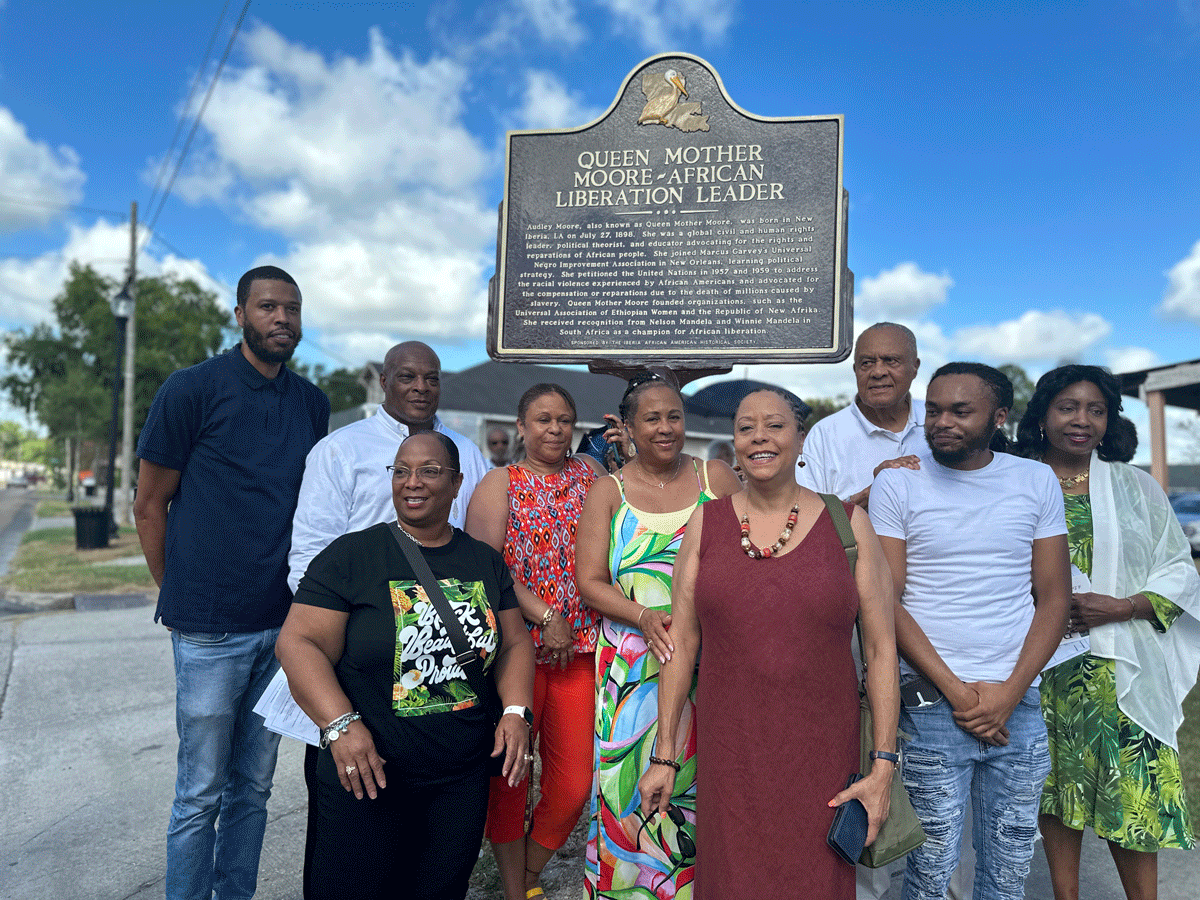
Audley Moore’s son, Tom; her granddaughters, Audley, Judith, and Christine; and members of her extended family in front of her historical marker.
Photo by Ashley D. Farmer
On a humid Saturday morning in August 2023, ninety-year-old Tom Warner stepped out of his car and into the muggy New Iberia air. He gingerly made his way toward several rows of plastic chairs under a red tent in the parking lot of Da Berry Fresh Marketon South Hopkins Street. Sounds of fluttering paper fans and soft greetings filled the air as members of the Iberia African American Historical Society (IAAHS), dressed in matching T-shirts emblazoned with the group’s logo, bustled around setting up microphones and handing out water. As the clock struck 9 am, IAAHS founder Dr. Phebe Hayes, a warm and elegant woman with silver-gray hair, leaned down to welcome Warner. This was no ordinary gathering. Warner and his family had traveled from Philadelphia to witness something deeply personal and long overdue: the unveiling of a Louisiana State Historical Marker honoring Queen Mother Audley Moore.
Born in New Iberia in 1898, Audley Moore grew up to be one of the most influential Black nationalists of the twentieth century and the pioneer of the modern reparations movement. Though her legacy is international, the ceremony marked a poignant return to her roots. For many New Iberians, it was the first time they had heard her name. For Moore’s family, it was the first time they visited the place where her story began.
Audley Moore was the eldest daughter of St. Cyr Moore, a Creole man who, despite all odds, made a prosperous life for himself in Reconstruction-era Iberia Parish. By Audley Moore’s account, her father was born in the 1850s and enslaved on a local sugar plantation. St. Cyr survived the Civil War and came of age in an era when American leaders were grappling with how to incorporate four million formerly enslaved people into society.
St. Cyr took advantage of the opportunities open to newly freed and enfranchised Black men. In Iberia Parish, white and Black Republicans maintained a strong political front in the 1870s, allowing formerly enslaved men to gain a foothold in local politics and the economy. Rather than work for former plantation owners, St. Cyr became an independent carpenter. Steady work allowed him to expand his business as well as buy a few horses to open a livery service for locals to ferry goods around town. It didn’t take long for the Moore patriarch to become part of the monied Creole class in New Iberia. St. Cyr also sought political office to lay claim to the full rights of citizenship and protect his burgeoning family and fortune, becoming a constable in New Iberia, a position that allowed him to command respect from his white counterparts and, in theory, protect his Black ones.
For many New Iberians, it was the first time they had heard her name. For Moore’s family, it was the first time they visited the place where her story began.
Historians and genealogical enthusiasts alike can now find out more about Black New Iberians like St. Cyr Moore thanks to the IAAHS. In 2013, Dr. Hayes noted in her presidential address to the IAAHS that “except for mention of Felicité, an African slave woman who supposedly nursed Black and white citizens during the 1839 yellow fever epidemic, the official history of Iberia Parish has included very little about the contributions of its Black citizens and institutions.” Instead it had mostly focused on Acadians’ and Spaniards’ contributions to the region. This all changed when Hayes led New Iberians in founding the IAAHS in 2017 to educate, commemorate, and preserve African American history in Iberia Parish. They began their work by erecting a historical marker for Dr. Emma Wakefield-Paillet, the first African American woman to earn a medical degree in the state, on Main Street in 2018.
Like Dr. Wakefield-Paillet, St. Cyr Moore lived and labored in turn-of-the-century New Iberia. Audley’s father was able to amass enough money to become a landowner, and many saw him as a “respectable-looking colored man” about town. But one day, when young Audley was playing with her sisters, she stopped at the sound of a horse-drawn wagon coming toward her grandmother’s house. Audley described the moment to Cheryl Gilkes in a 1978 interview for the Black Women Oral History Project of Radcliffe College. “I remember Grandma allowing us to peek through the shutters,” Audley said, as long as she stayed low so she could not be seen. The spectacle came into view: white men on horses “hollered like wolves” as they dragged a Black man off the back of their wagon to his death by lynching.
Moments like this one defined her early childhood in New Iberia. As she grew into a world-renowned activist, Moore credited her early life in Louisiana with shaping her worldview and racial politics. She never missed a moment to tell an interviewer or younger activist about the fact that her father joined the police force and the Republican political machine. Or the fact that her mother, Ella (Johnson) Moore, was highly educated and fluent in several languages. In other words, growing up in New Iberia taught her self-pride, self-determination, and, if needed, how to engage in self-defense to protect herself and her family.
It’s exactly this kind of rich, textured history that IAAHS members hoped to bring to New Iberians by establishing the first historical marker for Moore in the South. On that hot summer day, they watched alongside Tom Warner and his family as two men peeled back the covering and revealed a large, aluminum rectangular sign with an arched top bearing the title Queen Mother Moore: African Liberation Leader, with the historical context that “Audley Moore, also known as Queen Mother Moore, was born in New Iberia on July 27, 1898. She was a global civil and human rights leader, political theorist, and educator advocating the rights of African people.” Generations of Moore family members—grandchildren and great-grandchildren—smiled with pride as they stood before the historical marker, on land their ancestors once walked.
Queen Mother Moore’s deep ties to New Iberia are just one of many stories that locals can now explore at the IAAHS Center for Research and Learning, which opened just hours after the unveiling of Moore’s marker. Located on the second floor of the Shadows-on-the-Teche Visitor Center, the space is significant in more ways than one. Directly across the street from the main house of the Weeks family sugar plantation, the building echoes the plantation’s history and aesthetic. Its imposing façade—complete with four evenly spaced, neoclassical white columns—conceals two stories of symmetrical windows, once shaded by green shutters designed to block the summer heat. But times have changed. Now, when visitors enter the building, they walk beneath two large blue, white, and brick-red banners featuring Cornelius Manuel and Rosa Ella Manuel, Phebe Hayes’s great-grandparents and representatives of New Iberia’s African American community. St. Cyr Moore could never have imagined that a place dedicated to uncovering local Black history would one day stand on a former sugar plantation like the one where he and his family worked.

Portrait of Audley Moore, 1982. Photo by Judith Sedwick. Courtesy of Schlesinger Library on the History of Women in America at the Harvard Radcliffe Institute
On the day of the marker’s unveiling, St. Cyr’s grandson and great-granddaughters climbed the stairs to the second floor of the old house and stepped into a space where their ancestors would have never been allowed. There, they flipped through records of Black New Iberians who had fought in the Civil War as well as records from the Howe Institute, the first school for Black students in the area. And this is just the start; Hayes noted that “people give us or loan us their personal papers, their family archives,” to digitize and use. The IAAHS continues to add a significant number of materials to their archive as well as an impressive array of public history offerings, which now includes a journal, more historical markers around New Iberia, and public talks, all of which are free and open to the public.
The beauty of the Center lies not only in its ability to recapture the past but also in its power to highlight how Black New Iberians have shaped the present and are influencing the future. Moore is a perfect example. In 1922, she had the chance to hear famed United Negro Improvement Association (UNIA) founder Marcus Garvey speak; her involvement in UNIA during the 1920s laid the groundwork for her political work and started her lifelong investment in supporting African heritage, Pan-Africanism, Black political self-determination, and self-sufficiency.
Moore worked as a grassroots activist for the rest of her life, organizing on behalf of everyday Black people in Louisiana and beyond. In 1957, she founded the Universal Association of Ethiopian Women, in which she led a group of middle-aged Black women fighting to free wrongly accused Black men from Angola Prison and support Black women on welfare. Though small, the Association made a big impact on Black Nationalist organizing, and helped Moore realize that “someone had to pay” for the atrocities Black people had faced since the nation’s founding. From her New Orleans home, Moore single-handedly started the modern reparations movement in the 1960s, traveling around the country pushing Black people to file a claim for repayment with the federal government and mentoring movement luminaries like Malcolm X to join her fight.
Her decades of activism made her a sought-after advisor for African state leaders seeking support as they led nations during the era of African decolonization. Tanzanian president Julius Nyerere and Guinean leader Sékou Touré asked her to come and offer counsel. In 1972, the chief of the Ashanti Tribe formally anointed Moore as a Queen Mother—a testament to her reputation as a global Black liberation leader. In the eighties, Moore went on to mentor organizers like Al Sharpton, Louis Farrakhan, and New York’s first Black mayor, David Dinkins, hoping to broaden formal support for Black self-determination. She served as symbol of the movement until she died in 1997 at age 98.
No matter where she was or what she was doing, Queen Mother Moore believed in the importance of knowing one’s history and heritage. She made it a priority to educate both herself and future generations about the past. “I always kept a library for my son with all kinds of books—books on our history and everything,” she said in her 1978 interview with Cheryl Gilkes. It was only fitting, then, that her son was among the first to walk into the IAAHS Center for Research and Learning, a space dedicated to preserving and honoring the history of Black New Iberians.
The decision to position the historic marker at Da Berry Fresh Market was purposeful. The market is the brainchild of Envision Da Berry, a local nonprofit working towards community empowerment for New Iberia’s historically Black West End through fresh food and job opportunities. On the day of the unveiling, red, black, and green Pan-African flags flapped above the market’s entrance, welcoming guests into a space filled with the fruits of local labor: crates of colorful vegetables, shelves stocked with preserves and handmade goods, and murals of Africa. As market owner Carl Cooper guided Warner and his three daughters through the space, he spoke about the importance of cultivating local Black self-sufficiency. Moore’s granddaughters nodded in agreement. “Queen Mother would have loved this,” they said, fanning themselves with folded programs bearing a painting of her on the cover.
Indeed, she would have. The unveiling of a historical marker honoring Moore in New Iberia was more than a long-overdue recognition of her global impact. It marked a significant moment of community reclamation by reconnecting residents with a forgotten past and highlighting the deep ties between historical memory, local revitalization, and Black history in New Iberia and beyond.
Ashley D. Farmer is an Associate Professor of History and African & African Diaspora Studies at the University of Texas–Austin. She is the author of the first biography of Audley Moore, Queen Mother: Black Nationalism, Reparations, and the Untold Story of Audley Moore, as well as other books and articles about African American women’s history.