Rita and Her Ruins
Remembering Hurricane Rita’s impact on southwest Louisiana, twenty years later
Published: August 29, 2025
Last Updated: October 1, 2026
Courtesy of Laurie Trosclair
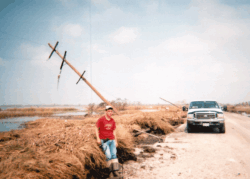
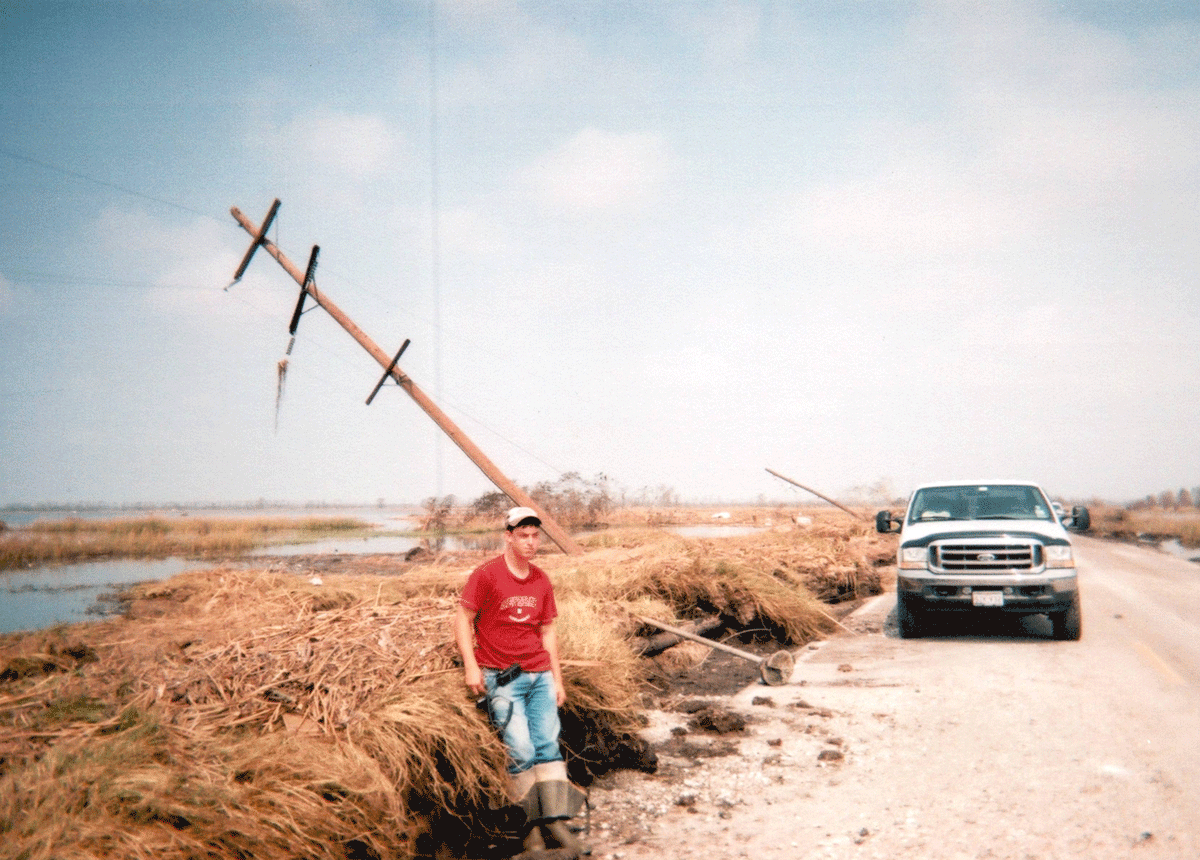
A resident stands in wading boots on the side of a Cameron Parish road flanked by power lines completely bent over by wind.
My soul is stuck in that September. Maybe sequestered deep in the Black Bayou marsh. Or lodged in the rafters of the old green barn. Or tied up with roseau cane. Somewhere in Sweetlake, to be sure. Caught there twenty years ago, when I was just fourteen.
I remember the moment it got stuck. But to this day, I fail to recall what, exactly, prompted it. Could have been when our local meteorologist cried on live television, begged us to leave. Or when the sheriff deputies came by with a permanent marker, mandated that we write our social security numbers on our arms if we insisted on staying. Or when the whole family gathered in my grandma’s den to finalize plans, say goodbye, and—unable to keep my fear offshore—I cried not to leave my dad.
All I know is that at some point, I tried crossing the road to go back home. For whatever reason I was alone. Only two lanes, but a greater expanse than usual. I tried hurrying time—already afternoon, we really needed to get going—but it kept slowing. And I kept walking, getting farther from nowhere. Yellow pavement markers under foot, I looked up, high lines framing my view, and saw three black buzzards in the direction of Creole, circling. Death announcing its arrival.
The eve of Hurricane Rita, 2005. That’s when it happened. By the time the storm came ashore, whatever in me that was still whole, or still believed things could be made whole, was already wrecked.
—
A brown pelican flew overhead and landed on a nearby fence post. My uncle noticed from an aluminum fishing boat, the only method for reaching his home at the moment, tiny crests lapping against the hull.
Odd, really. Ask hundreds of people in Cameron Parish and not one would say that water could rise this high in Grand Lake. Even after a hurricane, any hurricane. Too far north. Buttressed by groves and marsh. Besides, everyone had relatives who had lived through Hurricane Audrey—we measured that water line and built higher, by a foot or more.
So, this water was surprising. But the pelican was disturbing. Not until then did my uncle realize that the Gulf was in his backyard. Should have been fifteen miles south.
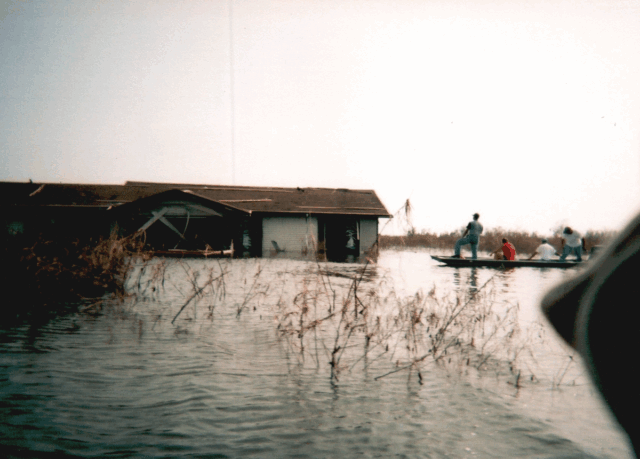
Men survey a flooded family home by boat. Courtesy of Laurie Trosclair
—
The Bonsalls of Creole can’t talk about Rita without talking about Audrey. Charlotte spent that night in her aunt’s attic, praying the rosary and watching the rafters shiver. Elton ended up outside with his dad during the worst of the storm, wind strong enough that they couldn’t stand. So, they climbed into the nearby salt cedar tree. Snakes, dead cows, entire homes floated past. When the waves grew higher than they could climb, his dad moved behind, stood tall, braced him from the crashes.
But then, forty-eight calm summers of tomatoes, cucumbers, bell peppers, squash. No reason to think it would happen again.
Of course, Rita would take everything. More than Audrey: the old house, the garden, the trees, old photos and sports trophies strewn across town.
Now they reside in Holmwood, well north of home. After Rita was not the last time the Bonsalls would rebuild in lower Cameron Parish. But Rita was the first domino to fall, Elton told me. He never did say how many dominoes ended up falling.
To date, Hurricane Rita remains the strongest storm ever recorded in the Gulf of Mexico. The fourth strongest in the recorded history of the Atlantic. Category 5. Maximum sustained winds of 180 miles per hour. Wind gusts of over 235 miles per hour. Minimum pressure of 895 millibars. That low pressure was her power, allowing her to suck more heat and moisture from warm Gulf water at an unprecedented rate. She grew from a tropical storm to peak strength in thirty-six hours.
She came in between Sabine Pass and Johnson Bayou in the early morning of September 24, 2005. Around 2:40 am. Almost identical to Audrey.
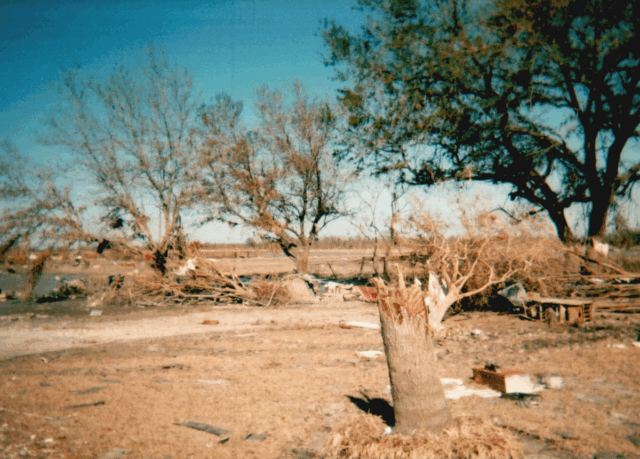
Damage to the Bonsall family property in Cameron Parish following Hurricane Rita. Courtesy of Laurie Trosclair
—
We were terrible at evacuating. Left late and only went thirty-five miles north to Reeves. Through the storm, we learned how ground trembles around the tallow tree, its roots clenching and clutching, shaky, but sturdy.
Then, barely an hour after she passes, we take off in different directions: men for home, women for Alabama. Around Biloxi, tornado sirens blare at the gas station—Rita also heading to Montgomery. My cousin claims we never quit watching the news. Uncle Ricky came on CNN, offered the nation a tour of his water-logged home, and we mourned states away, witnessing this scene as if it was someone else’s natural disaster.
Sometime, in the dozens of hours we spent in the car together, my grandma misheard the lyrics to a country song and declared a new favorite tune. It was true, she maintained, “there might be a little dust on the Bible, but don’t let it fool ya about what’s inside.” Didn’t have the heart to tell her that the man was referring to an old bottle of wine.
—
There was no more Holly Beach.
—
No rebuilding without a roof. And no roofing company in Cameron Parish besides Poole Roofing, which in the first few weeks after Rita was just my dad, my grandpa, his brother, my uncle, and my uncle’s brother-in-law. Right away, they came into the parish—from the back roads to dodge authorities. Five men against $18.5 billion dollars of damage. Five men stupid enough to think they could fix it all.
Tarping everything at no charge—pay us when we can get your shingles on. Rigging lights in trees to unload semitruck trailers at 3 am. Pumping water day and night from atop the hospital. But first, laboring for the water works utility office who didn’t have enough hands to shut off every water meter, the first step toward running water. We never did find who stuck a sign out by our equipment, calling the place “Ground Zero.” Eventually, heat stroke. And waking up every morning feeling like you had already failed.
In the office, my cousin and I handled the paperwork. No school for a while, then only part time for the rest of freshman year, so we helped family and friends file for FEMA relief. Once we all had claims to wait on, my mom taught me how to calculate payroll, generate estimates, mail invoices.
The Bonsalls of Creole can’t talk about Rita without talking about Audrey. Charlotte spent that night in her aunt’s attic, praying the rosary and watching the rafters shiver.
—
The National Guard confiscated our forklift upon arrival. Storehouses of diesel too, taken so their trucks could guard the Cameron Parish line, drive people out after curfew.
Not quite sure what the military needed to haul just then—wasn’t tarps or shingles, that much I remember. Whatever it was must have been heavy because the forklift was drug back, broken. A real shame that I never figured out where to send that invoice.
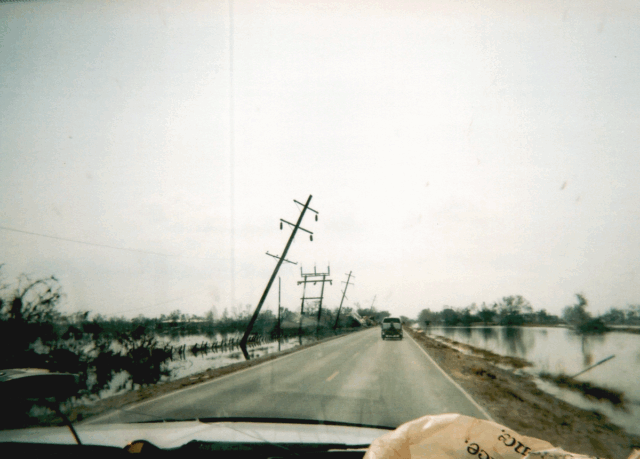
Flooding and damaged power lines were common sights in Cameron Parish and surrounding areas following Hurricane Rita. Courtesy of Laurie Trosclair
—
The only house on Country Lane unscathed—no standing water, no mud, no missing walls, no severe roof damage—belonged to the Guidrys.
No reason why that should be the case. Except this one: throwing everything in the car, running to buckle the kids, hurrying out the driveway—then Teena hops out. Takes scissors. Cuts blood red fringe from her daughter’s bedspread. Tapes a cord of fringe over every exterior door. Prays like Rahab.
The scarlet cord still there weeks later, held tight by nothing but Scotch tape.
In the aftermath my senses expanded. A new dark, sans electricity and not willing to waste generator fuel. A new hush, birds still gone, no leaves left to rustle, nothing to say between us.
—
A turtle trying, and failing, to scurry underneath your living room couch. Came in with the water and got stuck in the muddy aftermath. At least two inches deep, that marsh mud in your house. Covered everything.
A nutria rat in what was your childhood bedroom.
Snakes curled around your Christmas decorations.
Dead, bloated cows in your front yard. Forget the visual—the smell is what lingered.
The dog you left behind, who, after survival, was never not spooked, who would stare into the sky, growling, not trusting even clear mornings.
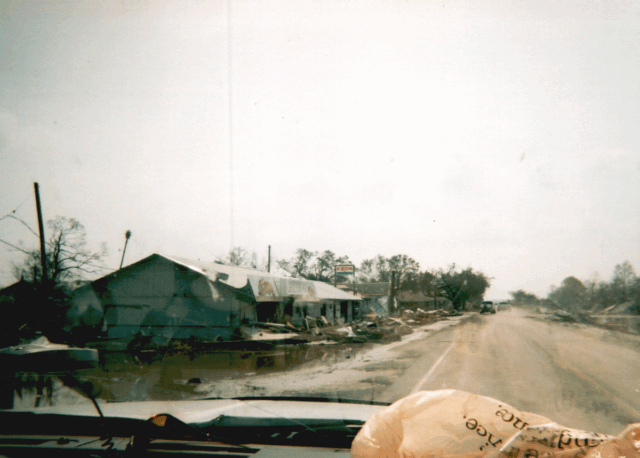
An extensively damaged section of a Cameron Parish street following Hurricane Rita. Courtesy of Laurie Trosclair
—
Meanwhile, my husband remembers that storm as the punchline of a family joke. He’s from North Texas. His Aunt Rita as a hurricane, what a thought.
To much of the nation, we were a laugh over dinner. To those more tender hearted, maybe a sigh.
—
A lack of color. That’s what Jo Griffith remembers about returning to her home in Johnson Bayou. The ground, the trees, the marsh, the rubble—all the same shade of brown.
Cameron Parish had been a lonely place for her as an outsider from Texas. It took her more than a decade to fall in love with her husband’s home. Over time, it became her home, too. Then, Rita.
Nevertheless, she had normalcy to rebuild for a son just starting high school, a whole life there to restore. So, she did, a line from Isaiah on repeat: “You will keep in perfect peace those whose minds are steadfast, because they trust in you.” That peace sustained her.
By the next September she held a strength that knew no bounds. Because Rita had knocked her down, and she’d found a way to stand back up again.
Only once did she break down. She found herself throwing muddy records off a broken front porch as if they were Frisbees. One after the other, soaring toward a treacherous Gulf to exact revenge. More force with every album, but each one fell short.
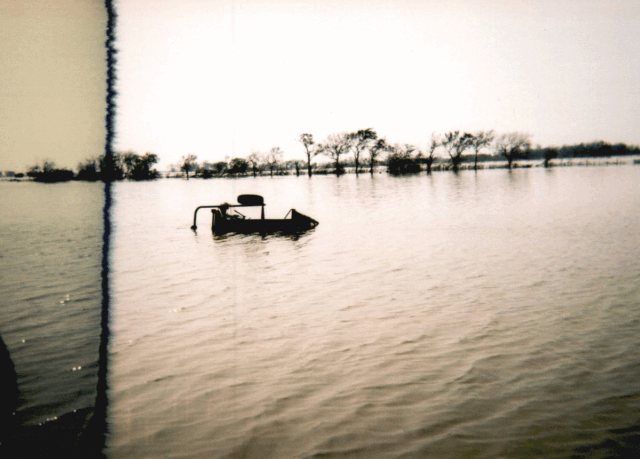
Flooding to Cameron Parish following Hurricane Rita rendered some areas unrecognizable. Courtesy of Laurie Trosclair
—
I wish I could hear what you remember. Or we could sit down with your neighbors and classmates from back then to swap anecdotes, corroborate details.
“What’s the most vivid sensation you can recall?” I’d ask. That one would take us hours. And we’d laugh until we cried. Or we’d just cry. Eyes shining, breath heavy, we’d grow silent, just nodding at each other, and we’d understand what that quiet meant.
Before I left—and it would be hard to get away; you would have so much more to share, and my listening would be the best way I could hold you—I’d be sure to ask: “What part of your self did she take?” I’d hope you wouldn’t have an answer, but, of course, you would.
—
In the aftermath my senses expanded. A new dark, sans electricity and not willing to waste generator fuel. A new hush, birds still gone, no leaves left to rustle, nothing to say between us. A new texture at hand, probably from putting all that laundry on a makeshift clothesline. A new ache, muscles lifting too heavy for too long for too many.
A reporter from The Times-Picayune asked me back then to tell this story, narrate what happened to us. I found the answers in my throat irretrievable, so I choked out an account, pretended we could explain it all away.
You know that feeling you get when you’re trying real hard not to cry? Back of mouth down to upper chest? It’s still there—I never could swallow it, what I meant to say to him.
At first I called it “fear,” like when the cell phone towers failed and we were all the way in Alabama and we couldn’t reach Dad and I was supposed to stop trying, but I hid in the other room, dialing dozens of times just to hear the roar of the busy signal. Later, I called it “shame.” We had a school, and beds to share—how dare my voice shake.
I would spend the next decade studying the limits of the sayable. I would specialize in how our bodies hold more than words can encase. Really, I was just trying to get the answers to his questions unstuck.
All that study, and here I remain, mumbling over meaning, almost clarifying, stuck on that road, September, still not quite making it home.
Megan Poole was born and raised in southwest Louisiana. She is an assistant professor at The University of Texas at Austin where she specializes in rhetoric, writing, and environmental communication. She wishes to thank the U.S. Department of the Interior, Marine Minerals Administration, Environmental Studies Program, Washington, DC under Cooperative Agreement Number GM-23-04, who provided study collaboration and funding for the Bonsall interview.