Magazine
What Endures
Shrimp and Petroleum’s legacy on the Atchafalaya
Published: September 1, 2026
Last Updated: October 5, 2026
Courtesy of the Shrimp and Petroleum Festival
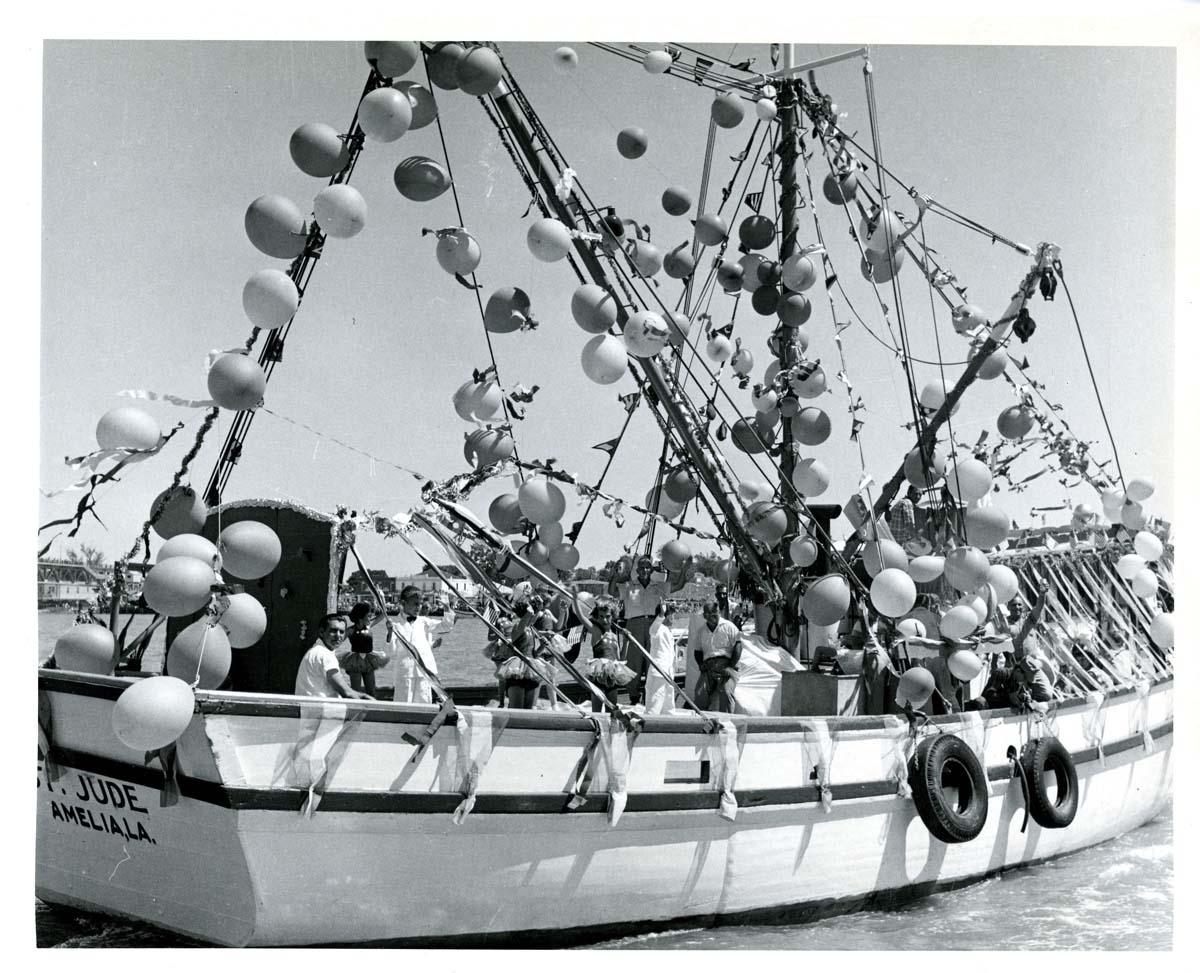
A shrimp boat, named the St. Jude Shrimper, decorated for the boat parade.
The walls of Hailee Thomas’s office in downtown Morgan City are crowned with posters and kitschy memorabilia, curated from ninety years of Louisiana’s oddest coupling—the Louisiana Shrimp and Petroleum Festival—and epitomized by a 1984 poster depicting an overturned barrel of crude oil with a shrimp tail floating above. Thomas, the festival director, has heard every quip. “It’s very much like, ‘I don’t want oil in my shrimp, and I don’t want shrimp in my oil,’” Thomas said. She will tell them the history and pageantry of it all; perhaps her grandmother’s 1950 coronation or her own in 2014. “When you’re from here, you just get it.”
Originally conceived simply as the Shrimp Festival to honor the port city’s reputation as “Jumbo Shrimp Capital of the World,” the festival was rechristened in 1967 to acknowledge the community’s integral part in oil and gas development and operations in the Gulf of Mexico. Over Labor Day weekend, about 100,000 visitors—nearly ten times Morgan City’s population of 11,000—pour in for the carnival rides, the parade of debutantes and local officials, the cookoffs, fireworks, and even helicopter rides for last year’s ninetieth anniversary. But the celebration is best symbolized by the traditional blessing of the fleet.
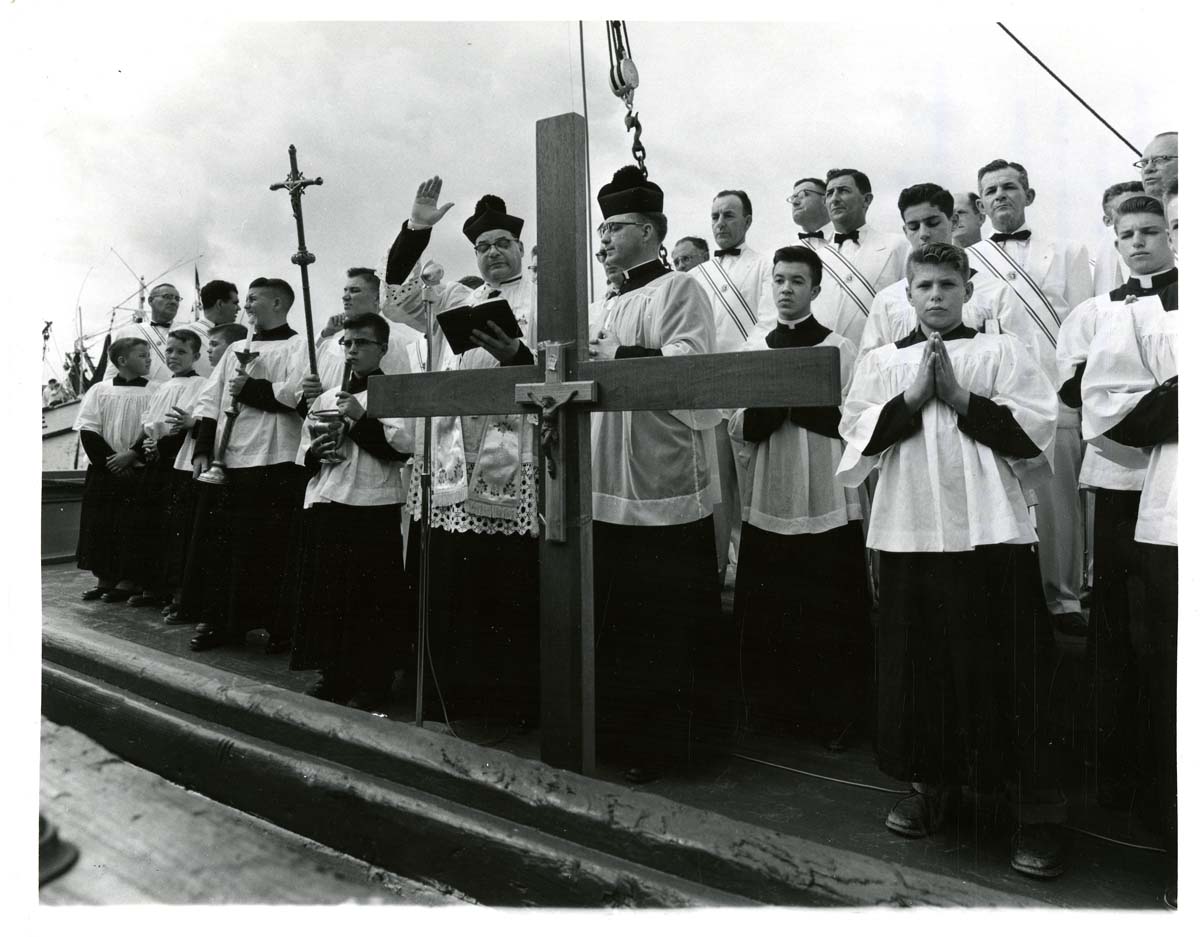
During the traditional blessing of the fleet, the only solemn portion of the Shrimp and Petroleum Festival, a Catholic priest and others bless the shrimp boats. Courtesy of the State Library of Louisiana
In the stretch of the Atchafalaya River just north of the Intracoastal Waterway known as Berwick Bay, a chosen king from the oil industry and a young queen board tugboats trailed by a work boat of ladies-in-waiting sporting gowns and tiaras, along with a scattering of skiffs and party barges. They sail clockwise around the bay, veer towards shore for a priest’s blessing with holy water, then moor up bow-to-bow to toast champagne glasses. In years past, dozens of trawlers and work boats crowded into the procession for the fishermen’s blessing. Today’s careful orchestration is largely symbolic, commemorating bygone days.
Both the shrimp and petroleum industries are undergoing profound changes. Cheap imported shrimp, which account for more than 90 percent of US consumption, have depressed wholesale prices for domestic wild-caught shrimp, which makes shrimping in the Gulf barely worth the time and money to keep the trawlers fishing. Many multigenerational fishermen have simply hung up their nets. Licensed shrimp boats in Louisiana have fallen from 6,900 in 2000 to just 1,396 in 2024, according to Louisiana Department of Wildlife and Fisheries biologist Peyton Cagle. Federally licensed fishers in the Gulf have also plummeted from 4,585 vessels in 1981 to 1,467 in 2023, according to the National Oceanic and Atmospheric Administration.
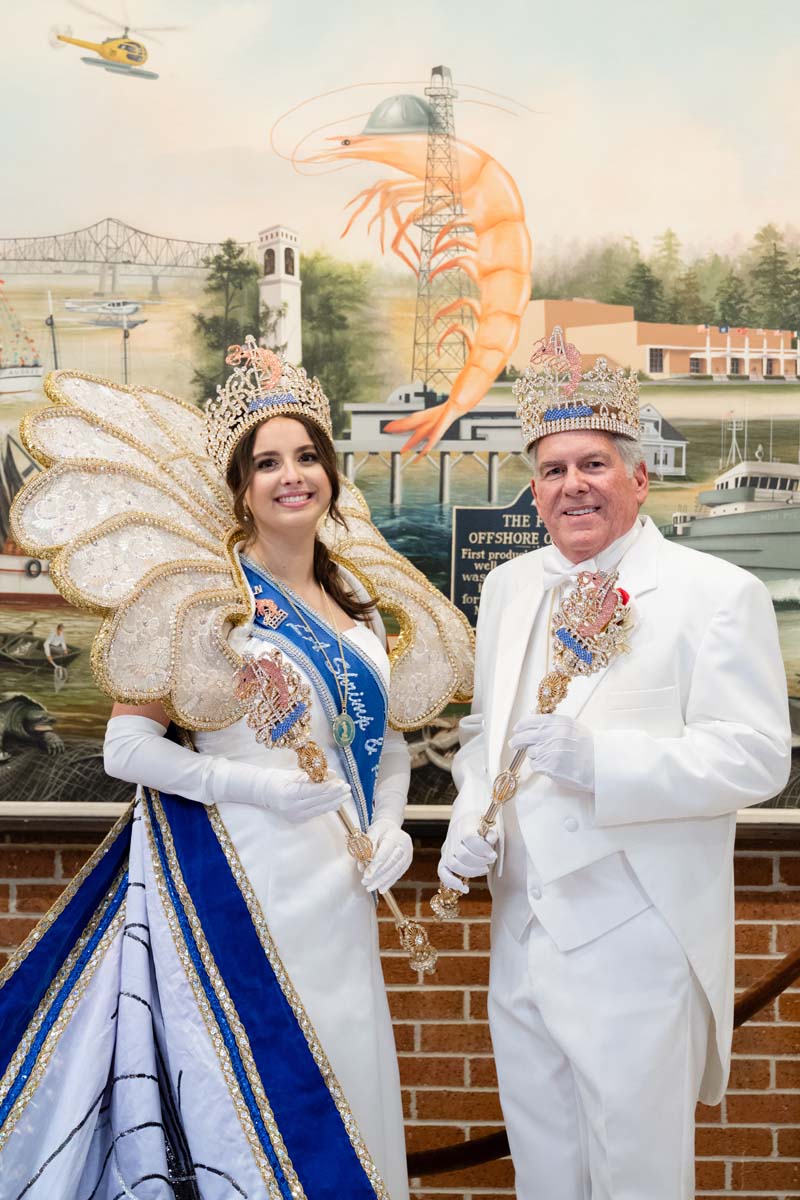
The 90th Shrimp and Petroleum queen and king. Photo by Sampey Photography, courtesy of the Shrimp and Petroleum Festival
Here in Morgan City, only a half dozen fishing boats anchor at the docks. “We don’t have a domestic fleet here anymore,” said Charlie Solar, the Shrimp and Petroleum Festival board president and Morgan City’s Chief Administrative Officer. Aging captains are more likely to nudge their children into steadier work over in the oil fields or fabrication yards.
Morgan City lays claim to the first offshorerig out of sight of land, built in 1947, and was of critical importance to the oil industry establishing itself in the Gulf.1 Just off the Intracoastal Waterway, many of the pipelines and shipyards still bear the surnames of earlier generations. But deepwater oil production in the Gulf of Mexico and beyond have left the shelf towns like Morgan City behind. Operations that serve the deep-sea rigs moved to Houston or Port Fourchon, the sprawling oil services site near Grand Isle. The remaining big three shipyards in the area—Bollinger, McDermott, and LAD Services—have diversified into other sectors, building landing barges for private aerospace companies and construction barges and fabrication parts and cables for the nascent wind industry, said Lee Dragna, Morgan City Mayor and founder of LAD Services.
While shrimp, then petroleum, built Morgan City’s fortunes, they remain an uneasy alliance.
The oil industry is also downsizing. Despite record national production—13.2 million barrels per day in 2024—Louisiana’s oil-and-gas workforce fell by 41 percent between 2014 and 2023. Megan Biven, a former federal analyst and biologist for what is today the Bureau of Ocean Management and founder of True Transition, noted that even with production up in the Gulf, the industry is consolidating through automation and outsourcing engineering services abroad. “They are going down to the slimmest of margins in terms of people out there working these platforms and rigs,” she said. In other words, record profits by the oil supermajors aren’t trickling down to employment opportunities for Louisiana workers.
“Oil is a finicky, finicky business,” said festival director Thomas. “It has its ups and downs.” But the oil men in second- and third-generation businesses are still buying sponsorships for the festival and keeping the “VIP Petro Pit” and the “Petroleum Heritage Music Stage” jamming with live music in Lawrence Park.
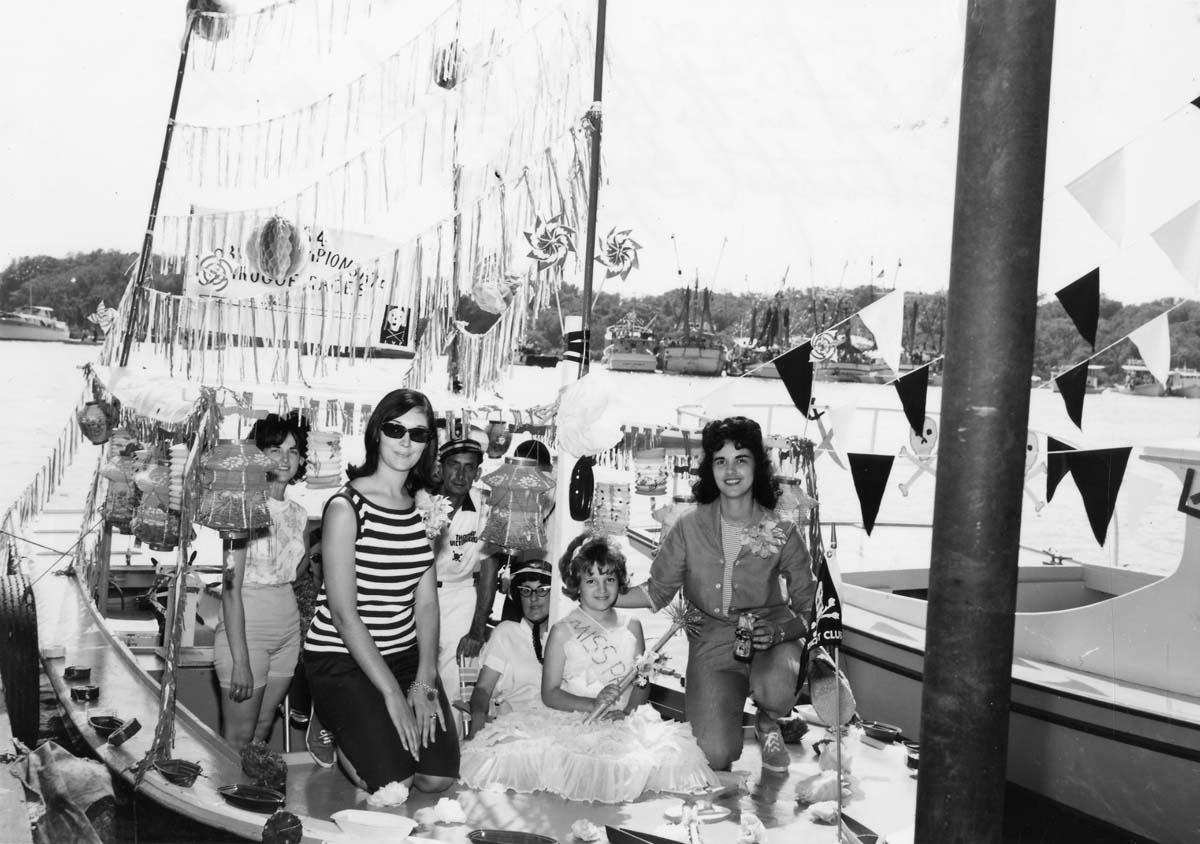
Capturing the spirit of revelry, the back of this photo included this note, “A boat in the Boat Parade with beautiful bayou girls,” 1960s. Courtesy of the State Library of Louisiana
Thomas was unexpectedly handed the festival director’s role in 2019 shortly after graduating from Nicholls State University. Outgoing and effusive, she was offered a job with her national sorority but decided to stay home to steward the festival that raised her. She earned her sea legs steering the organization through COVID cancellations in 2020 and 2021. Then came the discovery in 2024 that vendors at the festival were selling imported shrimp.
Houston-based Sea Development (SeaD) Consulting genetically tested festival dishes and found that 80 percent of them were foreign. The revelation—which continues to be disputed by some festival organizers—nonetheless triggered alarm bells at festival headquarters and prompted legislative hearings in Baton Rouge. “We’ve just kind of done it a certain way and went on autopilot,” Thomas said. “As uncomfortable as it was, it forced us to grow.”
The festival in 2025 required vendors to document that their shrimp were sourced exclusively from Louisiana. Violators would be banned for life. The effort seems to have paid off. “After their initial reaction, it appears they found religion,” said SeaD founder Dave Williams, whose analysis in 2025 found that all the shrimp tested were domestic.
“You can tell the difference, said John Gibson, owner of WoodDreaux’s Cajun Cuisine who bought the shrimp for his festival contribution directly from Dean Jackson’s boat in Morgan City. “It’s not even close. It’s got that earthy feel and texture.” Other vendors contacted said that while festival organizers are now checking their receipts, they’ve always sold domestic shrimp. But one restaurant owner complained about the unsteady supply from local shrimpers and the inability to re-freeze wild caught shrimp if something like a rainout occurs. “Rules are rules,” said Hilton Rhodes, owner of Kajun Seafood Shack. “But I have a business to run too.”
Tensions are also running high between fishermen and wholesale buyers. Prices for everything have gone up—fuel, boat maintenance, ice. “Ice used to be free,” said Morgan City shrimper Kermit Duck. “Now it costs seventy dollars.” Meanwhile prices for shrimp have fallen. The collapse of the domestic shrimp market has winnowed down the number of shrimp wholesalers, processors, and ice sheds where shrimpers fill their storage holds. Where wholesale buyers used to compete for wild caught shrimp, now they set the terms. “American processors don’t want to pay for wild shrimp,” said Duck.
The festival in 2025 required vendors to document that their shrimp were sourced exclusively from Louisiana. Violators would be banned for life. The effort seems to have paid off.
Some ice houses will refuse to sell ice to shrimpers unless they agree to return with their catch to sell wholesale, said Donald Ribardi, a multigenerational shrimper who sells from his boat Mama D in Berwick to escape the plunging prices offered by wholesalers throughout the Gulf. On a recent day, Ribardi was retrofitting Mama D with a new electric cooler to avoid the ice house squeeze. The $18,000 investment will save $700 in fuel and ice for each round trip to the closest ice shed over in Dulac, Louisiana. The system will also allow him to sell the shrimp dockside at $3.50 to $5 per pound without worrying about ice melting. “It keeps [the shrimp] just before freezing. Not like on ice. You get beautiful shrimp,” said Ribardi, whose daughter helps with sales. “I’m making the switch. Maybe that’s the ticket. I hope so anyway.”
Port Sulphur shrimper Roland Philippe said it cost $7,000 to get his boat out of dry dock for the season. His two-day run over the summer pulled a 4,000-pound haul and fetched 80 cents a pound at the wholesale dock down in Buras, Louisiana. After fuel and ice costs, he could only pay his two grandsons and son $150 each. He tells his grandson Noah, who is studying welding, to look for metalwork in the oil business—not the Gulf.
“We’re not going to have a shrimp industry,” says Grand Isle seafood buyer Dean Blanchard, who is watching business disappear before his eyes.“If the daddy don’t show the son no more, it’s broken.” And increasingly, due to factors far beyond individual control, financial incentive to pass shrimping to future generations has dwindled.
Commercial fishermen hope recent policy changes and tougher tariffs will help. Louisiana’s 2024 truth-in-labeling laws require restaurants to label imported shrimp and crawfish or face fines up to $2,000. SeaD’s Williams said restaurants and other local festivals are starting to fall in line. “Things are a little bit better,” Ribardi said. Prices have ticked up ever so slightly. White shrimp averaged 55 more cents per pound in 2025 over the year before; brown shrimp were up 20 cents more per pound, according to the Louisiana Department of Wildlife and Fisheries. But relief is fragile while imports from India, Ecuador, Indonesia, and Vietnam dominate.
“It’s a whole world of issues,” said Acy Cooper, president of the Louisiana Shrimp Association. “We can’t survive like this.” Cooper said he had to park his boat in the winter for the first time in fifty years to drive boats for an oil field.
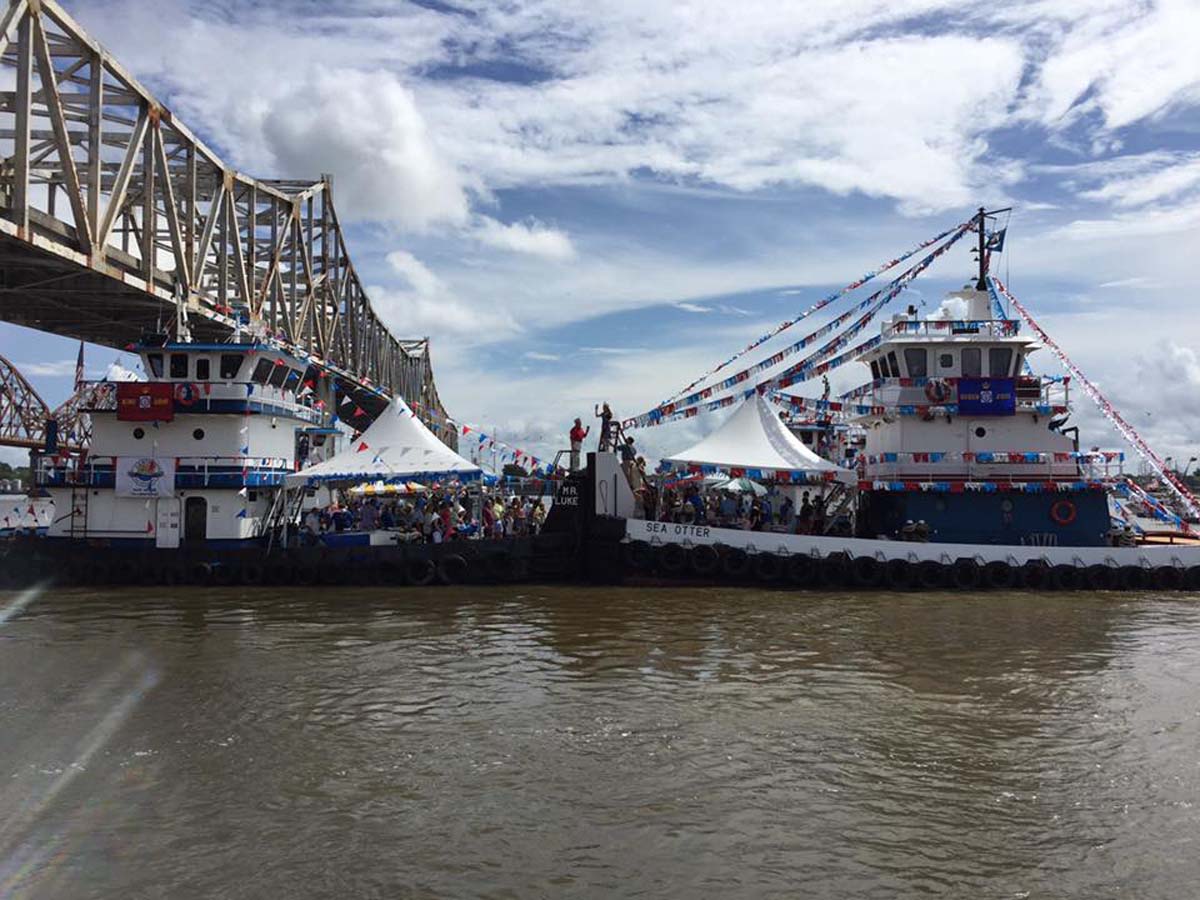
The Shrimp & Petroleum Festival, one of Louisiana’s oldest festivals, takes place every Labor Day weekend. Courtesy of the Shrimp and Petroleum Festival
Interestingly enough, the festival’s origins are rooted in a labor grievance. In 1935, a group of fishermen formed the Seafood Workers Association, affiliated with the American Federation of Labor. They successfully picketed five out of the six local processors for higher wages and better prices for raw materials. The next July, a group calling itself the Gulf Coast Shrimpers and Oystermen’s Association held a raucous City Hall meeting—which led to a Labor Day procession down Main Street joined by alligator hunters, crabbers, dock workers, Berwick Bay fishers, crews from Riverside Packing Company, and others. The event affirmed the industry’s place in the tri-city community of Morgan City, Berwick, and Patterson. Later that year came the first blessing of the fleet in Berwick Bay. According to the festival’s history, the annual occasion was simply known as “The Blessing of the Fleet” until 1948, when organizers formally enshrined it as “The Shrimp Festival,” with a legislative charter and a $5,000 grant to promote local industry.
While shrimp, then petroleum, built Morgan City’s fortunes, they remain an uneasy alliance. Thousands of miles of oil canals and pipelines have carved up the marsh, exposing critical estuaries to saltwater as well as chronic oil leaks and occasional catastrophes. None were more searing than the Deepwater Horizon, whose damage to the marine ecology is still being measured. Fossil fuel production and combustion are the source of most human-made greenhouse gases, which warm the Gulf, turbocharge storms, and nudge sea levels higher. As the marsh unravels, estuary nurseries for fish and juvenile shrimp disappear. While shrimp are particularly resilient and fast-growing, with an eighteen-month life cycle, they cannot outpace the disappearance of the marsh itself. Without grass and mudflats to cradle juveniles, the crop will start thinning permanently.
And then there is the upstream bargain that makes Morgan City possible. A twenty-two-foot concrete seawall along Front Street blocks the view of the Atchafalaya—a reminder of the city’s tenuous existence inside the nation’s largest floodway. Upriver near Angola, where the Atchafalaya mingles with the Mississippi River at the Old River Control, the Army Corps of Engineers gives the Atchafalaya just enough of the Mississippi to maintain the balance. The deeper Atchafalaya wants it all—which would steal the drinking water for two million people below Baton Rouge, lagoon the Mississippi’s giant petrochemical corridor below Old River, and bury Morgan City under a mountain of silt.
This balance allows Morgan City to endure. But the bargain that each generation inherits is also dependent on federal Mississippi River levees that starve Louisiana’s wetlands of sediment and hasten coastal loss. As the land recedes and insurance costs rise, general unease grows. For now, the policy adjustments like stricter enforcement against mislabeling imported seafood and trade actions against dumping are helping at the edges. But they don’t change the climate or regrow the marsh. Still, they keep faith a little longer with the people doing the work.
Ribardi, who used to get seasick when his daddy took him out fishing, hopes his new coolant system will keep him afloat a little longer. Both his sons traded the fishing life for steadier work, one as a tug captain, the other as a businessman in Idaho. “I swore I’d never be shrimper,” he said. “Now look at me.”
Ned Randolph III, writes about culture and the environment in the Gulf South. He received his PhD from the University of California San Diego and is a visiting scholar at Tulane University. His first book, Muddy Thinking in the Mississippi River Delta: A Call for Reclamation, explores the murky histories of South Louisiana and the Mississippi River Delta region.