Magazine
Independence Won
An interactive exhibition immerses visitors in the Revolutionary War
Published: June 1, 2026
Last Updated: September 1, 2026
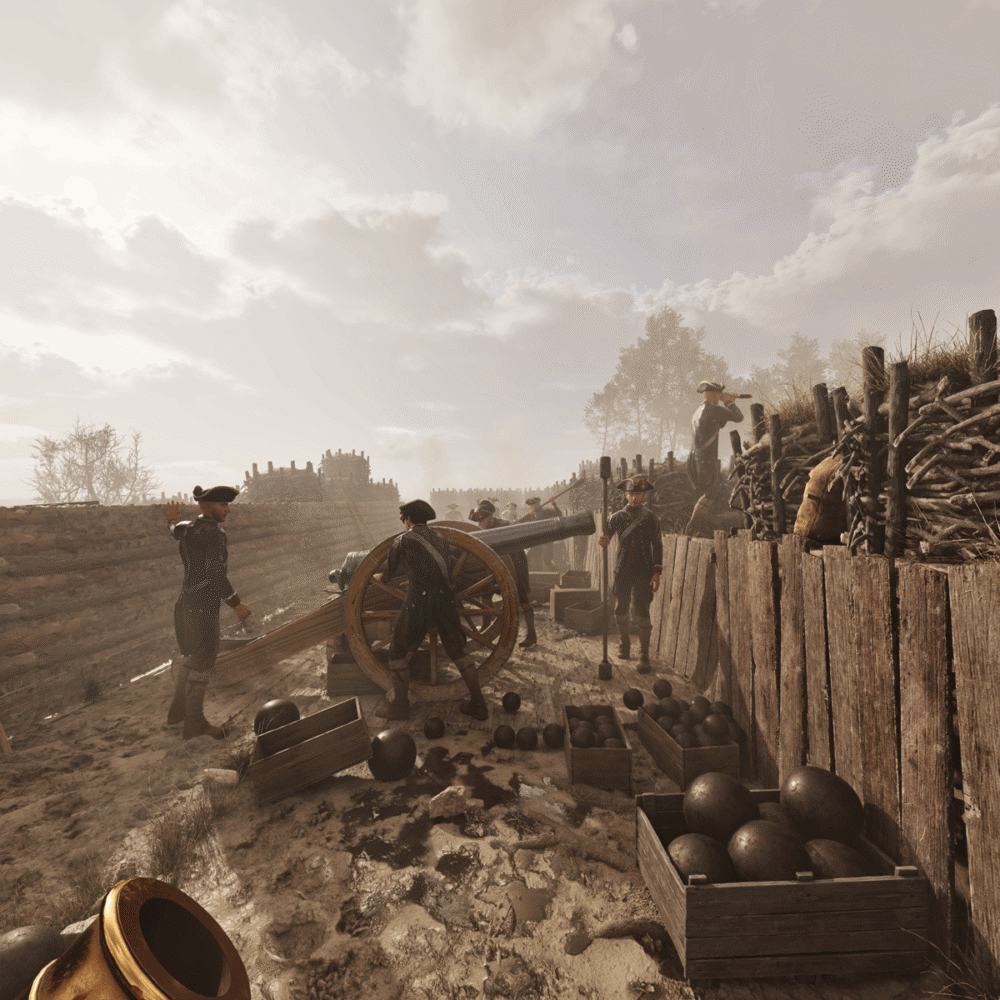
Image courtesy of Histovery via HNOC
Under heavy bombardment, Spanish militia artillery troops fire upon British forts from sheltered batteries.
Lexington and Concord, Valley Forge and Yorktown: These are the places that most Americans associate with the Revolutionary War. Pensacola is seldom mentioned—and yet the defeat of British forces there had a significant impact on American history. This battle is among the fourteen chapters in American Revolution: The Augmented Exhibition, now on view at the Historic New Orleans Collection. The new exhibition was produced and designed by French technology firm Histovery to commemorate the 250th anniversary of American independence.
Each exhibition chapter illuminates an aspect of the American Revolution, from colonial society and famous battles to diplomatic relations and the creation of the Constitution. These experiences come to life through visitors’ use of HistoPads, handheld devices that interact with gallery elements to display immersive 3D recreations of historic places, people, and events.
The Pensacola chapter focuses on Bernardo de Gálvez, the Spanish colonial governor of Louisiana, and how his diverse army faced down British troops in what was then British West Florida. Gálvez had arrived in the Spanish colonial capital of New Orleans in December 1776 to take command of the army. He almost immediately assumed the role of acting governor on January 1, 1777. Gálvez was then thirty years old, an inexperienced administrator, and he would soon be faced with military and diplomatic problems that would have challenged any veteran governor or commander.
Across Lake Pontchartrain from New Orleans was British West Florida, extending from Natchez and Baton Rouge east to Pensacola. There were British forts on the Mississippi from which attacks could be launched downriver. To complicate matters further, the thirteen colonies’ declaration of independence the previous summer had embroiled much of the continent in open warfare. New Orleans had only a token Spanish force guarding the city, so a citizen militia had to be carefully cultivated.
Spain was officially neutral toward both Great Britain and the American revolutionaries at the time of Gálvez’s arrival, but he began quietly planning for the possibility of war. Gálvez’s predecessor, Governor Luis de Unzaga, had covertly aided the American cause by supplying gunpowder to patriot forces in the Trans-Appalachian West. Gálvez built upon Unzaga’s policies by accepting American deposits at New Orleans, even opening the port to American privateers. He ordered the seizure of British smugglers and helped to secure additional supplies such as medicines and muskets, as well as Spanish dollars to help sustain the American war effort.
Gálvez set about improving New Orleans’s defenses, recruiting troops, and gathering intelligence about the three nearby British forts—at Manchac, Baton Rouge, and Natchez—that could threaten the city. When Spain entered the war in summer 1779, Gálvez was ready. He marched upriver with a group of soldiers that included recruits from Mexico and the Canary Islands, free men of color, and American volunteers. They were joined by 160 Indigenous volunteers, including Houmas, Choctaws, and Alabamas. This diverse group was quickly victorious at Manchac. They moved on to the formidable and well-defended Baton Rouge fort, where, after a decisive victory, they negotiated the surrender of both the Baton Rouge and the Natchez forts—ending British control of the lower Mississippi and retaking the western half of British West Florida for Spain.
Having ensured the immediate safety of New Orleans, Gálvez spent the final months of 1779 gathering troops and supplies for his campaigns against the remaining British strongholds in Mobile and Pensacola. In late January 1780, just over 750 men, crammed into thirteen vessels, left New Orleans for Mobile Bay to begin operations against Fort Charlotte. The British commander’s small garrison—fewer than three hundred men—surrendered on March 13, 1780. Fort Charlotte had fallen, and only Pensacola remained.
Pensacola was the capital of British West Florida and the most difficult and well-defended objective that Gálvez faced. His counterpart, British general John Campbell, commanded a force of nearly 1,100 men garrisoning three forts and the town. Allied with Campbell’s troops were about five hundred Choctaw and Chickasaw fighters.
The Pensacola chapter in American Revolution: The Augmented Exhibition gives visitors an overview of Gálvez’s siege operations. Animated 3D renderings take visitors through the trenches to the Spanish forward batteries as British cannonballs whiz overhead. The chapter concludes with the climax of Gálvez’s campaign, on May 8, 1781, when a Spanish artillery shell struck the powder magazine of the outermost enemy fortification. Following the spectacular and devastating explosion, Gálvez’s troops advanced, and British defenses soon collapsed. Visitors will see General Campbell raise a white flag and learn more about the long-term significance of Gálvez’s victory, gaining a deeper understanding of the reach of the Revolutionary War and its effects, even far from the Atlantic seaboard.
Learn more at hnoc.org.