Winter 2025
Louisiana v. the Franchise
New HNOC exhibition revisits the origins of the Voting Rights Act
Published: December 1, 2025
Last Updated: March 1, 2026
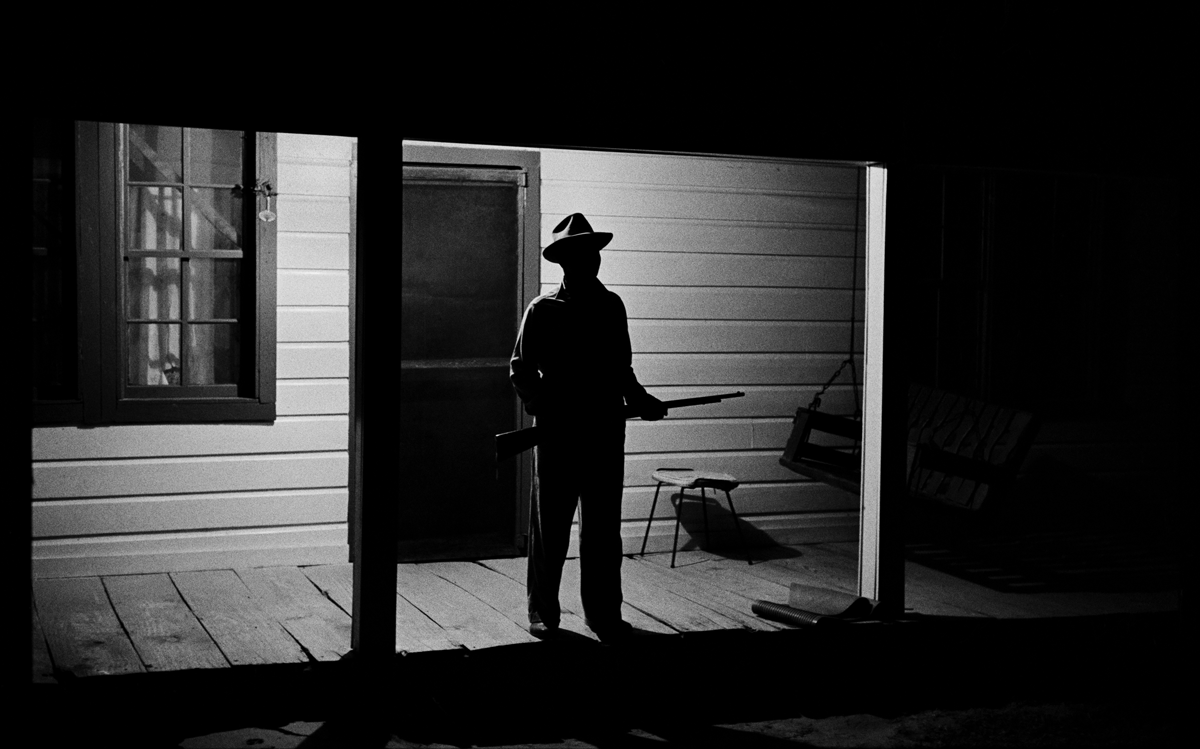
Photo by Bob Adelman, courtesy of HNOC
Rev. Joseph Carter stands guard on his front porch amid threats of Klan violence after he registered to vote, 1964.
Reverend Joseph Carter walked into the St. Francisville courthouse on a fall day in 1962 hoping to become the first Black man in West Feliciana Parish to register to vote in six decades. Inside, a young white sheriff addressed the fifty-five-year-old minister as “boy” and arrested him on the spot. Instead of walking out a new voter, Reverend Carter was taken to jail for the first time in his life. Episodes like his would motivate homegrown activists from the Congress of Racial Equality (CORE) to initiate voter registration drives across the state, and a groundswell across the Deep South led to the passage of the federal Voting Rights Act (VRA) in 1965. The Trail They Blazed, an exhibition on view at the Historic New Orleans Collection through June 2026, details Louisiana’s role in this story.
The selective enforcement of the law has long influenced the voting power of non-white Americans. The Fifteenth Amendment, enacted in 1870 as a response to white violence against Black men organizing to vote in the Deep South, states that “the right of citizens of the United States to vote shall not be denied or abridged by the United States or by any state on account of race, color, or previous condition of servitude.” But after the federal government abandoned Reconstruction and its enforcement of civil rights in the region, Southern states found new ways to disenfranchise Black people.
Louisiana’s 1898 “Jim Crow” Constitution established poll taxes and literacy requirements for voter registration, as well as a “grandfather clause” workaround to these restrictions that, by design, applied only to white registrants. As a result, the Black voting base in Louisiana fell from 130,344 in 1896 to 1,342 by 1904.
The grandfather clause was ruled unconstitutional in 1915, so Louisiana called a new constitutional convention in 1921 to replace it with an “understanding clause,” which granted unchecked power over the voting rolls to local officials. Registrars could, at their full discretion, ask any prospective voter to provide a “reasonable interpretation” of any section of the state’s constitution. The registrar had final authority to determine whether to deny somebody the right to vote on this basis. By 1940 the number of Black voters in the state bottomed out at 897.
If none of the above kept aspiring voters away, outright intimidation could be deployed. Ebony magazine reported that a year after his arrest, Reverend Carter returned to St. Francisville with a busload of forty-two other prospective registrants—strength in numbers. CORE volunteers had been training them weekly on how to pass the registrar’s onerous test. The group was greeted at the courthouse by a mob of a hundred white residents, who hurled epithets and death threats at them, while the registrar stalled for hours. Carter was finally permitted to enter and take the test—and passed, becoming the first registered Black voter in the parish since 1902, and the only one that day. The rest were turned away, and several were visited at home by armed white men in trucks the next night. Carter considered himself nonviolent but kept a rifle in his farmhouse just in case. “I don’t want nobody to hurt me,” he said, “and I don’t want to hurt nobody.”
The wisdom of Louisiana’s civil rights heroes echo through oral history audio that anchors The Trail They Blazed. In one clip, CORE volunteer Katrena Ndang summarized the grassroots essence of a fight that continues today: “It was like I teach you, and you teach some other people.”
Today the Pelican State again finds itself at the center of a furor over the rights of Black voters. In October, sixty years after the passage of the VRA, the Supreme Court heard arguments in Louisiana v. Callais, which focuses on congressional redistricting and Section 2 of the VRA, which prohibits diluting the voting power of minority groups.
When President Lyndon B. Johnson signed the Voting Rights Act into law in August 1965, it gave the federal government the legal teeth it needed to enforce the Fifteenth Amendment. By 1976, the number of registered Black voters in Louisiana approached four hundred thousand. In 1982, President Ronald Reagan extended the VRA’s protections to cover redistricting efforts that have a discriminatory effect on minority groups, regardless of intent. Those protections could vanish. Between now and June, the Court will determine whether race-conscious redistricting, enacted to protect Black voters, is unconstitutional, twelve years after ending another key VRA protection that had long required states with discriminatory histories to obtain federal permission before changing voting laws.
Learn more at hnoc.org.

