Magazine
Modern Baptists
The tragic hilarity of James Wilcox’s debut novel
Published: June 1, 2026
Last Updated: September 1, 2026
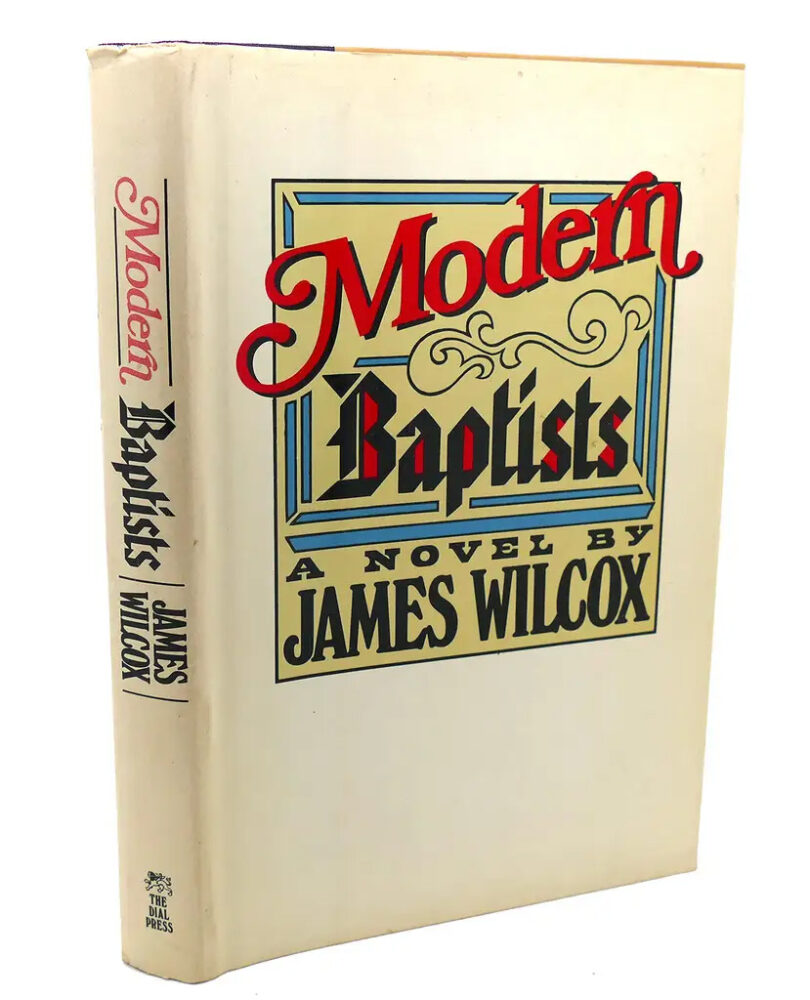
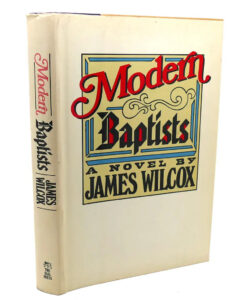
Bookthrift Co. (1983)
Pity poor Bobby Pickens, who in the opening pages of James Wilcox’s riotous 1983 debut novel, Modern Baptists, invites his half-brother F.X. (short for Francis Xavier) for a brief stay. Newly released from Angola and armed with “big, disgusting muscles,” F.X. is still as “jittery as a june bug” from the cocaine habit that landed him in prison. Three days later, it’s evident that F.X. has made himself at home in Pickens’s one-bedroom Tula Springs abode.
“Fish and visitors stink in three days,” observes Benjamin Franklin in Poor Richard’s Almanack. But the unwanted houseguest might be the least of Pickens’s troubles. Lonely—at least until F.X. moved in—Pickens is also likely to soon be unemployed from his assistant managerial position at the Sonny Boy Bargain Store. To boot, after doctors recently removed a malignant mole in the shape of New Jersey from his back, he’s descended into a spiritual malaise. “The whole idea of heaven scares me just as much as hell,” he confides to F.X. “I guess the thought of living forever, me up there forever—even if it doesn’t hurt, even it if feels good and I’m happy all the time—still, it’s just too much.”
A date with Burma LaSteele, a Sonny Boy candy counter clerk, feels promising, until he finds out she’s engaged to be married. She lugs along a third wheel, her coworker Toinette Quaid, a green-eyed, Farrah Fawcett–coiffed ginger who likes to toss back Tab colas spiked with bourbon. (Pickens prefers screwdrivers—two or three a night “before he felt relaxed enough to eat.”) He’s soon fallen for Toinette, who, according to her mother, “thinks everyone and everything’s in love with her, including the pet turtle she let starve to death.” Alas, she lusts after F.X.
Romance, like much of what life offers, doesn’t come easy in the fictional Northshore town of Tula Springs, perhaps lightly based on Wilcox’s hometown of Hammond. Once a logging boomtown, Tula’s cypress and pine stock dried up decades ago, making way for the chicken hatcheries along Old Jefferson Davis Highway on the edge of town. Most everyone covets the lakefront mansions in Ozone, the parish seat, “lavish houses that looked like wedding cakes piled high with sweet, useless fancy.” Tula Springs is too “Baptist, puritanical, its houses either dowdy or plain.”
Modern Baptists often reads like the source material for a lost Coen brothers script: a comically manic, sly dismantling of American culture and capitalism, punctuated with moments of over-the-top violence.
The good people of Tula Springs keep looking for love in all the wrong places. F.X. jilts Toinette for Donna Lee Keely, who recently moved back to town with a head full of ideas she picked up at Sophie Newcomb College. Pickens recasts his lukewarm attentions back to Burma, then her fiancé, Emmet, before giving up all ill-fated romantic entanglements for the comfort of the Lord’s divine love.
He dreams of presiding over a sanctuary for “modern Baptists.” Out with hellfire and brimstone warnings, in with reason and logic (and sex). Dancing, allowed. Innocent teenage petting, encouraged. At thirty, unmarried members can sleep together, free of sin. At forty, adultery is allowed, as long as couples keep their relationship discreet, loving, and respectful. “You’re too old to start being a preacher,” Burma exclaims.
“Did Jesus go to college?” he counters. “Did Matthew, Mark, Luke, or John?”
Modern Baptists often reads like the source material for a lost Coen brothers script: a comically manic, sly dismantling of American culture and capitalism, punctuated with moments of over-the-top violence. It remains a quintessential novel of the early ’80s, an era when Reagan’s swaggering machismo and Jimmy Swaggart’s questionable religiosity were ascendent, but also one that hasn’t lost much of its humor and pathos nearly a half-century later.
Modern Baptists was a critical darling, racking up a litany of kudos. It graced the cover of the New York Times Book Review, in which Anne Tyler wrote: “Mr. Wilcox has real comic genius. He is a writer to make us all feel hopeful.” Toni Morrison called the novel one of her three “favorite works by unsung writers.” In 1994, the towering literary critic Harold Bloom placed the book among the rare company he deemed the “Western Canon.”
That same year, James B. Stewart, writing in the New Yorker magazine, profiled Wilcox, who despite his continued critical success—five more Tula Springs–set sequels had by then earned comparisons to Faulkner’s Yoknapatawpha—lived “a life of near-poverty.” The article renders Wilcox a Tula-esque character himself, a man chasing something beautiful and perhaps even holy—in his case, literary glory—but suffering setback after setback that, in Stewart’s telling, often come off as tragically hilarious.
Staring down thirty and working as an editor at big-name publishing houses in New York, Wilcox dreams of selling his own fiction, telling Stewart, “I couldn’t go through life wondering if I could write something.” He writes and writes, quits his job, and after many rejections finally places a short story, the Tula Springs–set “Mr. Ray,” in his literary lodestar, the New Yorker. His former neighbors back in Hammond are left, let’s just say, unimpressed. “Jimmy sure has good punctuation,” one quips. Another, pointing to the unrelated mini illustrations, or “spots,” that have forever graced the magazine’s pages, asks, “Where did Jimmy learn to draw like that?”
Two years later, Modern Baptists. And every two years after that, a new novel. The critics applaud. The book buying public: mostly crickets. He downsizes apartments. Swears off taxis and eating out. Jumps publishers. Watches his advances nosedive, while the cost of living in Manhattan skyrockets. He takes a gig as a background extra in a Macy’s commercial, earning a hundred bucks. Constantly anxious, he’s never bitter, but, in fact, lives with grace, purpose. He volunteers at the local soup kitchen (“I’m only a check or two from being in the line myself,” he tells Stewart). Writes, publishes, only slowing down to move back to Louisiana in 2001 to teach in (and ultimately direct) the creative writing program at LSU.
“This is your chance,” a drunken Pickens tells Burma in the novel’s most sadly poignant passage, an episode that seemingly presages Wilcox’s own sense of the writerly path, with its risks, its demands for commitment and humor and grace. “We’re going to die, all of us, we’re going to die miserable, unloved.”
“At least one of us can be happy. You Burma. You be happy,” he says, offering himself, his body, as he begins to remove his clothing. “Grab life before it passes you by.”
And with those words, Pickens removes his briefs, standing stark naked—minus his holey left sock—for all the world to see.
Rien Fertel is the author of four books, including, most recently, Brown Pelican.