On the Horizon
The rise & fall of the Lake Charles Capital One Tower
Published: August 29, 2025
Last Updated: December 1, 2025
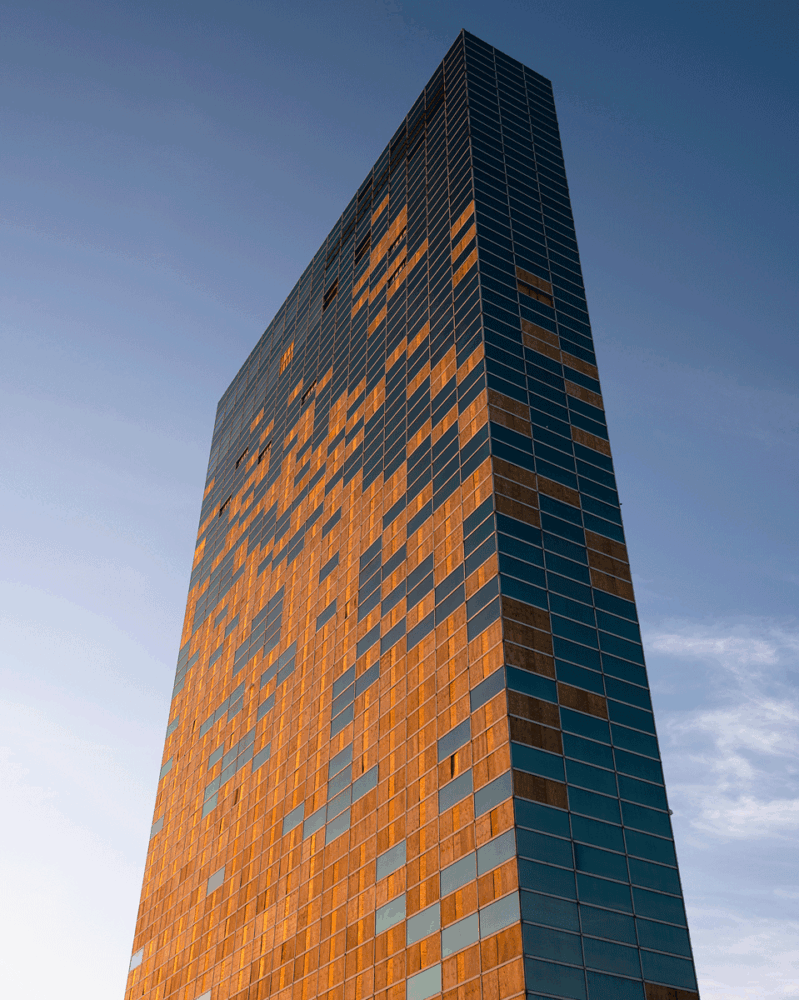
Photo by Jeremiah Ariaz
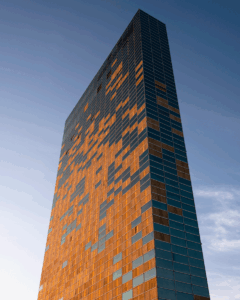
Following Hurricanes Laura and Rita, the heavily-damaged Capital One Tower remained overlooking downtown Lake Charles, with plywood covering broken windows.
It’s not hard to guess the main economic engine of southwest Louisiana while approaching Lake Charles from the west via I-10. The highway through the town of Westlake is lined with a tangle of smokestacks, pipes, oil tanks, trains, and other assorted tools of the petrochemical industrial complex. At night, the sight can feel otherworldly: bright lights and flares from excess gas and other industrial detritus burned in the open air, amidst a mélange of tubes and wires and boxcars. Companies with national name recognition (Phillips 66, Citgo) and names lesser known (Axiall?) populate this corridor at the intersection of a major interstate, a transcontinental rail line, and a deepwater port with direct access to the sea. They’ve done so for generations now, since the first inklings of industrial development during World War II.
The industrial dystopia of Westlake gives way to the Louisiana Memorial World War II Bridge, which crosses the dark waters of the Calcasieu River. At the bridge’s steeply graded peak, with the belching smokestacks and steel chimneys in one’s rearview mirror, the skyline of Lake Charles’s small downtown emerges on the horizon. For just over forty years, beginning in 1984, the dominant feature of the city’s downtown was a twenty-two-story office tower wrapped in shimmering blue reflective glass.
At the foot of CM Tower, as it was originally known, a much less imposing atrium, rounded to follow the contours of the nearby lake, provided street-level access to the building. Sparkling escalators whisked visitors to the tower’s elevator bank. In this atrium, the business of the locally owned Calcasieu Marine National Bank, namesake of the tower, was conducted via a row of teller stations and a collection of sleek bankers’ desks positioned along a balcony that allowed sweeping views of the lake just outside. This was no ordinary bank branch. It—and the first five stories above—were, for the first years of the tower’s existence, the headquarters of the bank, which was founded by a prominent industrialist, William T. Burton, in 1934. His family would control the Calcasieu Marine National Bank almost to the very end of the twentieth century.
“It was an exciting time, just the amazement that we were going to have a tall building . . . a glass building in downtown Lake Charles. I remember going in and going up the escalator, and going into the lobby, and it seemed so huge and so modern.”
In 1981, the global average temperature anomaly—the difference between the measured average global temperature and the same average for the years 1901–2000—was .46ºC. The national economy was struggling mightily under the weight of both high unemployment (its average annual rate that year was 7.6 percent) and oppressive inflation, with an annual average Consumer Price Index clocking in at 10.3 percent. The national vibes were, one might say, not great. But in Lake Charles, alongside the rest of oil-and-gas-rich South Louisiana, high energy prices meant high revenues for companies that owned, extracted, and refined the fossil fuels found in the deep waters of the Gulf. In March 1981, the inflation-adjusted price of a barrel of West Texas Intermediate crude oil reached $136.99. An oil boom had arrived on the marsh-covered shores of the Gulf. While the rest of America might have been eagerly awaiting Ronald Reagan’s morning in America, along Interstate 10 in Louisiana, no sun would rise as high or shine as bright as the black tar from deep under the sea.
It was in the midst of this trend-defying local economic boom that the new headquarters of Calcasieu Marine National Bank took shape. Construction of CM Tower began in March 1981. Designed by Houston architects Lloyd Jones Brewer and Associates, the building would, in the later estimation of a 1984 Texas Architect Magazine feature on the award-winning design, “attract attention to the new bank for miles around.” Pam McGough—daughter of Calcasieu Marine’s president at the time of construction, Leo McGough—shared her fond memories of the building’s heady first days in a 2024 interview with local news station KPLC-TV: “It was an exciting time, just the amazement that we were going to have a tall building . . . a glass building in downtown Lake Charles. I remember going in and going up the escalator, and going into the lobby, and it seemed so huge and so modern. The whole building was so modern for the time.”
Calcasieu Marine had been born in the ashes of the Great Depression and made it through the tumult of World War II to grow into the largest and most prominent bank in the area. Constructing a 310-foot-tall skyscraper in a city of seventy-five thousand people with no shortage of flat, buildable land for outward development seems, in hindsight, gratuitous. But consider the historical and cultural context in which the building was conceived. The abundance of the future appeared to be at hand, and what better way to usher it in than to manifest it with twenty-two stories of glass and steel. CM Tower proudly announced, to Interstate-10 passersby and residents alike, that Lake Charles had arrived.
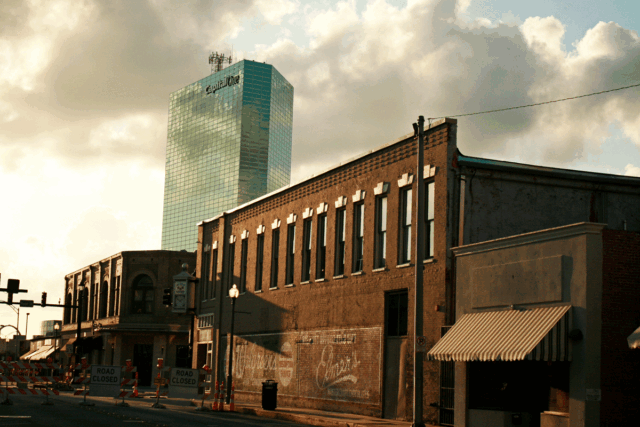
The Capital One Tower in downtown Lake Charles. Courtesy of Lake Charles Southwest Louisiana CVB
In Louisiana, the oil boom of 1981 became an oil bust by 1984, when the inflation-adjusted price of a barrel of West Texas Intermediate crude oil fell to $95.94 (it would reach its nadir of the era in July 1986, when a barrel could be had for only $32.49). The state’s unemployment rate reached ten percent that year. By the mid-1980s, downtown Lake Charles had become a shell of its former self. The weak economy augmented suburbanization southward, with big box stores and strip malls replacing the walkable storefronts and human-sized footprint of Ryan Street. CM Tower remained, with tenants including its eponymous bank, law firms and other professional service companies, and the City Club restaurant on its highest floor.
At the same time, the national economy was recovering from the deep recession caused by the energy shocks of the 1970s. National unemployment dropped, averaging out to a rate of 5.4 percent for the year 1988. It was also the hottest year in recorded history.
And it could be said that it wasn’t until 1988, really, that climate change entered the zeitgeist, with the congressional testimony of Dr. James Hansen, Director of NASA’s Institute for Space Studies, highlighting the evidence of human activity’s effect on what was then called global warming. “The greenhouse effect has been detected, and it is changing our climate now,” he told the Senate Energy and Natural Resources Committee. That year, the global average temperature anomaly was .52ºC.
By 2005, the global average temperature anomaly reached .74ºC, and the Atlantic hurricane season broke a record: there were so many tropical storms and hurricanes (twenty-eight) in the Atlantic Basin that the National Hurricane Center exhausted their list of storm names for the year and had to move onto the Greek alphabet for inspiration. “Epsilon” was the last named storm of 2005. Fifteen of these tropical cyclones reached hurricane status, and four of those fifteen—Emily, Katrina, Rita, and Wilma—grew into Category 5 storms, with measured winds of at least 157 mph.
On August 29, 2005, the world watched in horror as Hurricane Katrina slammed ashore near Buras, Louisiana, as a Category 3 storm. The storm surge would send water towards the city of New Orleans, where levee breaches inundated the streets with floodwaters that would change it forever.
Just over a month later, New Orleans was beginning its long recovery from the fetid floodwaters as another hurricane, Rita, landed some two hundred miles west, in Cameron Parish, as a Category 3 storm. Southwest Louisiana would find itself the victim of its own history-altering storm as communities like Hackberry, Creole, Chenier, and Cameron along the Cameron Parish coast were nearly destroyed. Lake Charles suffered significant wind damage, with roofs shorn off homes, and a storm surge left as much as six feet of water in downtown Lake Charles. The region sustained $4 billion worth of damage. Recovery would take years.
Meanwhile, the building formerly known as CM Tower had become a little less local. New Orleans–based Hibernia Bank had acquired Calcasieu Marine in 1996 and hung its own logo atop the headquarters, whose building occupancy hovered around fifty percent in years leading up to Rita. Then, just five months before the storm, Virginia-based Capital One announced that it would acquire Hibernia Bank in a deal that would close that November.
That same year, Lake Charles’s first land-based casino, L’Auberge Casino Resort, opened just downriver from downtown. Riverboat casinos had since 1993 been a feature of the area’s economy, largely thanks to its proximity to Louisiana’s border with Texas, where gaming remained illegal and a population of millions sat within a three-hour drive. L’Auberge—with almost one thousand hotel rooms, multiple restaurants, and entertainment venues—cemented gaming’s place in the city’s culture. The twenty-six-story hotel was built on land formerly owned by the Port of Lake Charles at the edge of town and it clocked in at three-hundred-eight feet tall, just edging out Capital One Tower to become the tallest building in town.
Rita’s winds blew debris through glass on the bottom floors of the CM Tower, prompting a renovation and renewal of the public spaces downstairs. By the time repairs were finished and the building was fully reopened in February 2007, its signage would reflect Capital One’s branding along its roofline. But Capital One had by then sold the building to a real estate investment firm, Hertz Investment Group, and became little more than a tenant with branding rights.
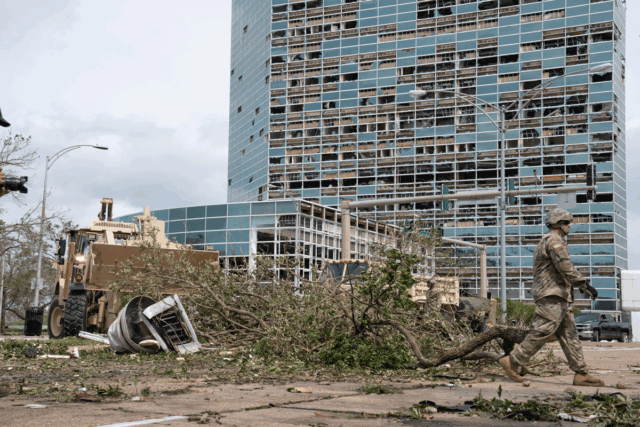
A member of the Louisiana National Guard in front of the Capital One Tower during the aftermath of Hurricane Laura in 2020. Photo by Josiah Pugh
In 2020, the global average temperature anomaly reached 1.14ºC, tying with 2016 as the hottest year on record. Hurricane Laura slammed ashore in Cameron Parish on August 27, 2020, as a Category 4 storm, bringing with it sustained winds of 150 mph and a fifteen-foot storm surge. A report by the National Centers for Environmental Information at the National Oceanic and Atmospheric Administration estimates that the storm caused $28.6 billion in damages, with the brunt borne by Southeast Texas and Southwest Louisiana. Shortly after the storm, a McKinsey & Company report estimated that over fifty thousand homes were badly damaged or destroyed in Calcasieu Parish—roofs gone, trees felled, and power lost for weeks. Just six weeks after Laura, another hurricane, Delta, came ashore as a Category 2 storm at Creole. Much of the progress made by those rebuilding from Laura was quickly undone.
The onslaught of these two powerful storms in such rapid succession meant that blue tarps, fallen trees, strewn electrical lines, and FEMA trailers joined the COVID-19 pandemic’s masks and hand sanitizer to infuse Lake Charles’s 2020 reality with a decidedly dystopic patina.
An ice storm, Uri, in February 2021 and massive flooding in May 2021 further exposed the inadequacy of the city’s drainage systems in light of the changing climate. The Weather Channel in 2021 called Lake Charles “America’s Most Weather-Battered City.” Federal help proved hard to come by in a bitterly divided political climate. Recovery and rebuilding happened slowly, where it happened at all. Many businesses, challenged by both the pandemic and the string of weather disasters, never reopened.
And for the same reasons, many residents left. The population of Lake Charles reached an all-time high in 2019, per Census estimates, before plummeting again after the storms, just as it did after the 1980s oil bust. In 2021, the Census Bureau estimated that Calcasieu Parish’s population dropped 5.3 percent from the official count in the 2020 census. The United States Postal Service reported that Lake Charles had the highest out-migration of any of 926 metro areas surveyed between 2019 and 2020, as indicated by change-of-address requests received. Climate migration—long a theoretical proposition—was now inside the house.
Recovery aid was spent not only on rebuilding houses and infrastructure but also on adapting the city’s footprint to the realities of a changing climate. Residents of the Greinwich Terrace neighborhood had for generations been a thriving community of middle- and working-class families who owned their homes and knew their neighbors. By the middle of 2023, over one hundred homes in that community were in the process of being bought and demolished by a state program that allocated $30 million to relocate residents of the frequently flooded streets. Much of North Lake Charles, which has a median income lower than the city’s average, was left largely abandoned, with services and civic life harder and harder to find.
Laura dealt a fatal blow to Capital One Tower. Thanks to a group of storm chasers setting up camp atop the tower’s parking garage across the street, it was possible to watch in real time as the explosive power of a Category 4 storm sent debris crashing into the tower’s street-level glass panels. Then, the glass high above began to shatter. The prosaic accessories of office life—manila folders, office documents, window blinds—were sucked out by the hurricane’s brutal winds.
Years later, it remains unconfirmed why the engineering of this building, rated to sustain winds stronger than even Laura’s 150 mph, failed so quickly. One theory posits that Laura’s remarkably low central pressure violently depressurized the core of the building, causing the exterior glass to shatter inward. More than half of the tower’s glass skin was lost to the storm.
On Saturday, September 7, 2024, hundreds of people gathered at various points around Capital One Tower . . . to watch the building’s scheduled implosion.
The residents and other stakeholders who remain in Lake Charles are well aware that they are sitting at an economic and cultural crossroads. Ironically, 2020 had started with much promise. In the precarious marshland lining the coast of Cameron Parish, the possibility for a new global energy hub had emerged. Liquified Natural Gas (LNG) was being developed as a transitional technology to lessen the carbon footprint of a fossil-fuel economy until renewables could be adequately built out. South Louisiana—particularly its western corner—was uniquely positioned to serve as the center of the North American LNG industry. The access to deep water ports, pipelines, rail, and other infrastructure that serviced the fossil fuel and petrochemical industries now made South Louisiana an ideal place to build new international depots for exports of American LNG. Record US natural gas production resulting from shale fields as far north as the Dakotas would pump plentiful natural gas into the liquefication-export facilities, ready to be sold to markets hungry for clean energy as far away as Europe and Asia.
Meanwhile, other regions have begun to transition their energy systems to renewables. Next door in Texas, a state no one could accuse of being hostile to fossil fuels, March 2025 marked a record level of solar generation, wind production, and battery storage discharge. Some days of that month even saw renewables produce the majority of the state’s energy. Despite evident progress towards cheaper renewable-energy-generated electricity next door, Louisiana hasn’t quite made the same transition. Jesse George is a Lake Charles native and the New Orleans Policy Director for the Alliance for Affordable Energy, a nonprofit that, according to its website, “safeguards Louisiana’s future by protecting consumers’ right to an equitable, affordable and environmentally responsible energy system.” George explained, “Solar and wind are already the cheapest ways of producing electricity. Batteries continue to increase in efficiency and the cost of installing and operating them continues to dramatically decrease.” But according to George, “multiple parishes in Louisiana have created bans on large-scale solar projects, with misinformation about solar panels leaking mercury proliferating.”
George acknowledged that “it’s a challenging information environment, and it’s particularly frustrating because the assumption is that it’s oil and gas that will be our savior. But if the state’s prosperity is so dependent on oil and gas and petrochemicals, why are we at the bottom of almost every measure of quality of life?”
Other organizations, like the Community Foundation of Southwest Louisiana, are working holistically to chart out a new urban future. The foundation’s Just Imagine SWLA initiative has brought together stakeholders—including parish and city governments, private industry, nonprofits, universities and colleges, and private citizens—to develop a fifty-year Resilience Master Plan. Projects include increased investment in the Nellie Lutcher Cultural District along Enterprise Boulevard in North Lake Charles, and further downtown, economic development to take advantage of the beautification efforts made post-storms. There are also plans to implement a Chennault/Sowela Resilience District, a particularly notable project that will optimize an economic engine—Chennault Airport—as a cornerstone to the development of a diversified local economy.
Sara Judson, the foundation’s president and CEO, explained, “Just Imagine is all about how the community comes together to make big things happen—to better position the community to face challenges in climate, in economics, and in politics. We can withstand those better because we’ve come together to plan for ourselves in a strategic and robust way.”
To experts, it’s clear that the worst outcome for the region would be to continue to rely on the boom-and-bust fortunes of the very same extractive industries that have, according to overwhelming scientific consensus, contributed to the supercharged hurricanes that leave the region teetering on the brink of civic and economic collapse. Their forward-looking, comprehensive, community-driven propositions make it increasingly difficult to frame the survival of the region as a choice between a healthy economy and a healthy environment.
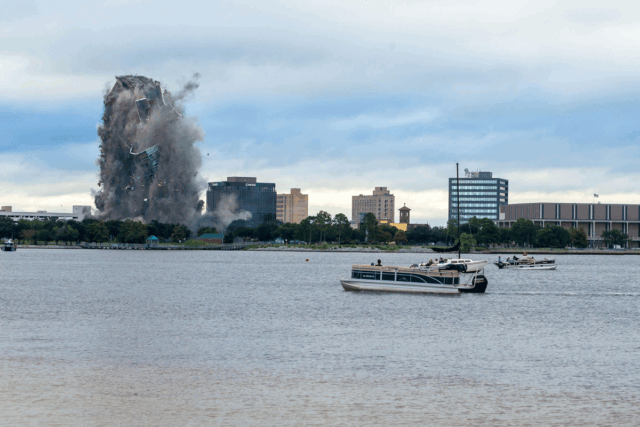
The Capital One Tower in Lake Charles was imploded during a controlled demolition on September 7, 2024. Photo by Kirby Lee, courtesy of Alamy Stock Photo
In 2024, the global average temperature anomaly reached 1.34ºC—the hottest year on record. Plywood patched the windows of Capital One Tower, their reflective brilliance once shining towards a bright future but now bearing the marks of the mightily challenged present. The owners of the tower—Hertz Investment Group—found itself in a pitched battle with their insurance carrier over their repair claim, a scenario familiar to many Lake Charles residents. The dispute wound its way through arbitration and legal proceedings for over three years.
In the months and years after the 2020 hurricanes, as Capital One Tower sat empty and in a state of insurance-induced limbo, members of a Facebook group dedicated to historic Lake Charles neighborhoods shared their memories of the building that dominated the city’s skyline for a generation. One member of the group recalled the “very nice people that worked there, like a big family. Everyone that worked in that building knew one another.” Another said, “When I was kid coming into [Lake Charles] from Westlake it always felt to me like I was coming into a huge city like New York. Used to love seeing it and also used to love riding in the Sears parking garage that wasn’t far from the CM Tower. Great memories.”
Efforts to find a buyer to redevelop the building proved challenging; it seemed increasingly unlikely that the property would make sense as an investment opportunity. Finally, in May 2024, Lake Charles Mayor Nic Hunter announced that a deal had been struck between Hertz, their insurance company, and the city to destroy the tower and redevelop the site.
On Saturday, September 7, 2024, hundreds of people gathered at various points around Capital One Tower—in the parking lot at the Lake Charles Convention Center, on the streets of downtown, on North Beach along I-10, and even on boats in the lake—to watch the building’s scheduled implosion. KPLC-TV, which for four years post-Laura had been operating from a cramped set in the corner of a newsroom office, broadcast an hourlong program leading up to the demolition, with anchors interviewing people who used to work in the tower, as well a former construction worker who’d helped build it. On YouTube and TikTok, livestreams ran, eagerly awaiting the dramatic fall.
Just before 8 am, KPLC played an interview with Charles Manuel, a Lake Charles iron worker who was one of the first of his trade to help construct the building’s steel core. “It was just some green grass over there,” he recalled of the site. “We had no clue what kind of building we were fixing to build. We just knew a bank. We didn’t realize [we were building] a tower like that in Lake Charles. It was pretty awesome.” Then, as the clock struck eight, the trip down memory lane abruptly ended. A series of sharp booms, not unlike fireworks, rang out.
Cartoonishly small puffs of smoke from the detonations wafted languidly from the initial explosions, then the battered husk of the building went down. All that remained was a tangle of steel and wood and concrete and wiring, ready to be carted off to a landfill, and a plume of dust and debris rising out and up, finally blending into the low gray clouds above.
Lake Charles native Mac Hawkins is the founder of Pragmatic, a New York-based literary scouting advisory that helps film/TV producers find and develop books for the screen. He is completing his debut novel—a coming-of-age saga about an artist-revolutionary set in a vividly re-imagined 19th-century New Orleans—and he writes Your Inside Voice, Pragmatic’s literary and culture newsletter on Substack.