Magazine
Rose Nicaud’s Coffee Stand
The 19th-century face of the French Market’s hottest commodity
Published: March 1, 2026
Last Updated: June 1, 2026
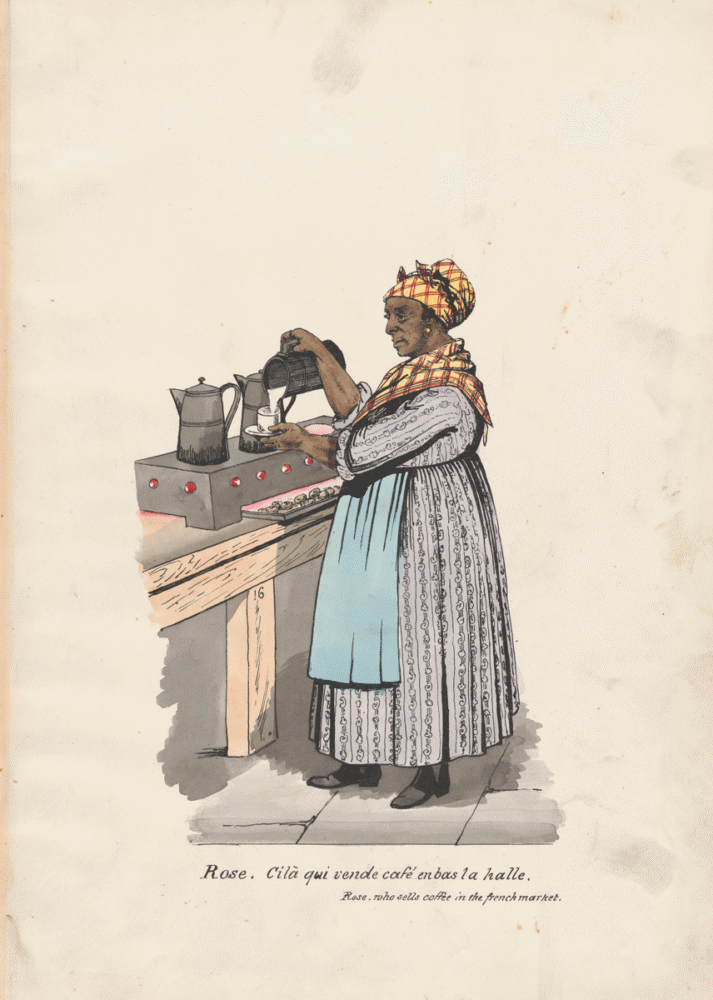
HNOC, L. Kemper and Leila Moore Williams Founders Collection
“Rose, the Coffee Woman at the French Market,” hand-colored lithograph by Léon Joseph Frémaux, from New Orleans Characters (1876).
Some may opine that the city at the bend of the river runs on Sazeracs or Pimm’s cups or even various IPAs. I know, however, that the real fuel that keeps the wheels of commerce both social and professional lubricated is something else. From the morning call through the day until the last drop of liqueur-infused brûlot is consumed, the beverage that keeps the city going is one that has been sometimes called the wine of Islam: coffee.
Coffee originates in the highlands of Ethiopia. A legend tells of frolicking goats (obviously enjoying their caffeine buzz) who led a goatherd named Kaldi to a bush with red berries. After eating the berries, he too experienced increased energy. The word spread. Monks came to use these miraculous berries to stay awake for longer devotions. The berries began to be transformed into a variety of foodstuffs. Over the centuries they were mixed with animal fat, fermented into a form of wine, and eventually roasted to create the beverage that we know today.
New Orleans was an early adopter, at least among cities in North America. The port of New Orleans was a major entrance for food products from the Caribbean, where the beans were first cultivated in the Western Hemisphere. Shipments of green coffee began to arrive here from Cuba and other Caribbean islands in the late 1700s. And so a culture rooted in the consumption of the beverage began—long before the arrival of the dual-tailed siren.
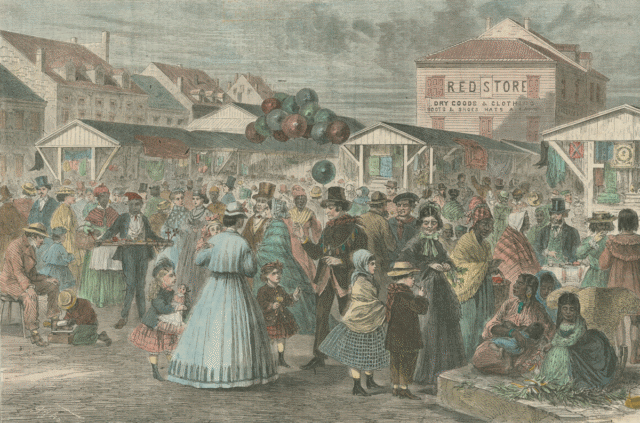
An 1867 illustration by James Earl Taylor of the French Market in New Orleans, from Frank Leslie’s Illustrated Newspaper.
HNOC
However, yellow fever and other contagious diseases frequently closed the port; Civil War blockades also took their toll on access to the imported beans. It is embedded in city lore that the Civil War blockades resulted in canny New Orleanians stretching their coffee with chicory (or even using chicory instead of coffee), thereby producing the city’s characteristic blend. This trick had no doubt served some of their ancestors well—it was also an adaptation used by the French during the blockades of the Napoleonic wars.
By the nineteenth century, coffee had become the city’s go-to beverage, with itinerant vendors of coffee and beignet or calas stationing themselves near Saint Louis Cathedral after Mass, where they served communicants who had attended without eating as per the rules of the Church. Permanent stands began to be established in the French Market area, where visitors and locals alike could sample the beverage. Established in 1862, Café du Monde remains an obligatory stop for many tourists who savor the chicory-scented coffee and inevitably leave with a dusting of powdered sugar from the accompanying beignets.
Initially selling coffee from a cart and eventually obtaining her own stand in the French Market, Nicaud became the nineteenth-century face of New Orleans coffee and the mentor for other Black women coffee vendors.
However, the preeminent coffee stand in the nineteenth century was owned by a formerly enslaved African American, Rose Nicaud, who sold coffee in the French Market for more than forty years. Nicaud began her coffee vending while still enslaved and probably sold the beverage on Sundays by the cathedral to obtain extra money that she saved to purchase her freedom. (It was a feature of urban enslavement in New Orleans that the enslaved had time to themselves on Sunday and could work for their own account.) Nicaud first appears on the census as a free woman of color in June 1840.
Initially selling coffee from a cart and eventually obtaining her own stand in the French Market, Nicaud became the nineteenth-century face of New Orleans coffee and the mentor for other Black women coffee vendors. She also became a local celebrity. Artist and social commentator Léon Frémaux included an image of her in his 1876 work New Orleans Characters with the description “Rose Nicaud a good old black woman known to the entire French and Creole population who for thirty-five years has bread and coffee at the vegetable market.” Author George Washington Cable celebrated her in his 1884 novel Dr. Sevier; one of his characters, “leaving the celebrated coffee stand of Rose Nicaud,” declares, “it is astonishin’ how good” the coffee is.
Catherine Cole, author of the 1916 book The Story of the Old French Market, recalled Nicaud’s preparation of the coffee in vivid detail:
It was something to see that black “Old Rose” pile the golden powder of ground French market coffee into her French strainer—the heaping tablespoon for each cup—and then when the pot was well heated, pour in just two tablespoons, no more of boiling water.
In ten minutes this had soaked the coffee, and then, half a cup at a time the boiling water was poured on and allowed to drip slowly. The result would be coffee, black, clear and sparkling—ideal French market coffee!
A coffee house on Frenchmen Street bore her name well into the twenty-first century; it closed in 2019. Today there is no physical reminder of the legacy of Rose Nicaud’s coffee stand in the city. But she was an early champion of one of the great beverages of New Orleans, which Charles Maurice de Talleyrand-Périgord, the nineteenth-century French statesman, instructs us should be black as the devil, hot as hell, pure as an angel, and sweet as love: coffee.
Jessica B. Harris is the author, editor, or translator of eighteen books, including twelve cookbooks documenting the foodways of the African Diaspora. In March 2020, she became a James Beard Lifetime Achievement awardee.