Magazine
A Studio of One’s Own
The Joan Mitchell Center’s decade-long impact on New Orleans artists
Published: March 1, 2026
Last Updated: June 1, 2026
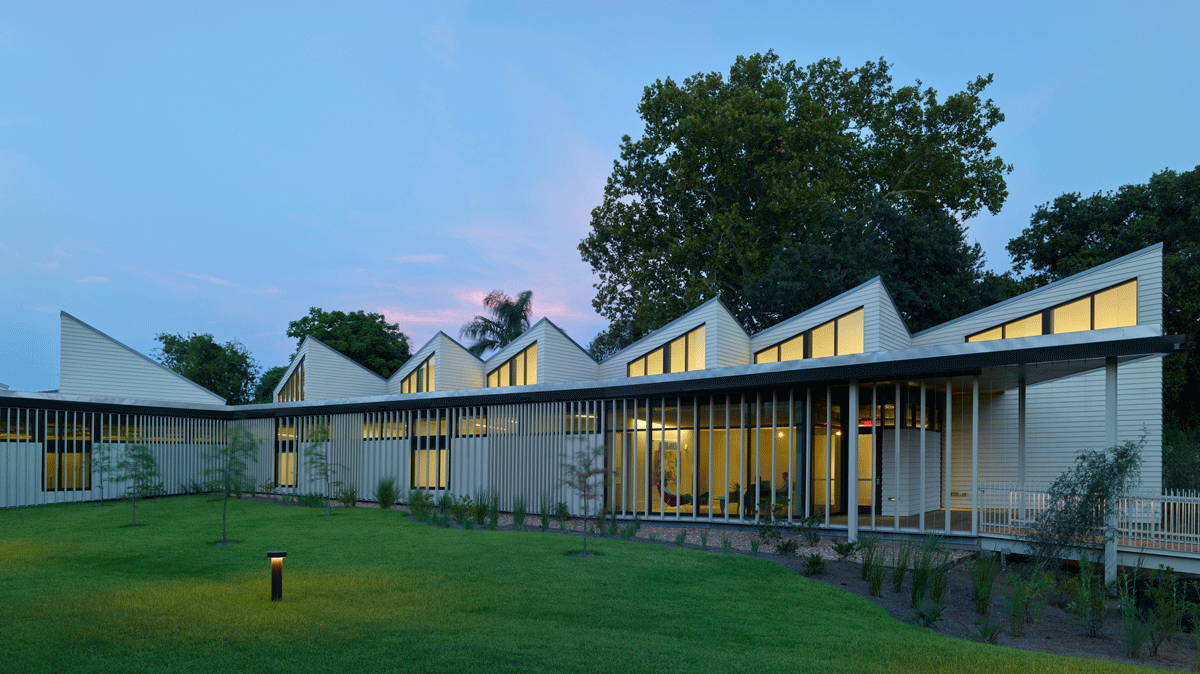
Photo by Tim Hursley, courtesy of the Joan Mitchell Center
Studio building at the Joan Mitchell Center in New Orleans.
On August 22, 2025, the Joan Mitchell Center marked ten years of artist residencies at its Seventh Ward campus in New Orleans. Established a decade after Hurricane Katrina, the Joan Mitchell Center represents a culmination of local support and interventions in the wake of the storm from parent organization Joan Mitchell Foundation, headquartered in New York City. The foundation had initiated a relationship with the city starting in September 2005 by conferring emergency grants to local artists and funding to various cultural institutions, developing career opportunity grants for underrecognized local artists, and collaborating with the Arts Council of New Orleans (now Arts New Orleans) on the project Art in Public Places for nineteen site-specific works.
Renowned for her dynamic abstract paintings, prints, and drawings, Joan Mitchell (1925–1992) understood artists’ need for time, studio space, and financial resources; Mitchell consequently established a foundation to support visual artists that is solely sustained from the sale of her work. The development of the Center was a staggered process. The Center is located on Bayou Road, the city’s oldest roadway used first by Indigenous peoples, connecting Bayou St. John to the Mississippi River when the area was known as Bulbancha. In her roles as local consultant (2011–2013) and later as the Center’s director (2013–2018), New Orleans–born Gia Hamilton fostered community alliances and institutional engagement, taking care to align the Center’s establishment with the neighborhood’s history, including its roots in Creole culture and the legacy of craftsmanship among the descendants of Free People of Color. While overseeing architect Jonathan Tate’s conversions of the older buildings to living and working spaces, Hamilton invited local fraternal organization Black Men of Labor to hire and train ten new workers on this project. Lee Ledbetter and Associates designed the modernist, environmentally-conscious 8,000-square-foot studio building, which houses ten large workspaces, a media lab, and a common area.
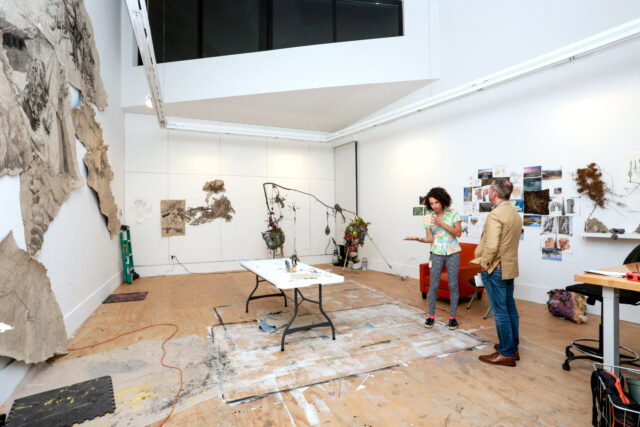
2019 Artist-in-Residence Hannah Chalew with guest in her Joan Mitchell Center studio.
Photo by Cfreedom Photography, courtesy of the Joan Mitchell Center
In 2013, the foundation created two pilot residency models in the French Quarter while the Center was under construction. The first session, designated for the foundation’s former national and international grant recipients, offered housing, studios, and stipends. The second session was called the New Orleans Local Artists (NOLA) Studio Program, and it granted stipends and studios to local artists Katrina Andry, Aaron Collier, Bruce Davenport Jr., Jer’Lisa Devezin, Dave Greber, Norah Lovell, Mario Padilla, Brooke Pickett, Rontherin Ratliff, Ayo Scott, and Carl Joe Williams. These two models were merged the next year to encourage a broader exchange between local and out-of-town artists as well as consistently maintaining a mix of emerging and established artists.
As of November 1, 2025, the Center has hosted 343 Artists-In-Residence, which includes 131 New Orleans-based artists as well as eight Louisiana artists living outside of New Orleans. All participating artists have full access to programming, events, meals, and studio space; New Orleans residents commute to the campus rather than live on site. The residents engage in artist talks, studio visits, professional development meetings and workshops, guidance on taxes, and even estate-planning tutorials.
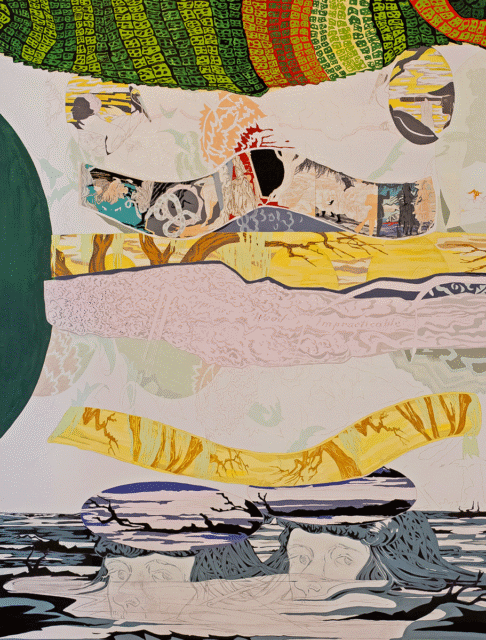
Norah Lovell, Reconnaissance: Battle of New Orleans (Inception: After Magafan), 2015. Gouache on panel. Created during residency.
Photo by Charles Lovell, courtesy of the artist
The year 2025 was also the centennial of Joan Mitchell’s birth. The convergence of this milestone, the twentieth anniversary of Katrina, and the tenth anniversary of the Center’s inauguration inspired the onsite exhibition, History or Premonition: A Legacy of Artistic Practice at the Joan Mitchell Center. The title recalls a line from “Cobble Hill” in Poems, a 1992 book of lithographs and poetry created collaboratively by Mitchell and Nathan Kernan in which they contemplate their positions in the environment over time. The exhibition was curated by alums Nyeema Morgan (Chicago) and Josiah Gagosian (New Orleans) and featured works by forty of their peers installed throughout the ten studios.
The artworks in this anniversary exhibition expanded on themes of environment and emotional atmosphere using installation, assemblage with narrative objects and salvage, painting, sculpture, printmaking, fiber arts, feathers and beadwork, photography, and drawing, inviting artists to call upon their own histories and premonitions. The metaphor of the environment as body deserving of protection, and as an intimate container of generational histories, is seen in the 1996 aluminum-and-mixed-media My Black Madonna and Child by photographer Clifton J. Faust (1970–2025). In Joshua Mintz’s wall-mounted installation with audio Our House Swallows Moths (2021–2024), viewers can move along a road where some unknown disaster has taken all the humans and left their gaping shell homes and personal effects subject to the elements. The cohesion of this exhibition was in its many voices arriving from varying pathways—traditions of culture bearing, art school, and autodidactism—all engaged in the descriptive, diagnostic, and transformational work of worldmaking.
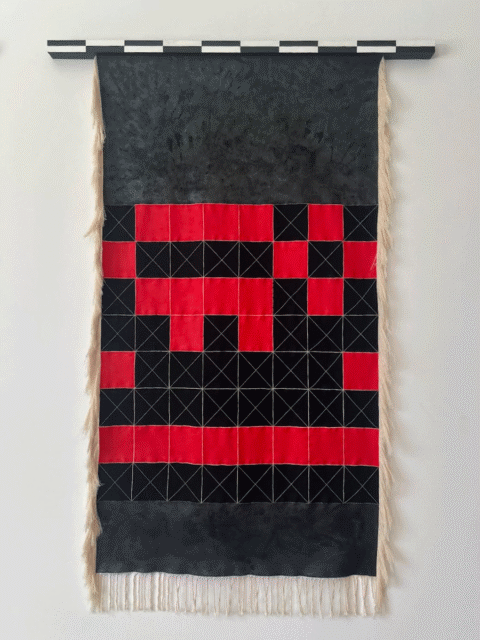
Ana Hernandez,REMEMBER (OUR RELATIONS, WHERE WE COME FROM, WHO WE ARE), 2023. Acrylic, cotton thread, repurposed “binary beads” on canvas hanging between reclaimed wood. Courtesy of Other Plans Gallery
There is no uniform pedagogy at the program. The artists arrive in various phases of their careers, with staggered expectations of their time in alignment with their own trajectories. Their work asks us to imagine other worlds through lenses of cultural memory, collective experience, critique, identities, collaboration, restoration, resistance, recycling, sharing, opting out, joy, and diversification towards new realities. Because the creation process can be so challenging, Stephanie Pearl Travers, Artist-Centered Program Manager, noted the program’s intentions around relief and balance: “In addition to the obvious needs of studio space, professional development, and financial support, there are also the softer, less measurable resources that the residency offers—a serene environment to take necessary deep breaths, nourishing meals, conversations had around the dinner table or in the courtyard late at night with peers.”
Open spaces like these are an essential container for artists who seek the ineffable and describe the indescribable, as translators of our humanity—the beauty and the flaws.
In conversation, most alums acknowledged communal meals as a space of comradery and reflection. And nearly everyone remarked on the spaciousness of their studios, some experiencing this amenity for the first time. At the Center, resident artist Jacob Reptile worked on a larger scale on his recycled material anthropomorphic plant fiber sculptures towards his 2026 Mobile Museum of Art in Alabama exhibition. Reptile also manages Aquarium Gallery, a New Orleans artist residency and gallery with ten studio rentals, and after his experience at the Center he planned to integrate the community-building experience of meal sharing into his own programmatic offerings. I met conceptual quilt artist Jane Tardo during Open Studios, an intimate and convivial way to see how artists work; Tardo’s work-in-progress was a maximalist environment of appliqued cat textiles and surrealist juxtapositions—a universe of anarchic craft joy called Tunnel of Love. Like Reptile, Tardo needed space to build the monumental quilted installation. Urban landscape painter Kaori Maeyama’s goal was to make larger paintings and work on multiple pieces at once, a spatial impossibility in her home studio. At the Center, she was able to work on her atmospheric landscape and industrial scenes side by side, experimenting with different surfaces, while working towards her first solo show at LeMieux Galleries.
Residents work with a variety of materials in assorted and combined disciplines. Because the Center does not have a darkroom, printing presses, or kilns, artists who usually rely on these tools use the time to pivot to another medium or draw on new resources. Ceramic artist Christian Ðinh’s work investigates how identity convergences in the American South’s Vietnamese communities. During residence, he developed a photography project inspired by the sun-bleached blue posters seen in the windows of regional hair salons and is experimenting with woodcuts, goldleaf, and found objects. He has been engaged with professional development workshops regarding grant writing, exhibitions, and taxes and had a studio visit with a museum director.
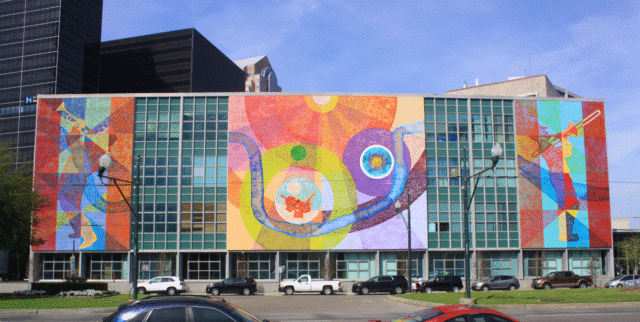
Carl Joe Williams, Love Letter to New Orleans, 2025. Mural on the New Orleans Civil District Courthouse
Photo courtesy the artist
Culture bearer artists continue regional ancestral traditions in residency, employing traditional arts to highlight lingering and contemporary issues. Alum Cherice Harrison-Nelson continues family masking traditions as Maroon Queen Reesie of the Guardians of the Flame Mardi Gras Indians. She has earned a Fulbright fellowship and is a dedicated educator. Nelson’s exhibition Maroon Queen: A Narrative of Black Women’s Labor is an ongoing installation at New Orleans African American Museum.
Conversely, Haitian New Orleanian interdisciplinary artist Nic[o] Brierre Aziz became an artist after interning at the Center, arriving at artmaking while working in art spaces such as New Orleans Museum of Art, where he was the Community Engagement Curator. During his 2021 residency, Aziz initiated two ongoing critique-based series: Juguete, a performance centered around a piñata, and RAFTERS, which unpacks the Code Noir history of the fleur-de-lis symbol. (Employed as the New Orleans Saints football team’s logo and embraced as a signifier of cultural heritage and the city’s resistance post-Katrina, the fleur-de-lis symbol was also used to brand escaped enslaved people.) As a guiding principle, Aziz employs a quote from the late artist John T. Scott: “I am not an artist until the community tells me that I am. I can’t call myself an artist.” Aziz earned his MFA in Sculpture from Yale University in 2025.
Visual artist Cristina Molina investigates environmental themes through an eco-femme perspective using photography, sculpture, video, and performance-based expression. At the Center, she worked on the multichannel video installation and performance Ghost Orchid: Fever Dream, but the residency was truncated by Hurricane Ida. During this disruption, she contemplated the autonomy of creating an artist-run studio and gallery space and researched spaces, resulting in the collaborative Camp Street Studios and Parlour Gallery on Camp Street in New Orleans Arts District.
Sean G. Clark is a painter and adjunct instructor at Dillard University who left a career in public health. He entered the residency with a studio practice and exhibition history, describing his time at the Center as a “launch pad for career growth” with strong networking. “Two years after my residency I applied to graduate school at Tulane for an MFA in painting and drawing. I went into that experience knowing that I had a goal of becoming an instructor and that is currently what I am doing part-time.” Clark’s use of quilting as a motif in his MFA show was ignited during Open Studios at the Center.
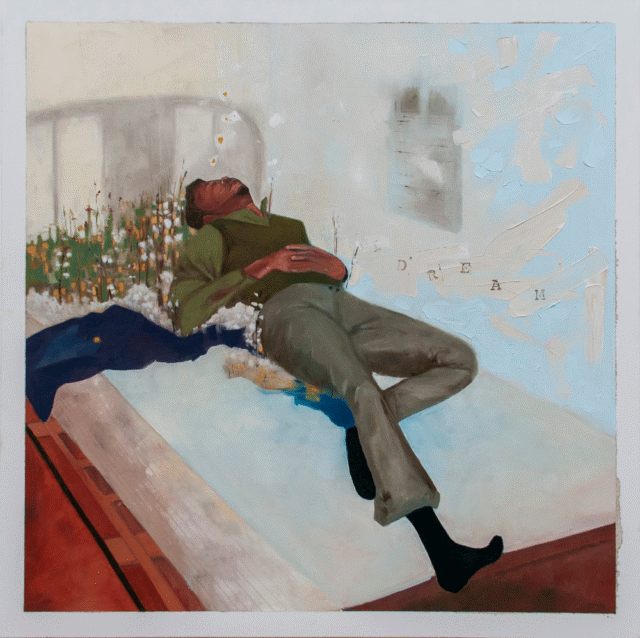
Sean G. Clark, The Revolution, 2019. Oil on Canvas. Created during residency at the Joan Mitchell Center.
Courtesy of the artist
Multidisciplinary artist Kristin Meyers experimented with height and scale under her studio’s high ceilings, working on multiple installations at once. Significant post-residency opportunities included placement in the Ogden Museum of Southern Art exhibition Entwined: Ritual Wrapping and Binding in Contemporary Southern Art as well as an exhibition entitled The Body-Split Trick at Essex Flowers Gallery in New York City.
José Torres-Tama is an award-winning performance artist, published playwright, and cultural activist. In remembrance of the twentieth anniversary of Katrina, he restaged his one-man play The Cone of Uncertainty: New Orleans After Katrina at CANOA for the Katrina at 20 Arts Project, retelling his personal-as-political story of evacuation and survival as “an actual storm ‘refugee.'” Torres-Tama, then a legal permanent resident with a green card who later became naturalized, “… began documenting the stories of Latin American immigrant workers who experienced wage theft during their rebuilding efforts.” The CANOA performance was accompanied by Torres-Tama’s No Papers! No Fear! series of assemblage paintings created while he was in residency at The Joan Mitchell Center.
Established as a post-Katrina revitalization project in 2008 by curator Dan Cameron to position New Orleans as a contemporary art destination, international contemporary art triennial Prospect brings together local and global artists, including many Joan Mitchell alums. Hannah Chalew, Abdi Farah, L. Kasimu Harris, Blas Isasi, Ruth Owens, Brooke Pickett, Ashley Teamer, and Christian Ðinh exhibited in Prospect.6: The Future is Present, the Harbinger is Home (2024-2025), curated by Miranda Lash and Ebony G. Patterson and installed throughout New Orleans in institutions, galleries, and other spaces chosen for their narrative context. Prospect.6’s installation at the Contemporary Art Center featured figurative painter and video artist Ruth Owens’s four-channel video installation “Black Delight, An Ecopoem.” Viewers were welcomed into an ephemeral space of interior and exterior worlds featuring archival Black home movies of dance parties merging with imagery of fragile marshlands projected over flocked wallpaper. L. Kasimu Harris holds space, in defiance of gentrification’s erasure, through his ongoing documentation of Vanishing Black Bars & Lounges. Harris’s photographs of warm, low-lit interiors are peopled with regional bar décor such neon and bar rules signs, culture bearers’ effects, family and friend photos, and the patrons themselves; in exhibition, photographs are staged with each bar’s objects. For Prospect 6, this series appeared at both the Ogden Museum of Southern Art and within one of his subjects—the historic Sweet Lorraine’s Jazz Club. (In 2022, Harris was honored as the Louisiana Endowment for the Humanities Documentary Photographer of the Year for this body of work.)
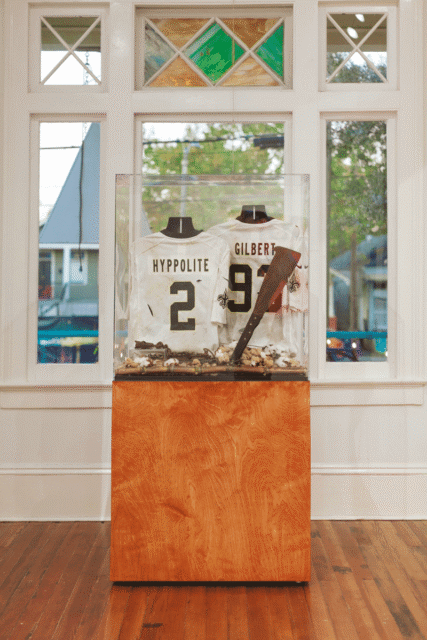
Nic[o] Brierre Aziz, RAFTERS (Hyppolite + Gilbert), 2021. Tattered New Orleans Saints jersey, sugar cane, sugar cane leaves, brown cotton, white cotton, indigo, transatlantic slave trade shackles, machete, plexiglass vitrine display case, “Colonial Maple” stained wooden base. Photo by Jose Cotto, courtesy the artist
Humble’s ten-foot steel sculpture The Guardian watches over the Poydras Corridor, commissioned by the Helis Foundation during his residency. For her 2024 exhibition Ana Hernandez: Color of Clouds at Other Plans Gallery in New Orleans, Hernandez adapted principles of English, Spanish, and American Standard Code for Information Interchange (ASCII), an early binary coding system of 0s and 1s, to create a new messaging system in mixed media geometries of black, red, yellow, and white. The series was inspired by the Relación de Michoacán, a complex sixteenth-century illustrated manuscript from colonial Mexico with insights from Indigenous peoples, and a 1974 binary transmission sent from Puerto Rico’s Arecibo Radio Telescope to M13, a distant star cluster. Currently in the studio, Walton continues his neo-expressionist Black Paintings, commenting on identity, gaming aesthetics, pop culture, and the American South, while creating a new series of important New Orleans women. Ratliff’s Things that Float, a Katrina capsule story of remembrance, also appeared in History or Premotion at the Center; Ratliff’s sculpture is a reminder of how artists seek to describe the indescribable. Commissioned by Arts New Orleans via the City of New Orleans Percent for Art Program, Williams’s kaleidoscopic 1,100-square-foot mural on the Civil District Court building elevates Black and Indigenous histories and regional creative traditions, visually activating the public space of the Central Business District. The mural’s name is Love Letter to New Orleans.
Notably, the artists from the pilot year of the residency program remain active in their careers, a positive indicator of the value of the residency model in supporting artists as well as a testament to the commitment of the artists drawn to participate in the program. Norah Lovell, visual artist, designer, and educator, reported, “The Center helped me to think more strategically about the way I structure my work.” Utilizing the studio’s high ceilings, she created a monumental suite of ten paintings depicting the Battle of New Orleans that forecasted her signature arabesque storytelling style. Opportunities generated by her residency includes acceptance into the International Scholars and Curators Program, which was sponsored by the Joan Mitchell Foundation with residencies in Venice, Italy, and Ireland. Lovell has been a member of artist-run gallery Staple Goods for ten years.
Ayo Scott affirmed that his experience of the pilot artist-in-residency program was extraordinarily generative, noting, “The simple request of twenty hours a week in the studio turned into several bodies of work, some of which I’m still exploring.” Scott said he was particularly invigorated by intellectual exchanges and dinners with professionals such as Mel Chin, which recalled for him the openness of his father John T. Scott’s studio. Open spaces like these are an essential container for artists who seek the ineffable and describe the indescribable, as translators of our humanity—the beauty and the flaws.
Editors’ Note: An earlier version of this story erroneously stated that Joan Mitchell established “an endowment” to support artists. This is not the case. Joan Mitchell established a foundation, which supports the Joan Mitchell Center’s work for artists, as stated in the article.
An earlier version of this piece erroneously stated Rontherin Ratliff’s artwork is titled “Things That Don’t Float.” This is incorrect, the title of the piece is “Things That Float”.
Veronica Cross is a visual artist, writer, DJ/radio host, material culture specialist, and independent curator.