Magazine
Two of a Kind
A new biography and exhibition about cartoonist Bunny Matthews describes the genesis of a beloved local duo
Published: September 1, 2026
Last Updated: September 1, 2026
HNOC, gift of Bunny Matthews
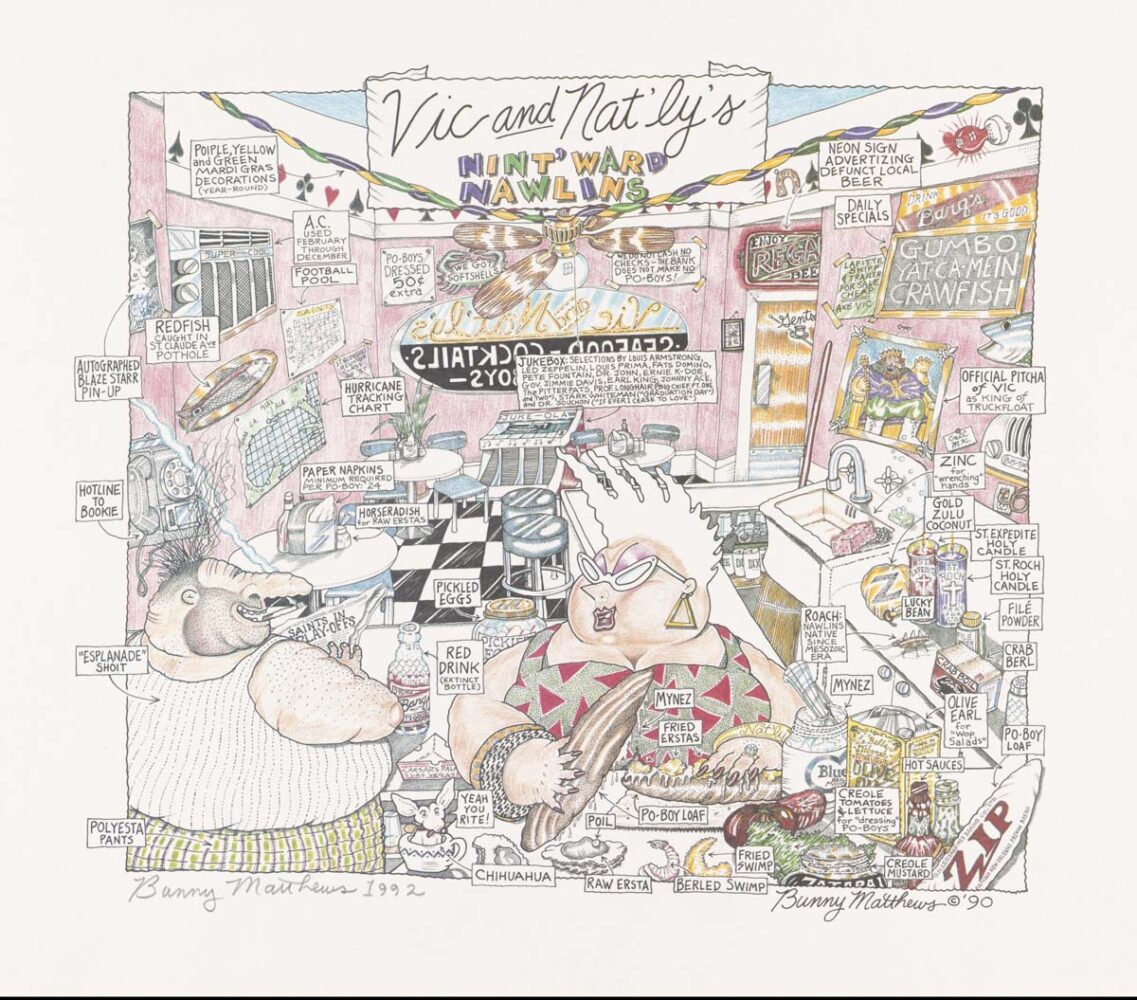
Vic and Nat'ly's Nint' Ward Nawlins, 1990, offset lithograph on paper, by Bunny Matthews.
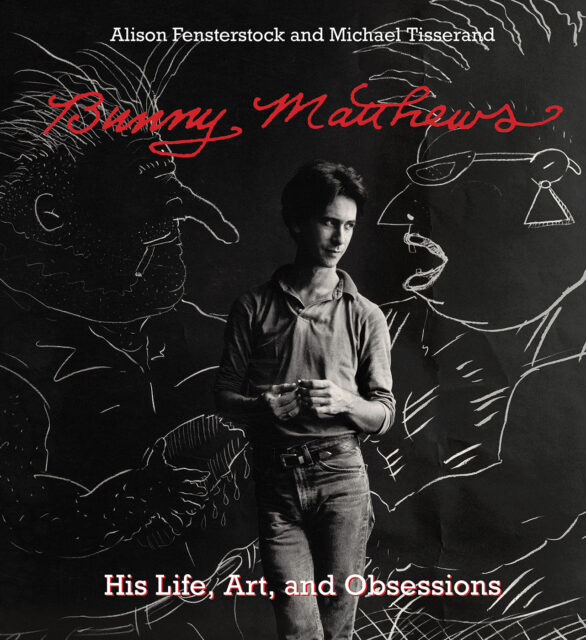 Fiendishly creative, sharply observant, and deeply devoted to New Orleans, Bunny Matthews (1951–2021) was among the city’s most influential cartoonists and writers. Matthews is best known for his characters Vic and Nat’ly, two irreverent bar owners from the Ninth Ward who rank alongside Ignatius J. Reilly and Blanche DuBois in the pantheon of fictional New Orleanians. In this excerpt, biographers Alison Fensterstock and Michael Tisserand describe the introduction of Vic and Nat’ly to the city’s newspapers.
“Another day begins at Vic and Nat’ly’s, Vic and Nat’ly Broussard, your hosts.” For Bunny Matthews, it would be a day like no other. His life would change immeasurably after he introduced readers to Vic and Nat’ly on January 3, 1982, in the Times-Picayune’s revamped Sunday supplement, Dixie.
“One of his legacies is that he called attention to a layer of the city that was not written about, not thought about, not captured in any art form, and yet was so much part of the fabric of the city’s social life, cultural life, and commercial life,” said former Times-Picayune editor Jim Amoss. “Bunny made that happen more than anybody.”
Bunny must have thought this chance would never come. Just two years earlier, he had tried without success to become a Times-Picayune cartoonist. So he must have been both surprised and a bit skeptical when Jeannette Hardy—later described by Amoss as Bunny’s “chief encourager”—called to say she’d just been named editor of Dixie and ask if he could possibly work up an idea for a new weekly cartoon. Bunny didn’t waste time. Soon, he was driving to the newspaper office, sketches in hand.
“I’ll never forget the first time I saw them,” Hardy would recall. “There was Vic with that greasy hair, that 5 o’clock shadow and that nasty cigarette stuck in his mouth. And there was Nat’ly with those pointy eyeglasses, that 1930s print dress and that mad, upswept hairdo. They looked like creatures spawned in the swamp and seasoned with 50 years’ worth of fried oyster, hot sauce and pickled eggs.”
Inspired by the physical oddities of Ed “Big Daddy” Roth and R. Crumb—yet composed with thin, scratchy lines more comparable to those of Stan Mack or Jules Feiffer—the bodies of Vic and Nat’ly seemed always on the verge of collapse, sometimes looking less like human forms and more like the rotting jack-o’-lanterns seen on New Orleans stoops in warm Octobers. “One of the beautiful things about New Orleans is that a lot of it is falling apart, covered with mildew and mold, and decaying plaster; that gives it this patina which is beautiful,” Bunny said.
Joining Vic and Nat’ly was a third named character, a tiny white Chihuahua named Tootsie, soon to take up residence in a teacup. Bunny later explained that both that character and Tootsie’s companion, a tiny cockroach named Rex, were directly inspired by New Orleans–born cartoonist George Herriman’s most famous creations, Krazy Kat and Ignatz Mouse, who first appeared in the margins of an early-20th-century Herriman comic about New York City tenement dwellers. “Ignatz and Tootsie are part of a cartoon tradition of little creatures or insects commenting irreverently, rather like a court jester,” Bunny said.
A fourth character would soon enter, as well: Vic and Nat’ly’s grandson Li’l Arthuh, an underaged force of chaos who blows up Godzilla toys in the bathtub and hopes Santa Claus will bring him a live cobra. Unlike Vic and Nat’ly, Arthuh would age through the years. In the early cartoons, he is about five years old—the same age as Bunny’s oldest son, Jude.
For his new cartoon’s setting, Bunny wanted a public space where various types of characters could wander in and out. He said he’d always loved how businesses in New Orleans were named “Something and Something.” There was Clarence and Lefty’s, credited by Figaro for the best po-boys in town. Or Rocky and Carlo’s Restaurant and Bar, where Bunny would end his rock and roll nights in St. Bernard Parish. And best of all, the F & M Patio, named for its owners Fump and Manny, which was the Uptown New Orleans dance destination of Bunny’s teen years.
By naming both his bar and his cartoon after the proprietors, Bunny was giving his readers a weekly opportunity to enter the doors of a legendary New Orleans establishment, at least for a few moments. Later, for OffBeat magazine, he’d expand on the meaning of the bar and its neighborhood:
The business is located at the intersection of two streets named after, respectively, an obscure Alsatian saint and one of the cardinal sins. A wheel-less two-tone 1959 Chevy Impala convertible stranded on cinderblocks has died on the pavement outside, perpendicular to a pothole larger than a picnic basket and deeper than most philosophical notions.
The oval windows of Vic and Nat’ly’s joint are painted black (professional drinkers preferring subdued lighting) with gold lettering proclaiming the house specialties: Seafood Cocktails Conviviality. Except for a few moments in January, the air conditioner is never shut off, coolness being yet another requisite of devoted alcoholics.</EXT>
Until Bunny penned that description, the actual location of Vic and Nat’ly’s bar had been an unsolved riddle in New Orleans, comparable to guessing which town of Springfield was home to TV’s Simpsons family. If the obscure Alsatian saint is St. Claude and the cardinal sin is Desire, Vic and Nat’ly’s shop sat on a street corner in the Bywater neighborhood, part of the Upper Ninth Ward.
EXCERPT FROM:
Bunny Matthews: His Life, Art, and Obsessions
Book by Alison Fensterstock and Michael Tisserand
$59.95; 336 pp.
Historic New Orleans Collection
Exhibition on view September 18, 2026, through May 9, 2027
Historic New Orleans Collection, 520 Royal Street
Learn more at hnoc.org.