Magazine
A Juicy Story of Survival
With the Saline Watermelon Festival, the town celebrates the one-time fruit of their labor
Published: September 1, 2026
Last Updated: September 1, 2026
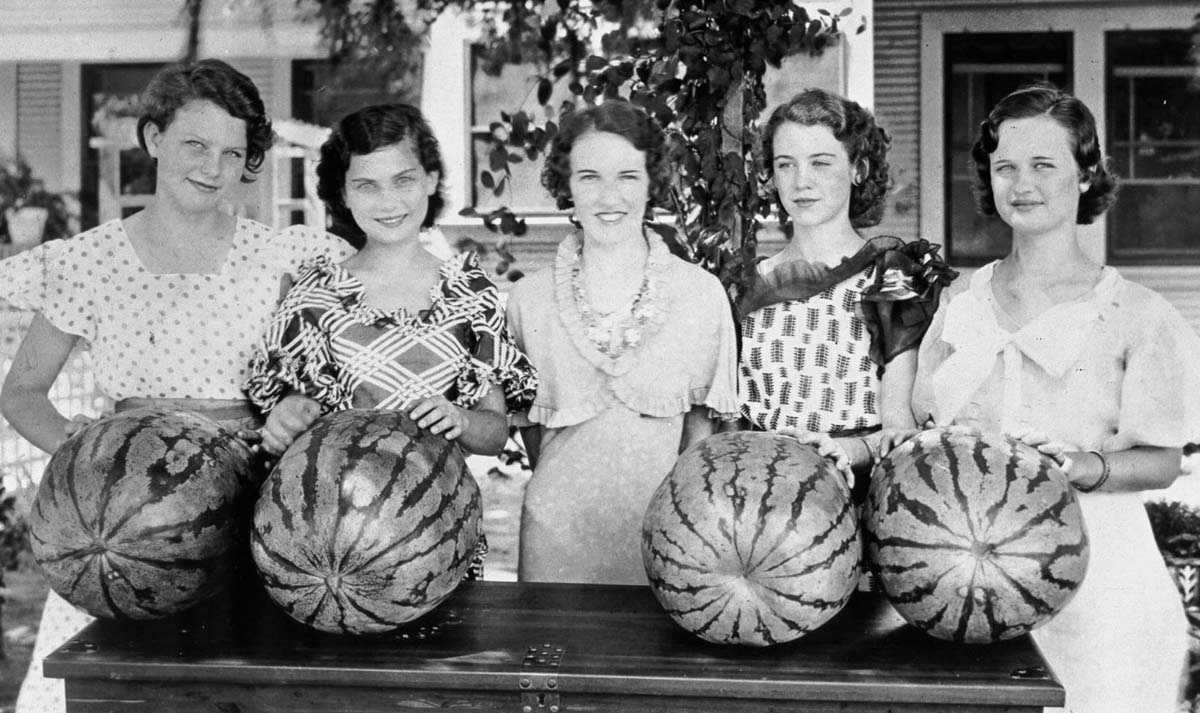
Image from Bienville Parish: Images of America, courtesy of Bruce Evans via Brad Dison
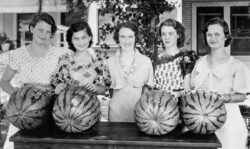
On July 20, 1933, the queen and her court were photographed with large watermelons from that year’s harvest. Pictured from left to right are Virginia Taylor, Camille Taylor, Doris McCain (1933 Watermelon Festival Queen), Mary Evelyn Frey, and Eleanor Stinson.
To win a watermelon-eating contest, a person needs the jaw action of a beaver, the mess tolerance of a toddler, and the noshing speed of a star-nosed mole, the world’s fastest eating mammal according to Guinness World Records. Of course, the Guinness record-keepers haven’t visited the Saline Watermelon Festival, where speed-eating is a sport.
Among the usual array of small-town offerings—parade, 5K run, street dance, a pageant complete with glittering crowns—a few features reinforce the festival’s fruit theme. Contestants hurl green behemoths onto the bed of a truck in a watermelon-loading competition. People spit seeds, hoping to send theirs the farthest. As for the watermelon-eating contest, competitors attack chunks of red or yellow fruit, juice drips down their forearms, seeds cling to their T-shirts, and sticky slush collects on a blue tarp beneath their feet. Smart spectators watch from a distance.
Though melon showdowns have been part of the gathering for years, the first Saline Watermelon Festival, in 1931, had less to do with food-gobbling spectacle and more to do with economic survival.
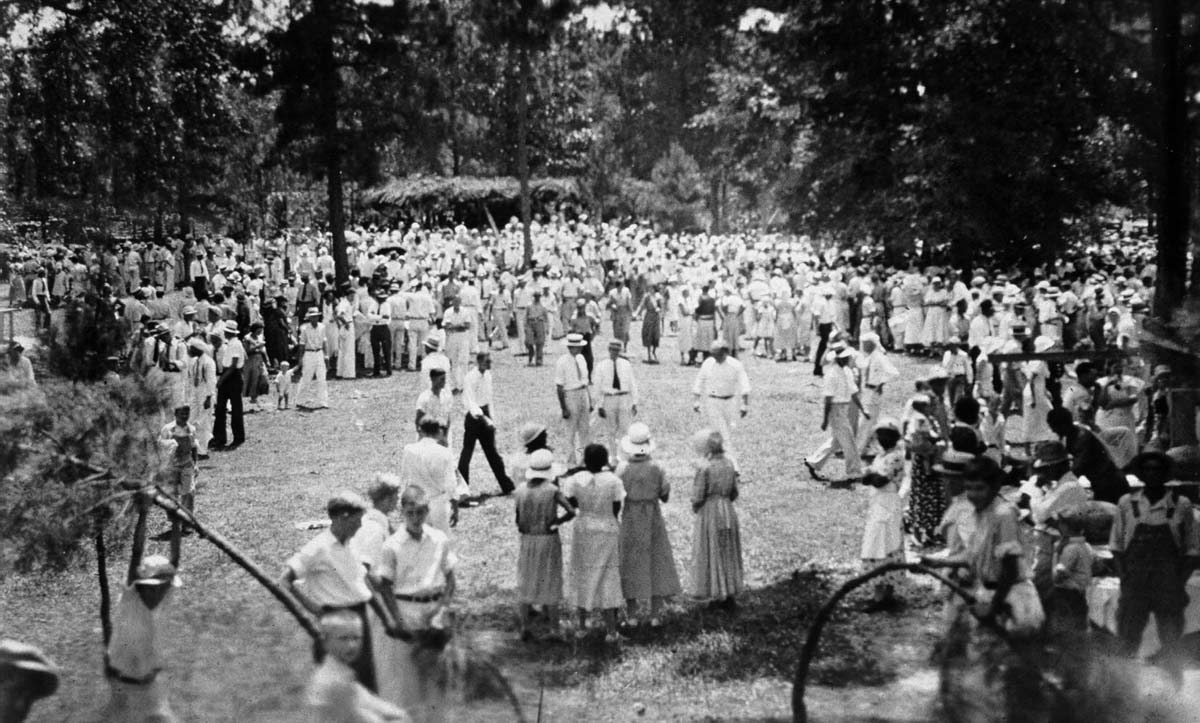
Excitement reigns as early festival goers gather to celebrate the harvest at the Saline Watermelon Festival. Image from Bienville Parish: Images of America, courtesy of Bruce Evans via Brad Dison
“Today we rejoice in this celebration as an occasion to do honor to the progressive spirit of our farmers and business men who are reaching out for financial independence through a diversified farm program,” reads one of several articles in a special edition of The Bienville Democrat published July 20, 1933, about that year’s festival. This event was no mere townie get-together. It was a collective sigh of relief.
Saline (pronounced “Suh-LEEN”) was carved out of forested land in Bienville Parish in 1903 when the Louisiana & North West Railroad built its southern spur. The young town quickly grew to have mercantile shops, a bank, two hotels, and a steady flow of passengers and freight from the rail line.
Most of the farmers calling the town home blanketed their land in cotton. In 1904, according to the same 1933 edition of the Democrat, 3,600 bales of the stuff lined the streets of Saline because there was no warehouse for storage. Not wanting to disrupt weekday routes, the railroad sent special trains on Sundays to move the product to market. Cotton was momentarily enriching, but not sustaining.
Growers needed something different, something that could flourish in the same sandy soil along the Saline Bayou and fetch better prices. Watermelon did the trick.
Cotton prices dipped from a high of roughly 38 cents per pound in early 1920 to about 17 cents a pound by 1921. Earnings from the crop remained volatile and often debilitatingly low throughout the decade due to a shift in demand after World War I, competition from international markets, drought, and pest infestations, among other factors. The situation threatened the economic vitality of area cotton farmers—and Saline itself.
Growers needed something different, something that could flourish in the same sandy soil along the Saline Bayou and fetch better prices.
Watermelon did the trick.
In 1928, local growers and business owners banded together, forming the Saline Truck Growers Association and sending their fruit far beyond the parish lines. Ventures into watermelon were so successful that by 1933, association members had added potatoes and tomatoes to their fields. But watermelons remained the field heavyweight, literally and figuratively.
“Boxcars full of watermelons were shipped all over the country,” historian and Saline native Brad Dison said. “They even shipped a watermelon to New York governor Franklin Roosevelt, who sent a reply thanking us for the watermelon.”
And so in 1931, the citizens of Saline decided to celebrate—and tout—the town-reviving pivot from cotton to watermelon.
“As you look upon the Saline Truck Growers Association today, it is hard to realize the heartaches, the back-breaking work, and disappointments through which this organization has struggled to reach its present membership of 400,” noted The Bienville Democrat. The same article reported that the association had attained a national reputation for excellent produce.
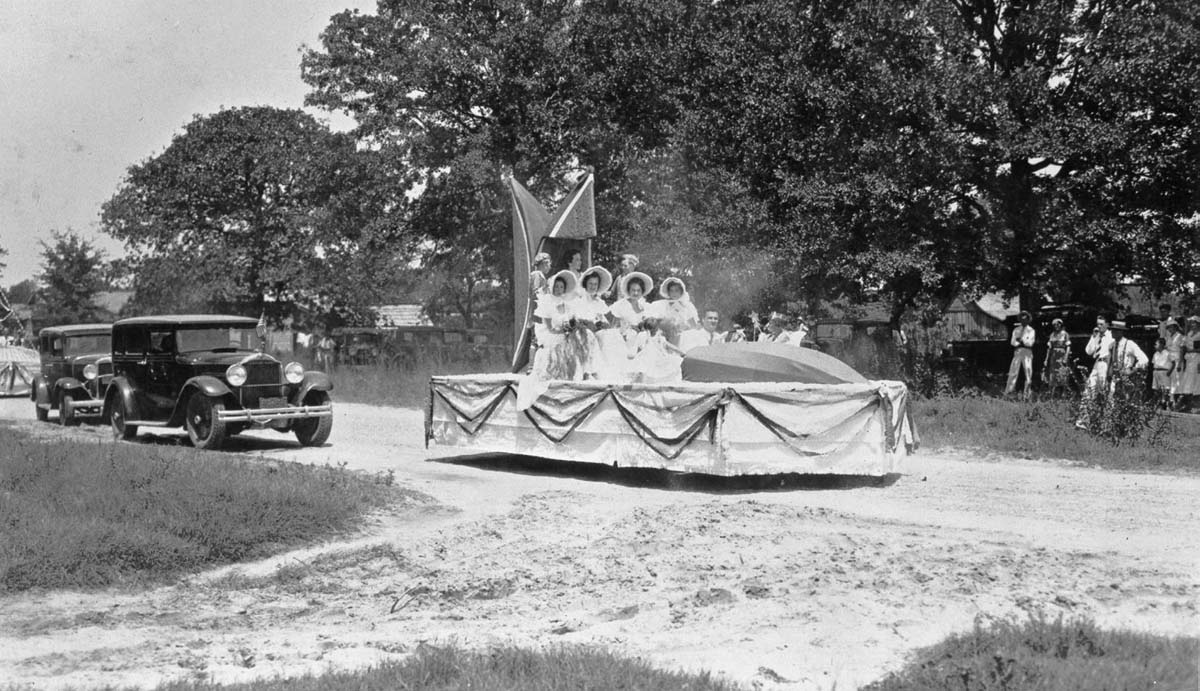
Elaborate floats were constructed for the Watermelon Festival Parade, like the 1933 queen’s float shown here. Image from Bienville Parish: Images of America, courtesy of Bruce Evans via Brad Dison
For three years, the festival drew crowds, some of whom arrived by train and Model T Fords. The 1933 event attracted an estimated ten thousand visitors to the small rural town. Two carloads of watermelon were served at 11:45 am; this refreshing snack break was sandwiched between a morning parade and an afternoon of speeches, including one by the president of the Saline Truck Growers Association. Floats depicted the variety of crops grown in Saline, appearing “in the order in which they mature,” per The Bienville Democrat. Three big bands furnished music throughout the day. A “wild west rodeo” capped the festivities.
That hopeful 1933 event would be the last for many years, a casualty of the Great Depression.
Then the watermelon business itself started to decline.
According to a 1936 Louisiana Works Progress Administration paper referencing Saline, the town produced excellent watermelons in large quantities. But “owing to conditions of marketing and handling after the melons left the shippers, the venture was found to be unprofitable and the scheme abandoned.” The Louisiana & North West Railroad stopped serving Saline in 1949.
Saline changed in those intervening years. The hotels closed. Fires claimed early school buildings. Signs of prosperity dwindled.
Then in 1983, fifty years after the last festival, the town revived the gathering with the help of several women, Dison’s mother among them. The lineup featured family members of those who had spoken in 1933, a link from past to present.
The Saline celebration claims the title of oldest watermelon festival in Louisiana. Farmerville began its own watermelon-themed fest in 1963; Beauregard has held one since 1966; and Washington Parish now boasts one too.
This year’s Saline Watermelon Festival took place on July 11. According to Dison, there are only a couple of watermelon growers left in town. But the Saline Watermelon Festival has never solely been about a crop. It celebrates a community’s fortunes, small and large, and symbolizes Saline’s ability to adapt, shifting from decline to revival. It also proves that a rural town can draw a crowd—then and now.
After the art and food vendors break down their booths, Miss Saline and Little Miss Saline go home, and the sloppy blue tarp gets rolled up, a watermelon-tinged sweetness still hangs in the air.
Kerri Westenberg, a New Orleans writer, has been an editor at numerous magazines, including National Geographic, Bon Appetit, and Cooking Light. She wrote the award-winning article “Warning: This Article May be Banned” for 64 Parishes.